Showing posts with label phonology. Show all posts

Monday, 30 November 2020

When who you are is relevant to what you think about accents

 A tweet from last week about London children's accents sparked a bit of twitter fuss and made me think about how the identity of the opinion-holder matters as much as the identity of the person the opinion is about. 

I think we can all agree that 'punching down' is bad, namely criticising or mocking someone in a position of less power than you. This would be like a very senior academic calling out a junior scholar in front of a room full of people at a conference, for instance - it's not cool. The opposite scenario may be confrontational, but the power dynamics mean that it probably isn't bullying in the second instance. Similarly, social groups have different levels of power or authority and so comedians' jokes can fall flat if they appear to be punching down: if you want to make jokes about poor people they'd better be couched in a lot of understanding and solidarity, whereas jokes about rich people are pretty fair game. 

The tweet was as follows: 

OK, so we have young children as the subject, so relative powerlessness, and working class children at that (we can tell from their accents), so a double whammy. Is this awful and mean? You'd think so, wouldn't you. Accent discrimination is a real insidious and nasty thing, a form of classism that often masks other prejudices and tends to be presented as concern or commentary on how people choose to live their lives. So this apparent mockery of these kids who do what linguists call th-fronting (pronouncing 'thought' and 'fort' the same) and l-vocalisation (pronouncing 'l' like a 'w') drew a bit of criticism from my linguist babes who are always on the lookout for injustice and sticking up for people who need a bit of help (trust me, there's a lot of Bad Opinions about language on the internet). 

The guy who tweeted it is Australian, and lives and works in Australia, and for me that puts a whole nother spin on things. Suddenly this isn't just some guy mocking the kids for speaking in an accent he thinks is 'wrong', it's delight in an utterly unfamiliar accent which probably sounds totally adorable if you don't hear it spoken around you or associate it with Eastenders. Maybe it has connotations of Victorian chimney sweeps and street urchins as in Oliver! and it seems anachronistic to find that it's just the everyday language of his sister's class. While it probably doesn't help with the overall ideal of removing the stigma of these features of London English, it also doesn't feel the same as people on the internet suggesting that the children should learn to 'speak properly' so that people take them more seriously. 

Monday, 19 October 2020

Greyhound-dialect puzzles yam

Because I have two long dogs (a greyhound and a galga) I follow long dog content on instagram, and I'm always slightly intrigued by their distinctive dialect. Here's a representative example: 

Photo of a greyhound in front of Lindisfarne castle with the caption: Flapsy earsies and lots of sheeples 👀🐑 Dey didn't like yam vewy much - don't worries, ze feeling was mutual!!

The posts are always written from the dog's perspective, and the dogs have this slightly childish manner of speaking (which is fair enough, they're only young) so they use diminutives like earsies and cutesy words like sheeples in the post above. Their spellings presumably reflect their phonology, so here you can see that this dog has vewy for very, indicating a common variant of the /r/ sound, especially in children. That one isn't necessarily universal, but what is universal to greyhounds is the 'th-stopping' you can see in Dey for They, where 'th' sounds are pronounced as /d/. This dog doesn't have it in all relevant contexts, as elsewhere he says ze for the rather than de or da, which would be more usual. Some of these things are also found in other dog dialects and even beyond, in cat varieties. Others are quite specific to greyhounds. 

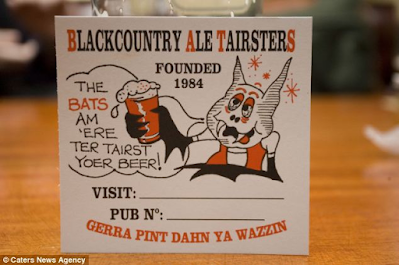
The thing that I spotted the other day was this yam. Yam is well-known as a feature of the Black Country dialect, around Wolverhampton and Dudley, where it's a variation of the verb be. In Standard Englishes you get am just for first person singular (I am). In many varieties you get levelling so that was or were is used for all the forms in the past tense (I were) or even is in present (you is). I think this is a form of levelling too: am is used for other persons than 1st singular, as in the message from the Black Country Ale Tairsters (tasters) below: The BATs am 'ere ter tairst yoer beer!. 

Beer mat featuring a cartoon of a boozy bat and the message 'the bats am 'ere ter tairst yoer beer'

Then you get it running together with the pronoun in speech and you've got yam. I did all that from memory (sorry, lots of teaching prep to do this week) so the details might be wrong, but that's about the size of it. But what it isn't, is yam being the pronoun itself. That's what the greyhounds are doing, they're using yam in place of me in standard Englishes, not in conjunction with the verb to be. It's not a one-off from Finn the greyhound either, it's pretty standard Greyhound. So they've innovated or borrowed a new first-person pronoun. 


Tuesday, 17 September 2019

Croiffle: The verdict

On my way home from the Linguistics Association of Great Britain annual meeting last week, this advert on the train (too late, I was already on my way to Kent at this point) offered me a free speciality coffee with purchase of their new 'croiffle'.

Advert offering a free coffee if you buy a 'croiffle'
A croiffle?, you might ask. And what is a croiffle? Using my linguistic skills, honed over the course of the last fifteen years of intensive linguistic training, I intuited that it is a croissant of some kind (see image) with something unspeakable done to it. Obviously this is a blend, or portmanteau, of croissant and, I assume, waffle, as it's apparently been toasted in a waffle machine. Why you would do this, I do not know.

But how do you pronounce it? While I and a friend both went with the vowel of croissant (slightly different for each of us, with his being more similar to the French than mine (/ɒ/ vs /ʌ/)), another friend said it as she saw it and used the oi of, well, Oi!. And a portmanteau that no one knows how to pronounce is an unsuccessful new word, especially if it's also just a toasted croissant that's a bit bumpy.

Thursday, 11 July 2019

Yo, Samity Sam!

Brilliantly, the tweet I am going to be famous for (at 200+ likes at the time of writing), is one in which I present myself as an idiot.
Lane Greene said that American kids learnt how to pronounce 'Yosemite' because of the Looney Tunes cartoon character 'Yosemite Sam'. Despite plenty of exposure to this character, I did not similarly acquire the correct pronunciation of the word, because I interpreted the name as 'Sammity Sam', a sort of reduplicated nickname form of the name Sam. This is not unreasonable, as I'd not seen it written down and never heard of the place Yosemite. Other people did the same thing, and basically heard it as 'Yo, Sammity Sam'.

But here's the thing: I didn't interpret that first syllable as anything at all. 'Yo' wasn't specially in my vocabulary as a child in 1980s UK. So I just kind of heard it as a meaningless syllable. I'm not an acquisitionist so I could be wrong here, but I'm pretty sure this is NOT how language works. There are not meaningless syllables that consistently occur adjacent to a specific word. I should have definitely called on my pattern recognition skills and interpreted that sound as part of the name, or as being part of the phrase, as others did ('Yo!'). But I didn't.

Tuesday, 21 August 2018

Ombudsmun

This is a screenshot from a tweet that passed through my timeline:

tweet including the word 'ombudsmun'

It includes the word 'ombudsman', but spelt 'ombudsmun'. I'm a big fan of this spelling. The word  contains the word 'man', but as in many words, the syllable is not stressed and the vowel is reduced to a schwa (the sound at the end of my name). The writer has reflected that in the spelling (probably not deliberately, maybe not consciously) by spelling it 'mun'.

For a while, I was spearheading a single-woman campaign to get 'man' to be truly gender-neutral by using terms like 'postman' for female postal workers. In the end I gave up but it remains true that if it's to be reinterpreted either as a suffix (as in postman, policeman, etc) or as just an inseparable part of the word, with no independent meaning, as looks to be the case here, then it has to be the schwa pronunciation rather than the full 'man' vowel. That loss of vowel content hastens its loss of semantic content.

There are other instances of this spelling, even on quite official ombudsman sites (enough that I had to quickly check it isn't actually a variant spelling - seems not). And I ought to also note here that 'man' is used as a pronoun in some varieties of English, such as Multicultural London English, but that it is more or less gendered when it's used in a non-generic 'one' sense (you get some instances of it being used of women, but it's rare). It's also a pronoun in German, in an obviously historically-related turn of events.

Monday, 13 March 2017

That's not a dumb question, innit

In my MA syntax class this week we were talking about innit and how it's going from being a tag question to a kind of discourse particle.

Tag questions (aren't we?, don't you?, won't she?) have the following properties (among others):

  1. They follow the main clause 
  2. They have the form of a question
  3. They contain an auxiliary verb that matches the one in the main clause or is do (are, do and will in the examples above)
  4. The verb agrees in person and number with the main clause verb (e.g. 1st person plural, 2nd person singular or plural, and 3rd person singular in the examples above)
  5. They have the opposite polarity to the main clause (so they're often negative, following a positive main clause, but can be positive if the main clause is negated: He's not coming, is he?) (though see NB below)
  6. They have a pronoun that matches the main clause subject (we, you, she above)

Isn't it is a form of tag question, then: it has all the above properties in an example like It's a funny old world, isn't it?. But in some dialects, it has crept out of these constraints and is used in a broader range of contexts, and as well as losing a lot of its phonological properties (it's reduced to innit), some of the syntactic properties in 1-6 no longer apply to it.

1: It still follows the main clause. But that's about it.

2: It may not have the form of a question. Lots of times, it's written without a question mark (OK, that's no guarantee, but it's telling). It's attached to sentences that can't possibly be questioned, like assertions on the part of the speaker: You're fit, innit. That's the speaker's opinion. How can it be questioned?

3: The verb probably doesn't match the main clause one now - in the example I just gave, it does, but you can also say I've got no money, innit, where it doesn't.

4, 6: We no longer need the agreement in person and number. In We're late, innit, the verb in the main clause is first person plural. Innit, if it comes from isn't it, is 3rd person singular. Similarly, the pronoun is it rather than the matching one in the main clause, we.

5: Generally, the polarity is opposite to that in the main clause, but only by chance: innit is negative, and more sentences are positive than negative. But I heard an example on Gogglebox this week of a negative clause followed by supposedly negative innit:
That's not actually a dumb question, innit. 
Cool, innit?

NB: Tag questions can have the same polarity as the main clause if they're both positive, but it has a different meaning. Compare: 
a. That's the bus we need to get, isn't it? 
b. That's the bus we need to get, is it? 
In a, the speaker thinks they have the correct information and wants their interlocutor to confirm it. In b, the speaker thinks that the interlocutor has the relevant information, and wants to confirm it. But we don't find negative assertions and negative tags:
*That's not the bus we need to get, isn't it? 

Tuesday, 14 February 2017

Full-priced tickets only available on trains

From next Monday, you can't buy discounted tickets once you're on board Southeastern trains, only the full-price ones. This, while a pity, as it was handy to be able just to hop on and buy one on the train, is only what all the companies do, so I suppose it was inevitable. But I'm sure you're eagerly awaiting the linguistic angle, and here it is, with the caveat that I've now stepped WAY outside my comfort zone and may have got this very wrong.

The announcement on the train went like this:
From Monday 20th of February, you will only be able to buy full-price tickets on board our trains. 
Fair enough. That says what they mean. Except it didn't! It said quite another thing, because they got the intonation totally wrong!

Sentences have intonation contours and prosodic units. It's where you put the stress and what bit of the sentence you treat as a phrase. Prosodic units line up with syntactic/semantic units, so the meaning is nice and easy to understand (I note that Wikipedia says they don't, though the examples there do, so I'm not sure what I'm missing).

I'm now going to try to convey the intonation with the use of bold text. The emboldened bits are meant to be given stress, and the bracketed bits are treated as a prosodic unit (the second one actually is a case where the prosodic unit doesn't match up with syntactic units):
You will only be able [to buy full-price tickets] on board our trains.
You will only be able to buy [full-price tickets on board our trains]. 
Try saying them out loud. In the first one, the meaning is that the only kind of ticket you can buy is full priced. Correct. In the second one, though, the meaning is that the only place you can buy full-priced tickets is on the trains, not anywhere else. False! You can buy them at the station or online too! And it's the second one that was in the announcement on the trains. If I were more of a pedant I might test them on this principle. But I'm not.

I'm sure I've got all the technical stuff wrong here, but I tried the two intonations out on my friend Stuart and he had the same interpretation as me, so the point is right, at least.

Thursday, 17 March 2016

Covert swearing

Following on from my last post about mishearing words in connected speech, here's an example of when I deliberately do this: covert swearing.

Covert swearing demonstrates that the taboo of swearing is not about the words themselves, or at least not the sounds of those words. I frequently utter the very same string of sounds found in the worst swearwords, but it's not swearing. We all do it, in fact: it's just that I do it on purpose. I don't know why I do this, but I find it amusing in a daft way.


To ease you in to the idea with an example that is inappropriate but not actually swearing, I'll always say penis instead of pianist. They sound more or less the same. Once you've smooshed together the vowels (basically, you don't really pronounce the second vowel in the first syllable of pianist) it's just a matter of reducing the consonant cluster at the end, which you might well do in connected speech anyway. I don't think people notice me doing this, or if they do they don't let on. I therefore sometimes say to people that Elton John is a penis.


More inappropriately again, when I say if I can... I'll more often than not reduce the initial vowel to nothing, and the second and third ones to schwa, so it sounds like /fəkən/, or in other words exactly the same as fucking (try and just pronounce the consonants and you'll get the idea). I'm almost certain people don't notice this, or they would surely say something. 


And so on. Nice demonstration that words are not just sounds: there has to be deliberate intention to say some particular word as well as the correct string of sounds. And in fact, the sounds can be extremely different from the carefully-pronounced version, as long as the intention is there and there is enough context to allow understanding. See this old post for an example. This is also why every now and then there's a toy-swearing story in the newspapers. 


I'm going to have to stop doing it now I've revealed it, though, else it'll feel weird. 

Wednesday, 16 March 2016

Eggcorn morphemes

Twice this week I've heard a phrase that sounded like the speaker had misheard it. On the QI podcast 'No such thing as a fish' Andy said that meteors/meteorites came from out of space rather than outer space, and a television continuity announcer said that a garden in an Alan Titchmarsh programme needed some tender love and care rather than tender loving care.

These, I think, count as eggcorns. I'm not certain, because 'eggcorn' has a very specific definition: it's misinterpreting a word or phrase as something else that makes sense. It's named after an example of itself: an acorn looks like an egg in an eggcup, so eggcorn makes sense.

In this case, it's a function word (or part of a word) that's been misheard as something else that makes sense. In outer space, the -er is just a schwa if you have a non-rhotic accent (you don't pronounce the 'r' at the end). As it happens, so is of in connected speech, at least a lot of the time. We even have a way of writing it: o' (although this looks affected or like you're mimicking an Irish accent or something). Another way of writing it is when we merge it into another word: a lotta fun, a lorra lorra laughs. And it's reasonable to say that a meteorite has come from out of space. The Eggcorn Database has an example of outer body experience, which is the same thing in the opposite direction.

In tender loving care, it's the -ing morpheme (part of a word) that's misanalysed. Again, the pronunciation in normal speech may be reduced to 'n', and so might and. And again, it's just as reasonable that you would give a garden tender love and care as that you would give it tender loving care (maybe more so, actually).

Friday, 4 March 2016

I were saying I wa'

It's National Grammar Day! Sadly this isn't as fun as it sounds due to the idiots on the internet. However, here is a thing I have learnt. Jeremy Butterfield wrote an article about how linguists and other people have different ideas about what grammar is, and in the comments someone mentioned the famous(?) Dennis Skinner complaint about being misquoted as saying I were. It's mentioned at the bottom of this link.

As he says there, he's not saying I were, because that would be 'grammatically incorrect'. He's saying I wah, as in dropping the 's' from was, and it just happens to sound like I were. Someone from Yorkshire in the comments agreed with him:


This is fine, I suppose, except that I really want it to be I were. It's a nice symmetrical counterpart to the We was found in many other places. Both are examples of levelling of verb forms, and I  teach it as an example of how levelling is something that tends to happen, but that it's more or less chance what form is chosen in what dialect. If it's not levelling, then that means the the levelling only takes place in some dialects, and it's always towards was.

On the other hand, if it is a phonological reduction of I was, then there's other interesting questions to answer. Why don't these dialects level? Do other dialects actually have I were? If not, why would there be a preference to level towards was? How can we tell, for sure, that it's I wa and not I were?

Sunday, 3 January 2016

Oldman, not old man

Another thing I watched over Christmas was a repeat of A Touch of Cloth, a comedy detective series by Charlie Brooker. There's a character in it called Detective Oldman, and many jokes are had around her surname and the phrase old man. The thing is, the name is pronounced differently from the phrase. You pronounce the name with a reduced second vowel, so it's [ˈɒldmən], whereas the phrase old man is pronounced something like [ɒldˈmæn] (the first vowel varies a bit). Even if you don't read IPA, you can see they're different in the vowels used and where the stress is placed. This meant that in the programme, for the jokes to work, her name had to be pronounced like the phrase rather than in the usual way, which sounds decidedly weird. 

Monday, 3 August 2015

Ribenary

I saw this advert last week:


It's an advert for Ribena. It's got some wordplay around the suffixes -y (which makes nouns into adjectives) and -est (superlative) and the combination of both of these. So in the slogan at the top, we have tastiest and fruitiest, both of which are common enough words, but also blackcurrantiest. That's the kind of word that people might ask 'is that a real word?' and of course it is, because it's made with perfectly legal word-creation processes, but it sticks out because it's new. Blackcurranty isn't normally an adjective, but of course we can make it easily (I just did) by sticking the -y suffix, which turns nouns (like blackcurrant) into adjectives. And then once you've got an adjective that ends in -y, you can make the comparative blackcurrantier and the superlative blackcurrantiest. With a word this long, we'd normally use more and most instead, though, so this word is eye-catching because it sounds unusual.

At the bottom, we have one the fact of it the exact same thing: it says 'You can't get any more Ribenary'. Again, just stick a -y onto a noun (Ribena) to get the adjective. Unfortunately here there is a spelling issue. Ribena, unusually for English words, ends in an 'a'. You can't stick -y onto the end of that, because Ribenay doesn't look at all like the word it's meant to be. So they've spelt it the same way we say it: with an 'r' that wasn't there to start with. This is called 'intrusive r' and all it does is make it easier for us to say two consecutive vowels.

Intrusive 'r' is closely related to 'linking r', which is the one that is there in the spelling but that people who speak dialects like mine wouldn't normally pronounce - like at the end of computer. When that word is followed by a vowel, like in the phrase my computer is switched on, the 'r' comes back again. For me, these two types of 'r' are so similar that I usually have to look them up to check I've got the names right.

Now, I believe that rhotic speakers don't have this intrusive 'r'. Rhotic speakers are the ones who would normally pronounce the 'r' at the end of computer. For those people, linking 'r' isn't really a thing because the 'r' is always there anyway, and the problems we might solve with intrusive 'r' are solved another way. So for those people (and that's most of Scotland, Ireland and North America, for instance), is this advert just weird? Does the word Ribenary work?

Friday, 28 March 2014

Why everyone who works with language needs linguistics

Someone on a blog I read the other day posted this question, asking for advice:
Does anyone know any tricks to know when English -ed is pronounced as [d~t] as in “begged” and “knocked” versus [ed] like “petted”?
Some of my students have issues and I don’t know how to help them.
(I haven't linked to the actual blog because I don't want to seem like I'm criticising them personally.)

You might think that people who teach language know linguistics. Most people seem to think that linguistics *is* teaching languages. In fact, lots of linguistics graduates go on to do language teaching, but they are far outnumbered by language teachers who don't have a linguistics background. TESOL MA programmes frequently have a core linguistics component, but people who've chosen to do TESOL but not linguistics are probably not that interested in linguistics anyway.

The reason I mention this is that the question above is taught on any first-year linguistics course as the absolute go-to example of phonologically-conditioned allomorphy in English. Typically, we point out that native English speakers do this subconsciously and consistently, and it's an example of how there are rules and we can discover them by careful investigation, as well as to teach the theoretical concept.

Of course, speakers of other languages with different rules will not do this subconsciously, because the rules of their language might not automatically force the same result as English. They'll need the rule taught to them. The fact that someone who (presumably) is teaching English doesn't know how to explain this simple fact is quite shocking to me, but I doubt the asker is alone. A few basic linguistics classes would make life as an English teacher so much easier, I can't even imagine why it wouldn't be standard.

Monday, 17 March 2014

This 'public service announcement' exists:


Why on earth would it be Patty rather than Paddy, I hear you ask? Well, it's a simple case of homophony. Two identical-sounding words, one pronunciation, confusion abounds.

What's that? They're not homophonous? Not to you, maybe. Yer average British English speaker will pronounce these with a /t/ and a /d/ respectively, or possibly a glottal stop instead of the /t/. Yer average American, on the other hand, will have what's called a 'flap' or 'tap' instead of the /t/, and this sounds so much like a /d/ it's pretty much indistinguishable and they're pronounced exactly the same.

I'm ashamed to say I don't know how yer average Irish person would say them - my instinct is telling me there's variation between the flap and the /t/ and /d/ distinction, but I don't know. But then any Irish person is likely to know how to spell the name of their patron saint in any case, one would hope.

Tuesday, 25 February 2014

Chavs throwing trees... or chillies?

I misheard someone say the other day that they'd seen some chavs (=charvas) throwing trees, rather than chillies. Tree and chilli are not very similar words, but there is a reason for this mishearing: the consonant cluster /tr/ is very often palatalised and pronounced with an affricate: /tʃr/ (='chr') That's actually quite hard to say, so the /r/ can be reduced, leaving the 'ch' sound.

Monday, 2 December 2013

Tom Daley's sibilant 's'

The diver Tom Daley posted a video on YouTube in which he told his viewers that he has a boyfriend (if he made any more revelations in the last minute or so, I missed them because I stopped watching - he doesn't half go on). Some delightful person called RogerGT posted a comment saying 'Of course he's gay! He has a sibilant 's'.':
This is obviously a gross stereotype. While there may be a stereotypical 'gay' manner of speech, this is about campness rather than gayness, and Daley does not have camp mannerisms. This is likely to be a post-hoc application of new knowledge causing delusions of prior knowledge. Similarly, an acquaintance of mine said people often tell her they could hear the German in her accent after she reveals her nationality, despite the fact that she sounds entirely English.

More to the point, though, is that everyone's 's' is sibilant: that's the term for that particular type of 'hissing' sound. 'S', as normally pronounced, is the canonical example of a sibilant. So, not a good diagnostic for someone's sexuality then.

What RogerGT is probably referring to is the camp stereotype of 'lisping': producing a sound more like 'th' /θ/ instead of 's' /s/. Daley does actually do this a tiny bit, though I'd never noticed it before I went back and listened out for it.

So what  have we learnt today? Well, from a linguistic point of view, we've learnt that people are quick to stereotype or judge people based on their accent, that people don't use linguistic terminology right (jk we all knew that already), and that people are really extraordinarily good at spotting even tiny differences in the production of speech sounds.

Wednesday, 3 July 2013

Swansea question tag on 'the Call Centre'?

I couldn't sleep a few nights ago and watched a truly horrific programme called 'The Call Centre'. It's a 'structured reality' programme, which basically means getting real people to provide cheap, low quality, soap opera type entertainment. It's set in a call centre in Swansea and most of the young call centre workers have very strong Swansea accents. It's a really distinctive accent so I began to enjoy the programme for its linguistic appeal, if nothing else.

Accent is the thing we notice most about the way people from other areas of the country speak, but dialect is not only a matter of accent. Accent is only the sounds: things like what vowel you use in 'bath' or whether you tend to use a fully aspirated /k/ sound in the middle of 'chicken'. Dialect is 'accent plus'. It includes lexis (words), morphology (whether you say 'I've gone' or 'I've went'), and syntax (whether you can say 'Hasn't she not?' or just 'Hasn't she?').

The Swansea accent is great, but what struck me was a matter of syntax. I don't know if it really is a feature of the Swansea dialect, but what I heard was what sounded like an invariant question tag 'inne' (not sure how to spell that, but it sounds like 'innie').

A tag question is one that ends in a tag, like 'isn't it', 'wasn't she', 'aren't they' and so on. These tags vary to match the subject and verb of the main clause, so you get 'That's nice, isn't it?', 'She was good, wasn't she?', and 'The students are keen, aren't they?' Invariant tags, as the name implies, don't vary. We see ones like 'right', 'yeah' and 'no', but we also see ones that look like they should vary. 'Innit' is the famous one: 'He's a good worker, innit?' (rather than 'isn't he').

This 'inne' that I heard, twice in one episode, sounds like a reduced form of 'isn't he'. If you're going to have an invariant tag, then you just pick one of the available tags, and 'isn't he' is just as good as 'isn't it' (well, I would have a preference for 'it', but preference has never had much to do with language).

The thing is, I only heard it twice in that one episode. I watched another one (for research...) and didn't hear it again. Any Welsh readers know if it's widely used?


Monday, 6 May 2013

Quiz!

OK, tell me this: can you translate the following conversation, in a language that you almost certainly speak?
Jon do?
A dee nah. 
Answer after the fold.

Friday, 3 May 2013

De-funk

Someone who shall remain nameless recently said the following about a piece of technology:
It might defunk.
Wooohoooo, reanalysis in action! Reanalysis is when someone interprets the structure (or meaning, etc) of a word or phrase differently from previous speakers. This can result in widespread permanent change to the language in question, and in fact is how much language change takes place. For instance, we all know that apron and adder were originally napron and nadder, but because a nadder is identical to an adder when it's spoken, people reanalysed it as the latter. Ditto peas and cherries, which are now the plural forms of the singular pea and cherry, but when they were first borrowed from French they were pease and cherise - mass nouns. We still have pease pudding and the colour word cerise (that one was probably borrowed again later on, though).

The reanalysed word in question is defunct, meaning something like 'not working'. This comes from Latin, literally meaning 'not working' (dēfunctus, with the prefix de- and the past participle of fungī 'to perform', says the OED). We don't really think about the etymology when we use it though, especially if we don't know Latin, which most people don't. So it's just a word that means 'not working' or 'not in use'.

The reanalysis has come about because the word-final consonant /t/ sounds just like the past participle ending -ed. (This is because -ed can sound like /d/ or /t/ depending on the sound it follows.) Therefore, defunct sounds exactly like defunked. Defunked doesn't exist (with this meaning), but it follows the pattern for verbs in English, with a regular past tense ending. So we can postulate that the word is the past participle of defunk. If that's the case, the verb can be used in all its forms, including the bare stem form used in the original example, defunk.

The process I've hypothesised here takes a word which is used in its current form as an adjective and reanalyses it back into its past participle form (possibly even complete with negative prefix on the root funk) from whence it came!

(By the way, clever people have of course spotted the potential for the word as a band name, so it's hard to google for other examples. But the fact that hits for this interpretation don't outweigh the band's hits shows that this is either non-existent or very rare so far. In addition, Urban Dictionary notes the verb with the meaning 'to remove funk [dirt]' or 'to make less funky', both predictable meanings of de-+funk.)

Monday, 29 October 2012

A @name

Twitter has a search bar thing and in it, it says "enter a @name or username". Now, I've been pronouncing @name as "at name", because that to me is an "at sign". I don't know if twitter is calling it something else. That's what the article "a" rather than "an" suggests. But what could it be calling it?

In other languages, it's called things like "monkey tail", "elephant's trunk", "little dog", "snail" and other animal-based names reflecting its shape. But in English it's really only called the "at sign".

So twitter, why you no obey phonological rules?