Showing posts with label new words. Show all posts

Monday, 7 January 2019

Omni rage

Image of a facebook post describing
a satirical rant as 'omni Greggs rage'
You may have watched The Thick of It, in which Malcolm Tucker, played by Peter Capaldi, characterises someone as an 'omnishambles'. It caught on because it is an excellent word. So I don't know, but I think that this use of omni in this facebook post might be an example of it going wild (the post it refers to isn't for real, but it is a convincing pastiche of a certain type of person).

Omni is a prefix most of the time. It means 'every', like in omnivorous. Prefixes can cut loose from their roots if they're typically used in one specific word, or if the free version has just one meaning. So, for instance, cis means cisgender because we don't really use cis for much else (though we could - cisalpine is a word, though not a common one, meaning 'on this side of the Alps', where 'this side' means with respect to Rome - it's a Latin thing). So cis has specialised into this one meaning. Other gender- or sexuality-related prefixes have similarly gained independence, so you can describe yourself as bi, meaning bisexual, even though we have the bi- prefix in loads of words (bicycle, biped, biennial). It's just with that one meaning that it can be used solo.

I checked Urban Dictionary for omni and quite frankly didn't understand most of the definitions, so I'm not totally sure what's going on here. I didn't find anything that suggested it's used alone in the omnishambles sense but that really does look like what it might be. Omni rage as a term for that pure, hysterical rage as displayed by Malcolm Tucker in full flow?

(If you're not in the UK you'll have no idea what anything in the facebook post is about but don't worry about it; it's just the latest nonsense. Basically, professional moron Piers Morgan threw a hissy fit about 'snowflakes' when Greggs started doing vegan sausage rolls and people were quick to point out the irony of his rage about something so harmless.)

Monday, 30 September 2013

Onomatopoeia from my students

In my first-year introductory seminar, I had the students coming up with new onomatopoeic words, which we then tried to guess the meaning of (spoilers: you usually can't guess, despite the supposed relation of the sound of the word to the sound it describes). Some of the words seemed quite useful, so here they are:
frip: the sound of flicking or rifling through a sheet or sheets of paper.
shplup: the sound of dropping something damp onto a hard surface.
zhoom: the sound of a car going by at high speed.
ouge (pronounced like 'rouge'): the noise of a washing machine.
mmm: the noise a fridge makes.
shlup: the noise it makes when you drink from a bottle with a 'sports cap'.
twing: the melodious jingling of windchimes or bracelets. 
I thought there were some very nice creative ones, and some interesting similarities in words or definitions.

Wednesday, 26 June 2013

Why can you email an email but you can't letter a letter?

A commenter on my recent blog post suggested that I blog about the fact that you can blog a blog, and then followed it up with the question 'Why can't you letter a letter but you can email an email'? 


Blog as both noun and verb is another instance of the process I mentioned a while back, the nounification of verbs or the verbification of nouns (that's not the real name: it's called 'zero derivation' or 'conversion', but that's dull). The process goes both ways, but you get different results. If you turn a verb into a noun, it's an instance of the action: a kick is an instance of kicking. If you turn a noun into a verb, you can't always say what the meaning will be: to fish means to catch a fish, to trouser means to put something into one's trouser pocket and to book means to make a reservation or charge with an offence, and so on. Here I think we've got noun to verb, and I'm fairly certain that this is supported by the date of the earliest appearances of the noun (which derives from weblog) and the verb, though that can be tricky to verify.

Back to blogging a blog and lettering a letter. It's quite unusual that the noun can be an object of the verb derived from it. I can't really think of any examples other than the ones given above, and maybe text as in text message. Maybe message itself. I don't know if it's important that these are all communication acts... you can shout a shout, I suppose, and whisper a whisper. 

In US English, the verb is more commonly mail, whereas in British English post is used. But in the US I don't think that mail is used for one particular letter, so you can't mail a mail. When email was invented, the word email was used, probably by analogy with mail, for the general process/system. It quickly became used as the name for a particular message sent by email, as no specific word for this item existed, and for the verb, by the same process of verbification. Thus you could email an email. 

You can't letter a letter because there already exists a verb post, or mail if you prefer. We could, when email was invented, have broadened the sense of post or mail to include sending an email, but we didn't, perhaps because it seemed quite different (and in British English, the verb post is not even the same as the one used in email). Post (or mail) likewise would have blocked the use of letter as a verb - but the plausibility of all this is dependent on when each was first used. 

So in short, my answer is: because there is already the verb post but there is no equivalent verb for the use of sending an email or writing a blog other than the generic-verb+noun combination like send an email. 

Monday, 29 October 2012

A @name

Twitter has a search bar thing and in it, it says "enter a @name or username". Now, I've been pronouncing @name as "at name", because that to me is an "at sign". I don't know if twitter is calling it something else. That's what the article "a" rather than "an" suggests. But what could it be calling it?

In other languages, it's called things like "monkey tail", "elephant's trunk", "little dog", "snail" and other animal-based names reflecting its shape. But in English it's really only called the "at sign".

So twitter, why you no obey phonological rules?

Thursday, 23 August 2012

Spoffles, flanges and pobbling

Words get into the language in lots of funny ways. Most of them have been there so long we don't know, or we just know that we brought them with us when we left Germany. Lots of them were borrowed, from Latin and French in the case of English. Lots of words we make ourselves, with our word-making tools like suffixes (brightness) and compounding (carwash). My favourite type of words are the ones that someone makes up, and they catch on.

Quiz was supposedly an early example of this, when (according to anecdote) a Dublin man had a bet that he could introduce a new word into the language. Sadly, as with so many such anecdotes, it's probably bunk, as it was in use already by the alleged time of this bet. Still, there are some words that we know were invented this way, as the people who did it either did so on film or are around to tell us.

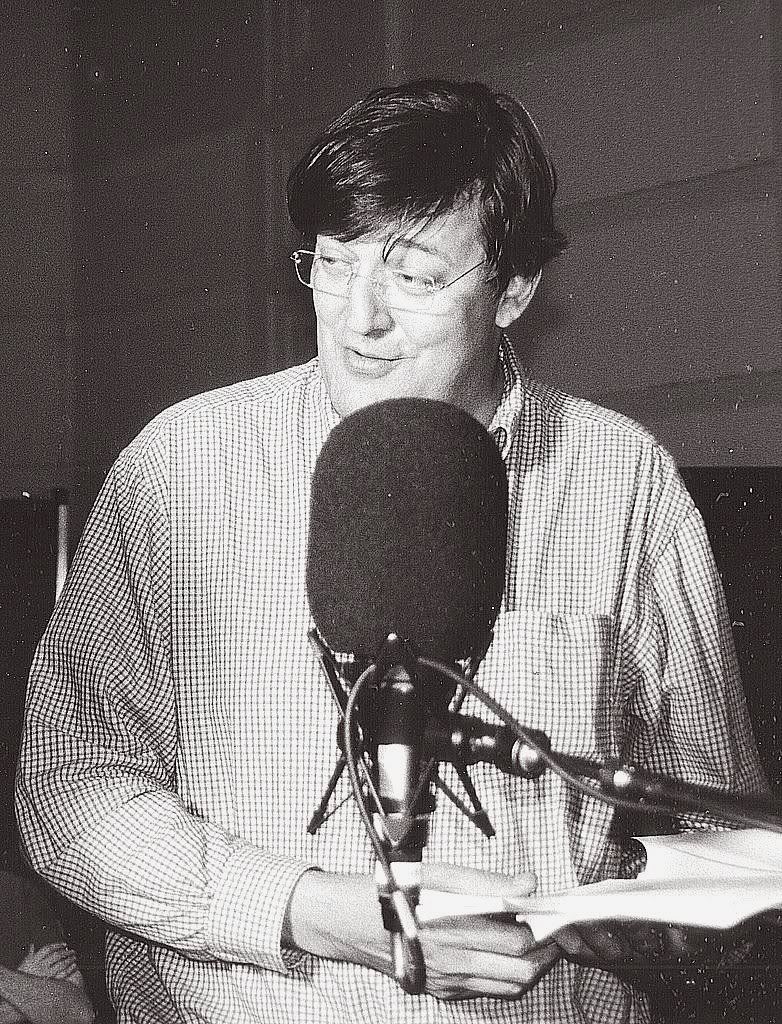
Spoffle, quite apart from being a great word, is a useful one, if you ever have anything to do with microphones, as I sometimes do. It's this thing, in front of Stephen Fry:

Source: http://www.stephenfry.com/forum/topic/fry-a-day/page/759
It's the foamy cover for a mic that prevents 'popping' and cuts down wind noise. Essential item, apparently unnamed (people seem to use the very dull microphone cover) until Hugh Laurie called it a spoffle (in Stephen Fry's hearing, which is partly why he's in the photo above). This is what I always call it, and lots of others do too. At my old job it was the common name for such things. But, astonishingly, it's not in the OED and it doesn't have a Wikipedia article. Apparently it used to but it was deleted, and now it's not even mentioned in the section on microphone covers.

Another word that came out of British comedy is the collective noun for baboons, a flange, and for gorillas, a whoop. Flange has caught on remarkably well and, although it too doesn't get into the OED (they're so cautious, those lexicographers) it's used by people, including (allegedly) academics (although I have not read the papers or books in which it's used). Here's the sketch, with Mel Smith and Rowan Atkinson talking to Pamela Stephenson:


Literature has been a source of some good words. Lewis Carroll invented the word chortle as a blend of chuckle and snort, although not many of his more creative efforts from the Jabberwocky have caught on. This OED blog post talks about Edward Lear, who made up a lot of words (runcible spoon being a particularly well-known example) and also used obscure real words. It has a charming anecdote about the blog-writer's doctor friend who was certain that pobble meant 'to amputate toes', until the blog-writer introduced her to the rhyme The pobble who has no toes. Pobble's Bay also seems to be a place in Wales, which does rather remind one of The meaning of Liff by Douglas Adams and John Lloyd (who created QI, presented by Stephen Fry - we have come full circle so it's time to stop waffling).

Sunday, 10 June 2012

Emotigif

I just made up a word. I happened to need a word to describe the gifs that some kids make of themselves to express the way they feel about a thing, and I picked emotigif.

Actually, those of you who spend less time pootling around on the internet than I do will need some kind of explanation here.

On Tumblr, which is a blogging site which is mostly devoted to teenagers endlessly reblogging each other's inane cute/humorous images, telling the world about their love of Matt Smith/Benedict Cumberbatch and delivering expletive-laden diatribes on other people's inability to use the words you're and your correctly, people like to express their feelings on a subject by adding a gif (a simple moving image on a short loop) to their post. This is a gif which in no way expresses my feelings:


These gifs are commonly snippets of films or TV programmes, with a close up of an actor or celebrity making some kind of easily-interpreted facial expression or action (sometimes with speech which is usually also provided in writing). Like this:


Anyway, sometimes people apparently feel that there isn't a gif that expresses their emotions well enough. This is commonly when they need to express the emotion 'Yeah bitch, I'm totally right about this trivial issue in a really camp way and will therefore do a stereotypical camp finger-pointy head-waggly shoulder-shrugging movement shot at a bad angle that makes it obvious that this is taken with the substandard camera on my laptop in bad light in my bedroom and put it on the internet'. Like this:


This, my friends, is an emotigif. Based on emoticon, obviously. I learnt in the process of researching this post that they are already called 'reaction gifs', but my name is better.