Showing posts with label signs. Show all posts

Tuesday, 15 March 2022

Best pub for precisely 8.5km is decent

There's a sort of trope that Japanese has no swear words, and instead you insult someone simply by using the wrong level of politeness. As with all these things, it's based on a grain of truth (there are linguistically-encoded formality registers) but it's also really xenophobic and demeaning to essentialise cultures in this way, as it perpetuates racial or national stereotypes of Asians/Japanese people. Plus, you miss out on the actual interesting facts about Japanese honorific speech if you skim the surface like this (you'll have to go somewhere else for those, though, as I am not a Japanese expert). The truth is often more interesting than the factoid and I encourage you to learn more if you didn't know about this! 

So probably I didn't even need to bring that trope up apart from I like to share information about languages, but some things I saw lately reminded me that English (and any other language, probably) is also perfectly capable of being highly insulting without using actual insults, and we do it with pragmatics. 

First, a tweet from @mralanjohnsmith, his second appearance on this blog in recent times, included this photo and observation: 

(Photo shows a cafe's outdoor A-board with things like 'awesome food', 'delicious cakes', 'the best brew', and 'decent staff'.)

Secondly, this one: 

Both of these seem to be maligning another establishment but not by directly saying anything bad. They in fact both just say good things about themselves. However, they do it in such a way that we fill in the blanks and infer a whole lot more. 

The 'decent staff' cafe has a lot of very enthusiastic words like 'awesome', 'the best'. So among these, 'decent' sounds like fairly low praise, meaning only tolerably good. I had a quick look on Urban Dictionary to see if the kids these days are using it in a more positive sense, and while there are a couple of entries with that sense, most have the 5/10 meaning. It seems strange, then, to put this on your advertising. The cafe could be saying that, if it's honest, its staff are only pretty good, but given that the staff wrote the sign, we might interpret it as more likely that they're comparing themselves to other places. Those other places may have good coffee, but this place has 'the best!' Those other places may have good food, but the food here is 'awesome!'. And by extension, if this place only has 'decent' staff, the other places must have less than decent staff, and the next level down from decent is, well, not good. 

The other sign, rather than saying too little, gives us too much information. If you said you serve the best pint for miles around, we interpret this to mean you think you're pretty good, but haven't literally done a taste test and got votes and so on. The non-specific nature of the claim means that it's not verifiable, because it's not meant to be. The pub next door might have something to say about it, but a pub five miles away can safely consider itself out of range of the claim. But as it says 'for 8.5km', which is a specific measurement, it just can't be interpreted as 'a large area' or 'a long way' in the way that a round figure like 'ten miles' could, so we wonder what is precisely 8.5km away. Is it, as the person suggests, that there is some other pub within that range that they're saying is less good? Perhaps the village is 8.5km in size, so it's a way of saying it's the best in the village? or is it, as I think I'd be inclined to think, that 8.5km away is a better pint? 

Monday, 14 June 2021

Please use four 15p coins

Two examples of confusing signage brought to you by pragmatics and lexical connotations this week. 

First, I was waiting outside a bakery for my lunch, and there was a phone box (I know! a real one!) with a sign saying this: 

Please be prepared to use four coins to pay the initial minimum fee of 60p. 

I was very puzzled as to why you should have to use four coins to pay this, especially as 60p doesn't even divide evenly into four coins (i.e. there's no 15p coin), so you'd be using a mix of 20p and 10p coins. I thought that probably it meant that you could use more than four, as long as you met the basic criterion of at least four, but wondered why this should be how the phone worked. Does it need four to activate some mechanism? 

I'm sure you're well ahead of me and worked out that it meant at most four coins - so you can use 50p and 10p, three 20p coins, whatever you like, but you can't be there putting in twelve five pences or sixty pennies, which makes much more sense. But the wording 'be prepared' primed me to think it was a minimum requirement that you had to meet, rather than a warning not to exceed a limit. 

Next, my own employer tweeted about the coronavirus restrictions a couple of days before they were relaxed a bit in May. The weekend before the rules changed from no meeting inside at all and maximum six outside to six inside and 30 outside, they shared this image: 

It includes this wording: 

Please remember the 'rule of 6' applies outdoors only until Monday.

I knew what the rules were so I wasn't confused this time. But the placement of only is, as so often, confusing. Does this rule apply 'only until Monday'? Well, yes. Does it apply 'outdoors only'? Well, again, yes. Maybe it's doing double duty and meant 'only outdoors and only until Monday'. But either way, this is still a bit weird to me. 

If a rule only applies in Context A, then the implication is that outside of that context, the rule doesn't apply, and no further action is needed. In other words, there is a restriction outdoors, or until Monday, or both, and anywhere else the restriction doesn't apply. If only is meant to mean 'only until Monday', then it reads like some kind of encouragement, like 'Come on, it's only till Monday, we can do this, one more weekend before we can meet more people!'. But if it applies to 'outdoors', the implication is that this is the stronger restriction, when in fact there was at the time no meeting allowed indoors at all. So you have to interpret it as 'you are allowed to meet up with six people outdoors but not indoors', but a 'rule of 6' sounds like a restriction, not an allowance, because it's called a rule. 

I doubt anyone was ever seriously inconvenienced by either of these things and probably no one else even noticed them, but they both made me stop and think. 

Monday, 7 December 2020

The nonexistent national rules apply until an unspecified date

Hooray, it's been ages since I did a 'rubbish council communication' post! Here's a tweet from my own local council about last week's lockdown/tier announcement. 

Honestly not sure how this one even happened. Did they copy and paste the information from a tweet last month saying the whole of England was in lockdown, and then not change any of it? 

They quite rightly say that we're in Tier 3. But to say that 'National COVID-19 rules apply' is non-informative, as the point of the tier system is that the rules are different in different areas. So do they just mean the rule that you have to follow the rules for your tier? Or is it more like 'the law still applies, no matter how post-apocalyptic this might seem'? Then they say that these rules apply 'until this date', which is helpful especially because there is no date mentioned anywhere in this tweet or at the page they link to. Ah well, carry on staying home and staying safe, folks. 

Wednesday, 3 June 2020

The everyday every day

Moose Allain, the cartoonist, tweeted about the word everyday and the phrase every day, noting that the distinction between them is probably being lost:
Maybe so, and if it is, we'll all get used to it and it'll be fine. In case you already don't have this distinction, everyday means 'ordinary', as in Just your everyday clothes will be fine for the event, while every day means more or less the same as each day: Parking charges apply every day. Just another bit of the internet sad about an ongoing language change, then.

I was intrigued by his follow-up tweet, which noted that pedantry is usually wrong, and this minor spelling change doesn't matter because we'll still have both possible meanings. Which is true. But he also thinks that the local authority should get it right.

On the face of it, it's totally logical. It may well be a change in progress, but while there is still a 'correct' option, official bodies should get it right, because official writing should follow formal conventions. I would tend to agree, in fact. But there is clearly a contradiction here. If it doesn't matter, then the local authority shouldn't have to get it right, no matter who they are. And if it is a change that's happening anyway, then at some point it won't be a mistake, and that line isn't a date when something is incorrect the day before but correct the day after. It's just the time when people can look back on 'the past' and note that we did things differently then.

Friday, 17 January 2020

Processing numbers as letters

I went to a training workshop thing at Canterbury Christchurch University recently. They number their rooms differently than we do at Kent. At Kent, typically, there's a letter or letters to denote the building, say CC for Cornwallis Central, and then a number for the room, where the first digit is the floor (or else it's LT for Lecture Theatre). So if your office is CC104, it's Cornwallis Central, first floor, room 4.

This is fine, once you know it, just like any conventional system. CCCU does theirs differently, and I'm sure it's also fine once you know it, but it really threw me. They also have a letter for the building  - in this case N for Newton - and a number for the room, in this case 03. But the floor is indicated by a letter that corresponds to the first letter of the name of the floor number - so ground floor is g, first floor is f, second floor is s, and third floor is t:
Sign with the text:
1st Floor Nf 01-14
2nd Floor Ns 01-17
3rd Floor Nt 01-19
This was absolutely flummoxing, even though I'd read the instructions and knew it to be the case. Every time, I had to think really hard about what letter 'second' or 'third' began with, perhaps because my brain was associating them with a digit rather than the written word, and it took me ages to process them.

Oh and if there's more than three floors (by which I think they mean three floors above ground floor), they revert to numerals. Honestly.

Monday, 17 September 2018

Bears, hamsters, coffee and hashtags

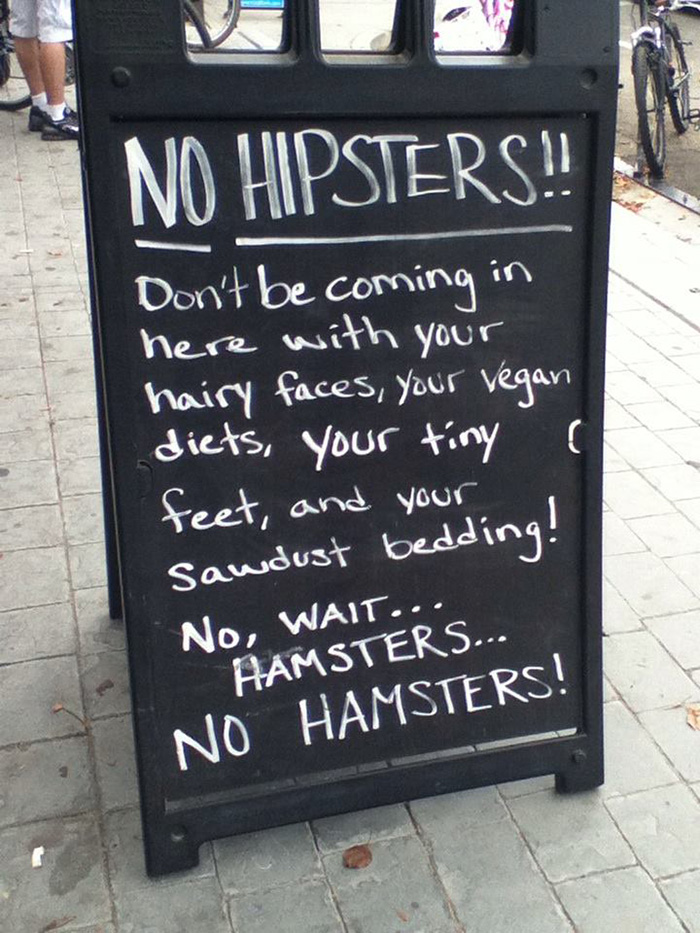
All hipster bars and coffee shops these days have signs with quirky slogans or jokes on them. They come with a punchline that undercuts the set-up, and the first time you see them they are genuinely really funny. For instance, this classic 'bears' sign:
Image result for funny coffee shop signs
Dunno, maybe bears... 

And this one self-referencing hipsters:

Image result for funny coffee shop signs
Hipsters... no wait, hamsters
But after the first time, the joke is no longer funny because it has to be original. That doesn't actually matter, because it will be new to most of the people that see it for quite some time, so it's OK that some people are bored of it (it probably won't put them off going to their regular place or a cafe that looks nice).

There's something more to the joke format that I'm beginning to find wearing, though, and I think it's the Conventional Set-up --> Twist format. Even though this is essentially how jokes work, it has somehow become a cliche on blackboard coffee shop signs.

I was at the annual meeting of the Linguistics Association of Great Britain last week. I go every year, as I'm on the committee, and it's held in a university somewhere in the UK. They had this sign:

Drink responsibly!
#DontSpillIt
If this had been a normal blackboard sign, I'd have found it twee and predictable, even though I haven't seen this exact joke anywhere. The format has become wearing. But somehow, putting the punchline in a hashtag was enough for my jaded joke palate to accept this as a witty sign. A normal blackboard says "We're cleverer than you: we made you think one thing and then turned it round on you". The hashtag somehow says "The sign is real; we mean the main message literally and aren't trying to subvert it. However, look at this funny interpretation too".

Tuesday, 15 August 2017

Picking up your litter is dangerous

Right, here's the other post I promised yesterday. The other litter-related sign I saw said this:
Picking up your litter puts road workers' lives at risk. 
This time, it's not ellipsis that causes the ambiguity, as it was in my previous post. Rather, it's a choice between two people who are doing the picking up:
You picking up your litter puts road workers' lives at risk.
Them [road workers] picking up your litter puts road workers' lives at risk.
And also unlike yesterday, it's clear which one is meant here. There's not any obvious way that you picking up your own litter puts anyone else's life at risk; it's a good thing and you should do it. On the other hand, a road worker having to dash out into the traffic to pick up your crisp packet is a danger to that person.

This is another example of ambiguity in the reference of a pronoun, just like yesterday. But in this case, it's the invisible pronoun that linguists call 'PRO' (pronounced 'big pro', to distinguish it from 'little pro', which is a similar but different invisible pronoun). It's the subject of the clause picking up your litter, which has a gerund form of the verb in it (the -ing form). When you have that, you can have a subject which isn't pronounced (PRO) and gets its meaning (reference) from something else in the surrounding discourse context.

If something is the topic of the sentence, that's likely to be what's assumed to be the meaning of PRO, but other things are also relevant, like where the other possible referents are in the sentence, and what kinds of things they are (e.g. litter is not a likely candidate to be picking itself up here, for many reasons!). Shameless plug: you can read some actual research by me and my colleague Vikki (mostly her) here, on a related subject, and we cite a load of previous research that you can look up if you like.

In my sign, the road workers are the topic (well, their lives are, but you also need to be an animate creature to pick up litter). 'You', the reader, are also an option, because your litter is in there too. It's also closer in the sentence to the PRO that needs a meaning, which counts for something, but a strong combination of the road workers being both the topic and the more sensible meaning ensures that no one would read it and think that PRO meant you. Except me. I thought that. That's why I wrote this whole blog post about it.

Monday, 14 August 2017

Take your litter home with them

I was driven across the country on Saturday, all the way from Sidmouth in Devon to Margate in Kent. On the way I noticed two signs about litter on the roads, both of which are pleasingly ambiguous. I couldn't take a photo as I whizzed by, but the first one said this:
Take your litter home with you.
Others do. 
The ambiguity is between what linguists call a 'strict identity' and a 'sloppy identity' reading of the missing bit of the second sentence. Others do stands for either Other people take your litter home with them or Other people take their litter home with them. The first one is the strict reading because it strictly preserves the part of the original sentence that is elided, and the reference is the sloppy one because it allows the reference to shift from your litter to theirs, along with the subject.

[Aside: note that the fact that the second pronoun must be them in either case, namely the sloppy reading. I'm not sure why; something about the semantics of take and home and you, probably. But it seems to be an exception to the generalisation discussed here by Neal Whitman, referring to work by Johnson and Dahl, that you can have all the possible combinations of strict and sloppy except for the one where the first is strict and the second sloppy. Which is weird.]

Unlike with most ambiguity, where context tells you which meaning is probably meant, I don't think it's so clearcut here. Presumably they are trying to shame you by saying that other people behave properly so you ought to as well (sloppy). But it is possible, I think, that it means that if you don't take your litter home, the litter-pickers will have to pick it up and take it away (presumably not literally to their homes), namely the strict reading. (We'll leave aside the point that if you take it home it's not litter, which is what my aunt Becky always points out.)

Right, I've gone on about this for so long I'm now completely unable to English so I'll do the other sign for a new post tomorrow.

Tuesday, 18 April 2017

Let's go Fuckoffee

I went to London last week and walked past this coffee shop, which I had heard of because it pops up on google maps. It's called Fuckoffee. (Incidentally, I've cropped out a woman wearing the same yellow leather jacket that I've got - she can fuckoffee an' all.)


The name is obviously intended to capture attention by incorporating a swearword. It works - I haven't heard of any other random coffee shops in London. But it's also a clever pun that only works if you have the exact non-standard thing that I'm researching right now: a missing preposition!

If you have the standard version of what I'm talking about, you'd say
Let's go to Costa 
or
Let's go to Fuckoffee
when you were suggesting coffee places to go to. But if you have this non-standard form, which is found in London and in various other UK places, it means you can miss out the preposition to when you're talking about certain locations or institutions, such as a familiar coffee shop. So you might say
Let's go Costa
or
Let's go Fuckoffee
which, for most people with a native London dialect, will sound exactly like Let's go for coffee.

Tuesday, 15 March 2016

Building sites is dangerous

There is a building site at my work (show me a university that doesn't have at least one building site on campus at any given moment) and it has this sign:
'Building sites are dangerous; Keep out'
Every time I walk past it (a couple of times a day at least) I think to myself 'Building sites is dangerous'. This is a sort of in-joke that me and approximately one other person in the world will find amusing, and he probably doesn't read my blog, so I'm going to explain it to you all instead and tell you about the moment I decided to become a syntactician.

It wasn't exactly the moment I decided to do it as my job, but it was the point of no return. It was in my very first syntax lecture, in September 2004, when aged 21 I had decided to go to university to do Linguistics. Why linguistics? Not sure. I don't think I was specially bothered about English Language in 6th form, but I did do three languages and enjoyed the grammar. (That's why I signed up to do Latin as my optional outside subject, and it's why I'm currently learning German.)

Anyway, back to the syntax lecture. The lecturer was Noel Burton-Roberts. I can't remember what else he said in that lecture (I've got the notes so I can look it up) but he used an example to show that syntax is a thing, and that words aren't just strung together in order.
Flying planes are dangerous (=planes that are flying are dangerous)
Flying planes is dangerous (=the activity, flying planes, is dangerous)
The verb has to agree in number (be singular or plural) with the subject of the sentence, and specifically the head of the subject. The subject of that sentence is flying planes both times, but in the first instance flying describes planes, so planes (plural) is the head and we have are, while in the second example it's flying that's the head, and planes could be left out (flying is dangerous), and flying is singular so we get is.

Such as simple example, but upon seeing this something just clicked in my mind. It's a cliché, but it's true. It was as if I had suddenly discovered this whole secret world, where the language we speak every day had proper structure and rules and could be explained. Everything from that point on just made sense.

I suppose that makes me a bit weird. But it's why I'm a syntactician now.

Thursday, 10 March 2016

Linger with Laura

It's election season at the university: the students are voting for their union officers for next year. This means that the campus is covered in scruffy handwritten cardboard signs in support of one candidate or another. There are some common themes.

Some are old-fashioned and simply go with this format:
[Name] for President
Many, however, have chosen an alliterative slogan which functions as an exhortative speech act:
Rely on Ruth
Stand with Stuart
Make it Millie
And one candidate had instead chosen a (near) rhyme and an alliterative nickname:
Only Sam can / Super Sam
She has a superman outfit to campaign in as well.

I don't know if these things go in fads, or what. The most effective signs by far (in my opinion) didn't have any of these gimmicks, but had the same logo (a green pharmacy-style cross) and the candidate's name and one of her sensible policies, a different one on each poster, clearly written. The others don't put their policies on their signs, apparently assuming the alliteration will be enough.

Thursday, 3 March 2016

It's hard to close the windows after you've left the room

I was in a room at work today that had a sign on the inside of the door saying something like this:

CLOSE WINDOWS
BEFORE LEAVING
THE ROOM

Underlining is the written form of stress on that word (before), and that kind of stress in that position can only make the word contrastive. That is to say, it contrasts before with after and any other word from the appropriate semantic and syntactic class (while, during, etc). It also makes before the focus of the sentence, so that the rest of it seems to be already-known information. The implication is that people have been trying to close the windows after they've left the room, it hasn't worked out well, so now we're being reminded to do it before and not after we leave.

Monday, 30 November 2015

Lazy to do laundry

This advert appeared in my workplace recently:


It offers laundry services under the line 'Lazy to do Laundry?'. This is not quite felicitous for me (that's linguist-speak for 'there's something not quite right about the syntax'). Of course I can understand what it means: it doesn't seem to me to be any different from 'Too lazy to do laundry?' or 'Lazy when it comes to doing your laundry?', and that's obviously the intended meaning.

I can't find any more examples like it: Google, CoCA and the British National Corpus all have the string 'lazy to+infinitive' preceded by 'too'. Normally, adjective+to+infinitive means 'To [infinitive] is [adjective]', as in 'It's lazy to sleep all day', and indeed there was one example of this in CoCA.

[Update] My friend Stuart pointed out that there are some examples on Twitter. Interesting in itself that they are there but not on Google: They must be rare enough that they're drowned out by the 'to lazy to' examples.

Friday, 10 July 2015

Hot water is hot

This sounds like an oxymoron or a tautology or whatever: please note, hot water is very hot. 


Well, thanks for that. Hot water is hot. Big surprise. It sounds like the 'redundant adjectives are redundant' meme (which pleasingly derives from the Simpsons: Ralph says 'fun toys are fun').

But it's just a warning telling us that the water coming from the hot tap is hotter than is comfortable, and to be careful. How do we get from one to the other?

The 'hot water is hot' interpretation arises if we understand the sentence as telling us something about hot water in general, namely that it has the property of being (very) hot. Note that in this context, 'very' seems to have lost some of its meaning and all hot water is very hot, not just some of it.

The warning about the hot tap interpretation relies on us knowing that wording on signs often omits function words like 'the' and interpreting it as if it was there: 'the hot water is very hot'. Then the definite article 'the' makes the sentence about some specific, relevant hot water that is known to us; in this case, it must be the hot water in the immediate environment, which is to say the water in the hot tap. Then it means that the water in the hot tap is very hot, where 'very' has its full meaning of 'more than usually'.

Thursday, 11 June 2015

Overly specific signage

It's been a while since I mocked some signage. Let's do that today. Sorry about the poor quality photo:

'Please do not store items under these stairs for fire safety reasons'
You can store items under these stairs for other reasons though.

Sunday, 18 January 2015

Dogs shall be carried

I was in London recently, and while I was at King's Cross station I noticed that the escalators, which bear the usual safety warnings, now say among other things that 'Dogs shall be carried'. Maybe they've always said that, but it's more common to see the warning as 'Dogs must be carried'. This has given rise to the well-known joke, also seen in the recent Paddington film, in which a child is late for school and when asked why, he says that the sign said dogs must be carried and it took him ages to find a dog.

So my question is, does using 'shall' instead of 'must' remove this comedy interpretation or improve the sign in any way? No one really uses 'shall' any more, but it indicates future and apparently has some sense of being a command. 'Must' also expresses a command ('deontic necessity' - it can also express 'epistemic necessity' as in 'It must be cold outside'). Does 'shall' seem politer? Does a warning sign need to be polite? Unknown. Some more good suggestions here.

(photo credit not known; it's all over the internet)

Monday, 30 December 2013

Excellent correcting effort

I spotted this sign in Canterbury, which someone has neatly lettered but made a mistake by leaving out the p in 'imported'. Not to worry, they've corrected it so that no one will know... 


Thursday, 12 September 2013

Tobaccos

I snapped this photo while I was in London recently, at the annual LAGB meeting. It's a newsagent just next to Russell Square tube station, and it offers, among other things, 'tobaccos'. 


'Tobaccos' is a word you won't hear much. You're far more likely to hear the singular, 'tobacco'. In fact, it's not quite right to call it the singular, because 'tobacco' doesn't usually refer to a single tobacco. It's a mass noun, and what that means is that it's a substance rather than individual things that can be counted (those things are called count nouns!). Water is a mass noun, as is rice, bread, tea, juice, gravel, and so on. Some mass nouns are physically uncountable, like water - it's one continuous thing, unseparable unless you're looking at the molecules. Others, like gravel, are composed of little bits you could count, but we don't refer to each one as 'a gravel' or 'a rice' (for rice, we have a separate word 'grain'). As I've mentioned before, 'pea' is now a count noun, but used to be a mass noun 'pease' before it was reanalysed as a plural, with each individual bit of pease being a pea.

So normally, you can't pluralise a mass noun because it's uncountable. You don't order some rices in a restaurant, for instance. However, there is one time when you can, and that's when it refers to types or instances of a thing. Let's take rice. I wouldn't ask for rices in a restaurant, but I might if I was a rice salesman wanting a wide selection of rices to sell - basmati, long grain, brown, etc. Then I could ask 'What rices do you have?'. Or beer: I might ask for 'two beers, please', and I mean two instances or servings of beer.

This makes me think that this shop might have a wide variety of tobaccos, from all over the tobacco-growing world. Alternatively, it might have been written by someone who didn't know that tobacco is a mass noun and pluralised it to mean 'tobacco products'. This would actually be a perfectly legitimate use of the plural, but we just happen not to use it to mean 'different types of tobacco products'.

Wednesday, 11 September 2013

Sensible advice from Morrison's

Morrison's offers this advice to shoppers at its Margate branch: 


I intend to accept no responsibility for any of the above, even if I cause the damage myself. Thanks, Morrison's!

(We can talk about why it's 'on' this car park rather than 'in' another time.)

Friday, 9 August 2013

Filled with vs full of

Apologies for the scarcity of posts; I've been moving house and we've been internetless and busy. Should be back to normal soon. In the meantime, have a brief observation on the subtle difference in meaning different syntactic structures can imply. 

Reece Shearsmith tweeted this photograph yesterday:

'Please do not use: machine filled with BEES'
Someone commented beneath it that using filled with rather than full of makes it sound 'almost like somebody has done it deliberately'. Full is an adjective, related to the verb fill. Filled is the past or passive participle of the same verb. As is clear from this photo, the adjective and participle can often be used interchangeably, and give basically the same meaning. Sometimes, there isn't an adjective and we just use the participle for everything: consider She is qualified to teach the course. Qualified is just like filled, and there's no corresponding adjective to full to use instead.

If we have two words that are basically the same, you'll often find a subtle distinction in use, which is why we have the sense that filled with has more 'agency' (i.e. someone did it) than full of (which is just a state of affairs). Because filled can be the passive participle, we perhaps interpret this as meaning that the machine (has been) filled with BEES (by someone).

Anyhow, don't use the machine. It's got BEES in it.