Showing posts with label semantics. Show all posts

Monday, 18 July 2022

Performing a flying fuck

At our students' graduations this week, a colleague told me about a (non-canonical) ballet step which, because of the particular way that it's performed, is called the Flying Fuck. 

(As an aside, we had a conversation about how many of the names of dance steps are bodily, sexual or generally risqué, something that is also true of one of the types of dance that I do.)

So as you probably know, there is an expression, I don't give a flying fuck. It means that you don't care at all. For anyone who's using this blog to learn English (ill-advisadly, maybe), it's pretty rude so go carefully. 

In this expression, a flying fuck is what linguists would call a Negative Polarity Item or NPI. These are words that don't sound grammatical in a sentence without a 'licensor', often a negation, hence the name. So we can say (1) but not (2), where there is no negative word in the sentence to license the NPI and it sound really weird: 

(1) I don't give a flying fuck about his career prospects. 

(2) *I give a flying fuck about his career prospects. 

There are actually more licensors than just negation. Lots of NPIs can be licensed by expressions like exactly two. We can see this with another NPI, any

(3) *Some people have eaten any salad. 

(4) Exactly two people have eaten any salad. 

NPIs are tricksy and puzzling. There are several different theories to explain why they work the way they do, all of which are appealing in some way, and none of which quite satisfy completely. For example, some theories of how NPIs work predicted that flying fuck would not be licensed by exactly, as it's what is sometimes known as a 'minimiser', but it actually sounds ok to me: 

(5) Exactly two people give a flying fuck about his career prospects. 

I think this fact would be predicted under what seems to me to be the most widely-accepted (current) idea, however, which is known as 'non-veridicality' and is essentially about (4) being more specific than (3), though in more technical terms than that. 

But especially interesting to me is the fact that because this is the name of a ballet step, the exact same expression can completely lose its NPI status, and doesn't need licensing at all: 

(6) They performed a perfect flying fuck.

(7) The dance opens with a flying fuck. 

I like this sort of almost-literal interpretation of the expression to repurpose it for the name, at which point it becomes just a bog-standard phrase like any other. 

The literature on this is very fun to read, by the way, because it's full of phrases like I don't give a flying fuck so I recommend it. 

Wednesday, 18 August 2021

We're all laypeople sometimes

The word layperson meant, originally, a non-ordained member of the church. Well, actually maybe it didn't since it's apparently pretty a recent (1970s) version of layman, but you know what I mean. It also means, in a more general sense, not a member of a specialist community or not having specialist subject knowledge. So I might use it when I'm talking to students like this: 

Linguists tend to have different judgements than laypeople do.

And then I mean, of course, non-linguists. It's a term that gets its meaning from being in opposition to something else. If I said Laypeople find this sentence ambiguous, you might infer that I meant non-linguists because I'm talking about linguists, but you might not. And if I was just out and about and I said What do laypeople have for breakfast?, the most plausible interpretation would probably have to be the 'not a member of the clergy' one. Which would be weird, but it's the only meaning of the word that is sort of independent of context. 

I was thinking about this because I always use it kind of jokingly in this way, in much the same way as I refer to non-linguists as 'normal people', but I was reading a recent paper by Lelia Glass where she uses it totally non-ironically (as far as I can tell, anyway) to refer to people who aren't strength-training enthusiasts. I'd thought the more generalised 'non-specialist' meaning was fairly recent and not as well-established as the 'non-clergy' one, but a check on Etymonline tells me that I'm wrong, and both are pretty much as old as each other. While lay does come from a French word meaning 'secular', ever since we've used it in English, more or less, it's had the general meaning of 'non-expert' too. 

Monday, 14 June 2021

Please use four 15p coins

Two examples of confusing signage brought to you by pragmatics and lexical connotations this week. 

First, I was waiting outside a bakery for my lunch, and there was a phone box (I know! a real one!) with a sign saying this: 

Please be prepared to use four coins to pay the initial minimum fee of 60p. 

I was very puzzled as to why you should have to use four coins to pay this, especially as 60p doesn't even divide evenly into four coins (i.e. there's no 15p coin), so you'd be using a mix of 20p and 10p coins. I thought that probably it meant that you could use more than four, as long as you met the basic criterion of at least four, but wondered why this should be how the phone worked. Does it need four to activate some mechanism? 

I'm sure you're well ahead of me and worked out that it meant at most four coins - so you can use 50p and 10p, three 20p coins, whatever you like, but you can't be there putting in twelve five pences or sixty pennies, which makes much more sense. But the wording 'be prepared' primed me to think it was a minimum requirement that you had to meet, rather than a warning not to exceed a limit. 

Next, my own employer tweeted about the coronavirus restrictions a couple of days before they were relaxed a bit in May. The weekend before the rules changed from no meeting inside at all and maximum six outside to six inside and 30 outside, they shared this image: 

It includes this wording: 

Please remember the 'rule of 6' applies outdoors only until Monday.

I knew what the rules were so I wasn't confused this time. But the placement of only is, as so often, confusing. Does this rule apply 'only until Monday'? Well, yes. Does it apply 'outdoors only'? Well, again, yes. Maybe it's doing double duty and meant 'only outdoors and only until Monday'. But either way, this is still a bit weird to me. 

If a rule only applies in Context A, then the implication is that outside of that context, the rule doesn't apply, and no further action is needed. In other words, there is a restriction outdoors, or until Monday, or both, and anywhere else the restriction doesn't apply. If only is meant to mean 'only until Monday', then it reads like some kind of encouragement, like 'Come on, it's only till Monday, we can do this, one more weekend before we can meet more people!'. But if it applies to 'outdoors', the implication is that this is the stronger restriction, when in fact there was at the time no meeting allowed indoors at all. So you have to interpret it as 'you are allowed to meet up with six people outdoors but not indoors', but a 'rule of 6' sounds like a restriction, not an allowance, because it's called a rule. 

I doubt anyone was ever seriously inconvenienced by either of these things and probably no one else even noticed them, but they both made me stop and think. 

Monday, 2 November 2020

Panic! in the pandemic

I had my first social distancing argument on Saturday. As I was queuing to pay for kippers at my local farm shop, a woman who apparently had no concept of personal space, never mind pandemic space, was right up behind me. I took a step forward, and she closed the gap again. Then I asked her to keep her distance (politely, I thought), and she sneered at me, shook her head, and told me not to panic. Panic! 

Panic, which I just now learnt is named after the god Pan, who'd shout when he woke from his naps and make the sheep scatter in fright, is a sudden fear provoking anxiety so strong it causes a fight-or-flight response. If you've ever had a panic attack, you'll know how strong a physical experience it is. Even if we're not using the medical or scientific definition, but a looser sense, it's still a pretty physical thing involving running about, not thinking straight, irrational decisions, things like that. 

Panic is not politely asking people to follow the guidelines we've been told to follow in order to stem a pandemic. (Pandemic is not named after Pan, sadly.) It's not a sustained, reasoned, relatively calm course of action. Yes, those of us keeping distance from others may be feeling anxiety, but it's not the sudden desire to flee and shortness of breath and racing heartbeat of panic. 

I've heard this word used a lot about people's rational (to me) responses to the pandemic, though, generally from right-wing or anti-lockdown or anti-mask commenters. They are the ones who think the virus isn't that bad, and that we should just go on as normal, perhaps 'protecting the vulnerable'. If you have this view, then a more appropriate word than 'panic' would be 'over-reaction'. 

Using the word 'panic' is just like when you're having an argument with someone and they say 'you're being hysterical', whereupon the correct response is to shriek 'I'm NOT being hysterical' and storm out slamming the door behind you. It makes you seem unreliable and undermines your actions, making them seem ridiculous or unreasonable. It's a dirty, underhand tactic but it works well. 

And yes, when the woman said that to me, I replied 'I'm NOT panicking' and stormed out. 

Monday, 25 May 2020

I'm going to go ahead and know it

Today in strange agency verb use: 

Screenshot of a tweet saying "Yeah if you're standing
in front of a Bentley at a Bentley dealership,
I'm going to go ahead and know that's not your car." 

Knowing isn't something that you have much control over. You can try and know things, by learning them or finding them out or whatever, but whether you know something or not is a state of mind, literally. 

It's the phrase go ahead and that gives rise to the oddness here. Without it, I'm going to know that's not your car, is fine. It means that in the scenario described, I will know a fact based on the evidence of my eyes, and my own knowledge and judgement of the likely circumstances (i.e. the car in a dealership is not necessarily your own; you'd probably take a photo of your own car somewhere else; pretending you own a Bentley is a plausible alternative to it actually being your car). 

I hadn't realised before, but go ahead and is actually a peeve for some people. Internet people ask 'why do young people say they're going to go ahead and do something'. The answers tend to be along the lines of it meaning you have the listener's tacit approval, that no one has given you a reason not to do the thing, or that it's a more decisive, proactive action. In any case, all things that one needs to deliberately decide to do – to have agency. 

And, as previously discussed, knowing something is not something that one can do deliberately. You can go ahead and reason that it's not my Bentley, you can go ahead and say that it's not my Bentley, and you can go ahead and assume that it's not my Bentley. But knowing that it's not my Bentley is a state you arrive at, whether you mean to or not. Sometimes, there are things one would rather not know – but you can't help it. 

Tuesday, 12 May 2020

Cryptic crossword pursues rather than follows

An occasional hobby of mine is trying to get better at cryptic crosswords. I sometimes print one out from the Guardian and it takes about two weeks between two of us, but eventually we finish it and we feel like we've learnt about how the clues work.

I was stumped on one:
Party leader pursues old educational institution's growth.
Pretty quickly I spotted that 'party leader' meant 'p' – the first letter of 'party'. I also knew that 'pursues' meant that the 'p' would be chasing after the rest of the word. Already, you may notice my problem here. 

If it had said 'follows' then I'd have been looking for a pattern like ___p. The 'p' follows the rest of the word, coming at the end. No worries. But because it said 'pursues', that has a more literal or contentful meaning than 'follows' (which can be entirely metaphorical as in this case), meaning 'chase after at speed' or something. So then, somehow, my odd little mind flipped the direction from the act of writing the word (beginning at the beginning and the rest follows) to something like reading the word from left to right, where the end of the word is ahead (yet to come) and so 'pursues' means that the 'p' is behind it, at the start of the word.

So I was thinking it must be 'Palma', because of 'alma mater', but didn't see how that meant 'growth', and anyway it's clearly 'polyp' - 'poly' is an old educational institution, with 'p' following it.

Friday, 24 January 2020

Get someone to open… what?


Just before Christmas, I played a game with a group of friends that consists of secret missions that you have to complete without the other players realising. They’re written on little cards which fold in half and are kept in a wallet. One of them read ‘Put this card in a jar and get someone to open it.’ My friend tried complete this mission by putting the card in a jar of sweets, which she then later on took the lid off and held out to someone. We pointed out that she had not got the other person to open the jar, and had therefore failed the mission. It then transpired that there is ambiguity in the wording! She interpreted ‘it’ as referring to the card (which, remember, folded in half, so it could be opened up). We had all interpreted it as referring to the jar. 

Strictly speaking, either interpretation is possible. A pronoun refers back to something else in the sentence, and provided certain structural constraints are met, it might refer to more than one thing. Take an example like ‘I saw Lina arguing with Mira. She looked pretty embarrassed.’ Here, ‘she’ could be Lina or Mira - it’s equally possible that either of the women was embarrassed, and structurally speaking one is the subject (so the topic), and therefore likely to be referred to, and the other is closer to the pronoun, so likely to be the intended referent. We can’t tell and in this case you’d probably have to ask ‘Lina or Mira?’, unless you had some prior knowledge that made it clear. 

In the case of the jar and the card, are both equally likely to be ‘it’? Well, because of the specific nature of this card, yes, both are things that can be opened, so the meaning of ‘open it’ is at least possible for both. Jars are probably more canonically ‘things that are opened’ (think Family Fortunes, ‘name something you open’) so that might push you towards the jar option. The jar is closer to the pronoun, and this is another thing that influences the interpretation, but not by much, so this might also slightly affect the preference for the jar. (See Mira Ariel’s work over the last several years for much more on this!) 

What interested me, though, was the fact that another friend said ‘it literally says “get someone to open the jar” on the card’. It didn’t - it said ‘get someone to open it’. But her interpretation of the referent of ‘it’ as being ‘the jar’ was strong enough that she considered it to have literally said ‘the jar’. 

Anyway, we decided it definitely meant the jar and she was considered to have failed the mission. 

Monday, 15 July 2019

Fusilli bolognese

I had the good fortune to be on a train full of children, maybe about nine or ten years old, the other day. I mean, literally full, there were two of them in the seat next to me.

They were off on a residential visit somewhere so meals were involved, so they started talking about their various fussy eating foibles. One said she couldn't eat steak, to which the teacher responded with admirable restraint 'It's OK, we're not having steak'.

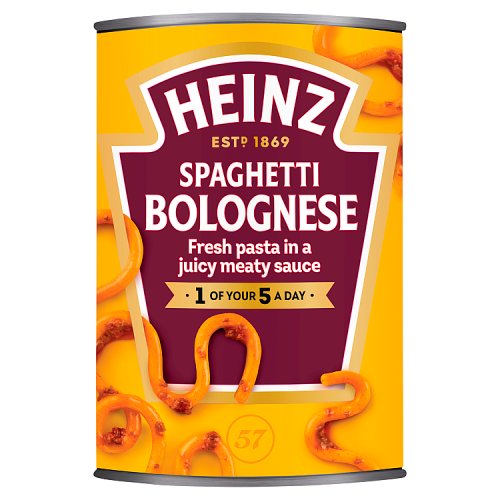
Another was alarmed when she heard one of the meals would be spaghetti bolognese (or 'skabetti', as the teacher called it, which I always find an adorable pronunciation), because she doesn't like spaghetti. Fortunately for her, it turned out that the spaghetti to be used was in fact fusilli (the spiral one), which she did like. For me, spaghetti is specifically the long, thin, solid, cylindrical ones, and any other pasta shape has to be called by its own name (or just 'pasta'). But spag bol is special, because it's the pasta meal most British people encountered first, so it's kind of a meal in itself. I'm not quite sure how to describe its cultural role, actually, for people that don't already have the same cultural knowledge of it. I mean, Heinz sells it in tins, is probably the most meaningful thing I can tell you about it. So I suppose for her, spaghetti isn't a thing in its own right and it could be used as the generic term for pasta as long as it's with that particular sauce.
Image result for spaghetti bolognese tin
Tin of Heinz spaghetti bolognese

Pasta words are one of those semantic fields where there's a lot of overlap and variation, by the way - 'noodles' for me has to be in an Asian dish, like chow mein, so even though they're long and thin, I couldn't call spaghetti noodles. For some people 'noodles' covers all kinds of pasta-type foods. 

Tuesday, 21 August 2018

Ombudsmun

This is a screenshot from a tweet that passed through my timeline:

tweet including the word 'ombudsmun'

It includes the word 'ombudsman', but spelt 'ombudsmun'. I'm a big fan of this spelling. The word  contains the word 'man', but as in many words, the syllable is not stressed and the vowel is reduced to a schwa (the sound at the end of my name). The writer has reflected that in the spelling (probably not deliberately, maybe not consciously) by spelling it 'mun'.

For a while, I was spearheading a single-woman campaign to get 'man' to be truly gender-neutral by using terms like 'postman' for female postal workers. In the end I gave up but it remains true that if it's to be reinterpreted either as a suffix (as in postman, policeman, etc) or as just an inseparable part of the word, with no independent meaning, as looks to be the case here, then it has to be the schwa pronunciation rather than the full 'man' vowel. That loss of vowel content hastens its loss of semantic content.

There are other instances of this spelling, even on quite official ombudsman sites (enough that I had to quickly check it isn't actually a variant spelling - seems not). And I ought to also note here that 'man' is used as a pronoun in some varieties of English, such as Multicultural London English, but that it is more or less gendered when it's used in a non-generic 'one' sense (you get some instances of it being used of women, but it's rare). It's also a pronoun in German, in an obviously historically-related turn of events.

Monday, 14 August 2017

Take your litter home with them

I was driven across the country on Saturday, all the way from Sidmouth in Devon to Margate in Kent. On the way I noticed two signs about litter on the roads, both of which are pleasingly ambiguous. I couldn't take a photo as I whizzed by, but the first one said this:
Take your litter home with you.
Others do. 
The ambiguity is between what linguists call a 'strict identity' and a 'sloppy identity' reading of the missing bit of the second sentence. Others do stands for either Other people take your litter home with them or Other people take their litter home with them. The first one is the strict reading because it strictly preserves the part of the original sentence that is elided, and the reference is the sloppy one because it allows the reference to shift from your litter to theirs, along with the subject.

[Aside: note that the fact that the second pronoun must be them in either case, namely the sloppy reading. I'm not sure why; something about the semantics of take and home and you, probably. But it seems to be an exception to the generalisation discussed here by Neal Whitman, referring to work by Johnson and Dahl, that you can have all the possible combinations of strict and sloppy except for the one where the first is strict and the second sloppy. Which is weird.]

Unlike with most ambiguity, where context tells you which meaning is probably meant, I don't think it's so clearcut here. Presumably they are trying to shame you by saying that other people behave properly so you ought to as well (sloppy). But it is possible, I think, that it means that if you don't take your litter home, the litter-pickers will have to pick it up and take it away (presumably not literally to their homes), namely the strict reading. (We'll leave aside the point that if you take it home it's not litter, which is what my aunt Becky always points out.)

Right, I've gone on about this for so long I'm now completely unable to English so I'll do the other sign for a new post tomorrow.

Thursday, 1 June 2017

No deal is better than a bad deal

My friend Michelle reminded me that Theresa May said this back in January, and has kept on saying it since then. Most people have been non-pedantic enough to let it go by without comment (after all, there's enough politics happening for us to talk about) but she, I and Chris Maslanka in the Guardian all noticed that it was ambiguous.


Negation, as I've mentioned in previous posts, is usually ambiguous because it takes scope over different bits of the sentence it's in. Here's Chris Maslanka's explanation of the two meanings:


Incidentally, there's a long bit in Alice Through The Looking Glass (or the other one) where a messenger pouts that 'nobody walks faster than I do' and the king says 'he can't, or he'd be here already'. Lewis Carroll was keen on logic and semantics jokes.

After some back and forth with my colleague (& friend) Christina, we think we've translated the two meanings into what looks like gibberish to non-linguists, but is actually a formal representation of the meaning. The notation explains how the bits of the sentence interact to give two different meanings from the same set of words in the same order. I've translated them underneath into increasingly more idiomatic English.

The meaning Theresa means, presumably, is this:

∀x∀y.[NO.DEAL(x) & BAD.DEAL(y) -> x > y]

(Roughly,
"For all x and for all y, if x is no deal and y is a bad deal, then x is better than y"
or "If x is no deal and y is a bad deal, then x is better than y"
or "Having no deal at all is better than having a bad deal".)
Whereas the meaning that's much more salient to me, and which made the sentence seem quite bizarre, is this one:

 ~∃x.[DEAL(x) & ∃y.[BAD.DEAL(y) & x > y] ]

(Roughly,
"There is no x such that x is a deal and there is some y such that y is a bad deal and x is better than y"
or "There is no deal which is better than a bad deal"
or "A bad deal is the best deal".)
Incidentally, I'm pretty sure that this particular type of negation scope ambiguity is regional - it seems less obvious to US speakers (see this post and the comments). But that's a purely anecdotal observation so do let me know if you have anecdata to add to that.

Wednesday, 24 May 2017

A luxury attic

Not long ago, a friend of mine was moving to Germany and looking for flats. She complained, on facebook, that the only kind of apartment to rent was Dachgeschosswohnung. I'm not great at German yet, so I let facebook translate it for me and it said that this word meant 'penthouse'. I took this to mean that she couldn't afford anywhere, as they were all luxury places and out of her budget, as this is the connotation of 'penthouse' in English.

What the word actually means is 'top floor flat', literally, and it's basically an attic. Now, while a penthouse is a top floor flat, it's not at all the same as an attic, which has a sloping roof and is small and non-luxurious, which is exactly what she meant when she made her complaint. Literal translation, yes, but a very different interpretation of the type of accommodation it refers to.

Monday, 28 November 2016

Don't you not want some points?

On this week's episode of QI (available on the iPlayer for a few days if you're in the UK), Sandi Toksvig asked Alan Davies the following question:
Don't you not want some points or not? 
The point of QI, if you don't know, is that the questions are all kind of a trick. In this case, the trick is that it's hard to work out what the right answer is, and there's a penalty for a wrong answer.

This question brought about some linguistic chat, all of which ended with Sandi saying that only 'arbitrary pedants' would worry about double negatives, and explaining why the stigma came about in the first place. Gyles Brandreth also took the opportunity to tell us at length how English has half a million words and German only a hundred thousand (I guess it depends how you count them).

But the point here is the difficulty of the piled-up negatives, of course. Let's dispense with the easy one first: the or not at the end caused both Alan Davies and Victoria Coren to claim that it wasn't a yes or no question: it's two questions. WELL. This is technically true, it is two questions, but as I discuss at length in my thesis (and as is generally known; it's not my idea), this is actually one question because yes/no questions are a choice between two alternatives. So that's OK. We can in theory give a yes or no answer to this question. So which is the right one, assuming that you do want points?

WE DON'T KNOW! That's one of the cool things about this question and it's not even because of the double negative! It's because negative questions are inherently ambiguous! Look:
Don't you want some points?
No (I don't want some points)
Yes (??)
We don't always really have a clear sense of what 'yes' means in answer to a negative question. Probably, you feel that it means yes, I do want some points in this case. I do. But it's got to have the right intonation otherwise it doesn't mean anything much, though it can't mean that I don't want points, I don't think.
Do you not want some points?
No (I don't want some points)
Yes (??)
Again, it's not clear, without a sort of contradictory emphasis, what this means. There's tons of research on this which you can read if you're interested. Kramer & Rawlins use examples like the following to show that in fact, the interpretation is likely to be negative in such questions:
Is Alfonso not coming to the party?
No (=he isn't coming)
Yes (=he isn't coming)
So we've already got an issue with this kind of negation. Adding in a double negation, as in the original question, just adds parsing difficulty to the already ambiguous question. It is a real double negative, so it cancels out, as in I don't not like him... or is it double negation as found in many varieties, where one reinforces the other, as in I didn't do nothing or Didn't you not? We just don't know.

What, you thought I was going to answer this one? Nope. Unsolved problem, my friends.

(The 'correct' answer was yes, which is actually not what I'd have gone for: I'd have said it meant something like Isn't it the case that you don't want some points, or is that wrong?, so I'd have answered No, that's not the case. But maybe they went with yes as in Yes, that's true, it isn't the case that....)

Sunday, 6 November 2016

Margaret Atwood is perfect

I saw this tweet today and thought it seemed really weird.
If you 'want for' something, then you lack it. It's usually used in the negative, such as We were poor but we wanted for nothing. Note that we wanted for nothing does not mean the same as we wanted nothing! They may very well have wanted lots of things, but didn't need them or feel a lack of them.

Want (without for) also means 'desire', however, because if you lack or need something, you may in fact also desire it, so the meanings overlap. The overlap is especially obvious if you think about a context like buying vegetables at a farmer's market. If you haven't brought your reusable bag (tut tut), the stallholder might say You'll want a bag for those. You don't specially feel a burning desire for one, but you need one, so you do also want one.

If the tweet had said 'If I wanted perfection...' then it would make a bit more sense. As it stands, Atwood seems to be saying 'If I lacked perfection, I would never write a word'. That implies that she writes because she has perfection, which is not at all the sentiment intended.

She may well be perfect, in fact - I think she's right up there in the best writers I've ever read. Top three, for sure. But it's a typo, of course... she actually said 'If I waited for perfection'.

Wednesday, 30 March 2016

Rotate, but don't turn

I've been looking at mattresses lately. It's bewildering. Not least is the instruction that some of them have:
No-turn mattress. Rotate regularly. 
Rotate and turn are one of many pairs of words that English has that are more or less synonymous but come from different sources. Typically, the one that we get from Romance (French or Latin) is used in more formal contexts or has a technical sense: here, that word is rotate. The Germanic counterpart (here, turn) is usually used in a more everyday sense.

That works for this pair. The OED has examples like The whole stage rotates concentrically and the kid turns on the spit, where each could be substituted for the other. The definitions are also more or less identical:
Turn (intrans): to move round on an axis or about a centre
Rotate (intrans): to turn about a centre or axis
We actually have the transitive senses here, as there is an implied object the mattress, but the transitive definitions are based on the intransitive ones.

The above discussion implies that it ought to be contradictory to say no-turn; rotate regularly, as how can you rotate something that can't or needn't be turned? Of course they mean it doesn't need to be flipped over, but you should turn it 180 degrees about its vertical axis (is that what I mean?? the thing stays flat, anyway) now and then to make sure it wears evenly. Here's an example of a pair of synonyms getting put to use in a situation where two different words meaning turn are needed. If one were so inclined, one could check whether the specific meanings each has (turn = flip over and rotate = stays flat) were generally consistent or if it's random which is used for which. That'll have to wait for another day, though, unless one of my readers wants to do it.

Monday, 21 March 2016

Mandarins and oranges, tortoises and turtles, rolls and sandwiches

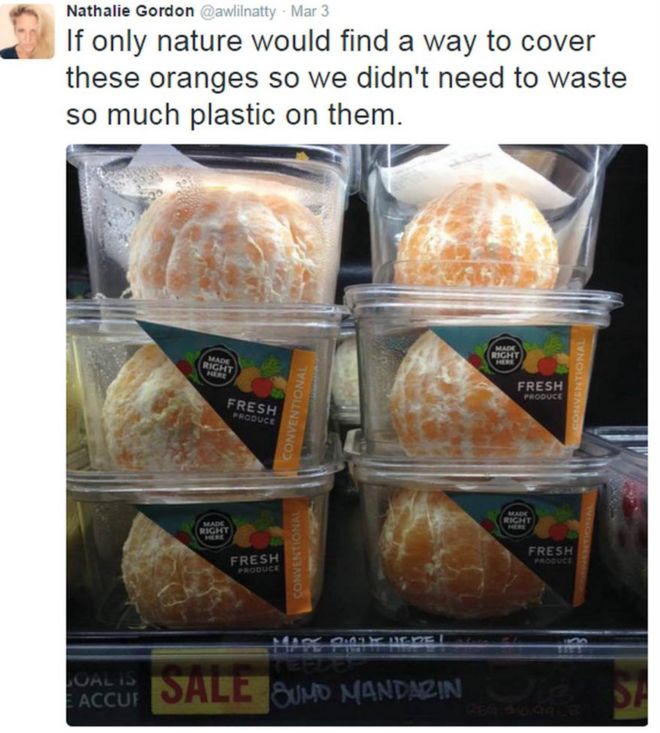
Recently, a story appeared in the news about some plastic-wrapped peeled mandarins for sale in Whole Foods. Whole Foods swiftly removed them and said 'our mistake'.

Here's the tweet that the BBC story used in its report:


Nathalie uses the term 'oranges' to refer to these fruits, which the story refers to as 'mandarins'. In my own native dialect, orange refers to something different from mandarin as well, with oranges being bigger, harder to peel, full of pips and generally a nuisance to eat. Clementines and satsumas are smaller but similar tasting, easier to peel and a much more pleasant experience. Mandarins are something I hardly ever eat, but they have a sharper, almost sour taste which is quite nice but very different again.

Many of the dialect differences I've experienced come from the time when we moved from Shrewsbury to Newcastle when I was 11, and this is one of them, although I don't think it's really a regional difference: I think that it just emerged through mixing with a different peer group. Plenty of my friends did call all these orange citrus fruits oranges, and I assimilated (though I still do make the distinction myself).

This kind of variation in the semantic coverage of a term is one that often causes great debate. A surprising one was tortoise/turtle. To my mind, it's easy: tortoises live on land and turtles live in the water. Americans (I thought) simply call all of them turtles. It turns out that not only is my classification of chelonians not quite accurate, neither is my classification of Americans (they vary! who knew?). I'm yet to work this one out fully, but it sparked a full-on twitter row last time I tried.

The most bitterly-fought battle is probably the one over what different kinds of bread should be called (buns, rolls, baps, etc.) but a related one is what counts as a sandwich. An effect of moving south a couple of years ago was that I would sometimes order a bacon sandwich in a takeaway place and get bacon between two slices of bread. Now stay with me, this is complicated. At home, or in a place where I'm sitting down to order a bacon sandwich, I expect this. But in a takeaway place, I expect it to come in a bun (bap, roll, whatever). In places round here, it seems that sandwich is more restricted in meaning, and covers only those made with sliced bread. You can have a roll, but you have to ask for it specifically. A bacon roll is a taxonomic sister of a bacon sandwich, not a hyponym of it (in other words, bacon rolls and sandwiches are two different examples of bacon-in-bread items, rather than a bacon roll being a sub-type of bacon sandwich).

Thursday, 3 March 2016

It's hard to close the windows after you've left the room

I was in a room at work today that had a sign on the inside of the door saying something like this:

CLOSE WINDOWS
BEFORE LEAVING
THE ROOM

Underlining is the written form of stress on that word (before), and that kind of stress in that position can only make the word contrastive. That is to say, it contrasts before with after and any other word from the appropriate semantic and syntactic class (while, during, etc). It also makes before the focus of the sentence, so that the rest of it seems to be already-known information. The implication is that people have been trying to close the windows after they've left the room, it hasn't worked out well, so now we're being reminded to do it before and not after we leave.

Tuesday, 15 December 2015

Grainy painies

For some reason, the other day I remembered a thing that happened on TV years ago. Frank Skinner had a chat show at the time, and Britney Spears was big, so I suppose it was probably the late 1990s. Britney was on Frank’s programme, and she at some point used the term ‘granny panties’ to mean ‘big knickers’.

Normally, we translate effortlessly between accents, so much so that we don’t even notice that we’re doing it most of the time. If someone tells you their name and they have an accent different from yours, you repeat it back in your own accent, not in an imitation of the way they said it. Let’s say you’re from London and your friend is from Vancouver, and her name is Martina. She’s probably got a ‘rhotic’ accent so she’ll pronounce the ‘r’ in her name, but you probably won’t. When you say her name back to her to check you heard it right, you aren’t going to pronounce the ‘r’ just because she does.

That’s why it’s weird when this doesn’t happen. When Britney said ‘granny panties’, it wasn’t a phrase Frank had ever heard before. Britney’s accent is also very different from Frank’s, and when she said it, what he heard (and repeated back to her) was ‘grainy painies’. If you can’t relate the sound string you hear to a known word or phrase, the only thing you can do is approximate the way it sounded. What you say sounds just like the phrase but you don’t know what it is you’re saying.

I see something like this in my first year seminars. One week, we do an exercise where they have to work out what phrase is written in phonetic transcription. The way to do this is to ‘sound it out’. Often, they are literally saying the exact phrase perfectly, but they can’t hear the words or extract the meaning from the string of sound. It’s fascinating and completely hilarious.

Friday, 13 November 2015

Professional toilet paper


Normally, ‘professional’ quality means better quality. Artists’ paints, for instance, come in ‘student’ and ‘professional’ grades, and the professional ones are made with real pigment instead of synthesised stuff and are correspondingly more expensive for the ones made of precious things. A professional bricklayer will do the job better than some bloke who does it in his spare time (in theory, anyway). A professional musician plays music for a living and can be assumed to be pretty good at it.

Olympic athletes are not professionals, though: they’re amateurs. It’s in the rules. If you ‘turn pro’ in boxing you can’t compete in the Olympics any more. Here, ‘professional’ means ‘does it for money’.

And the toilet paper they use in my workplace is ‘professional quality’, which in this context means ‘not the good stuff that you buy for yourself’. 

I was going to photograph the actual packaging but it's been thrown away, so here's The Professionals instead. 

Tuesday, 22 September 2015

Not all moths

I host a quiz night in our local micropub (it's cosy). Recently, in the 'insects' round, I asked whether insects are warm- or cold-blooded. They are cold-blooded, of course (this is not a technical term: they are actually ectothermic, which means they don't regulate their body temperature internally). One quizzer challenged me, because there are in fact three species of moth (out of maybe 10 million species of insect - we don't know exactly) that are warm-blooded.

Leaving aside the fact that rounding this off to, say, 3 significant figures is 0.00%, we have a question of genericity. Now, either my statement 'insects are cold-blooded' is an absolute statement meaning 'all insects are cold-blooded', in which case a single warm-blooded insect is enough to prove it wrong, or it's a generic statement: 'insects in general are cold-blooded'. I meant the latter, of course, and in the context of a quiz question where two options are given, this should be clear. One of the things Steven Pinker said, actually, was that to avoid the hedging ('almost', 'in general', etc) you find in bad prose, you should allow your reader to assume the generic interpretation. In academic writing there is a place for the precision afforded by hedging, but for much other writing I agree.

There's limits though. While researching my quiz, I read the supposed fact that 'babies are born with blue eyes'. That, I thought, was astonishing. It turned out that what the author meant was 'white babies who will have blue, green, hazel or grey eyes', not 'babies in general' - there is a very high proportion of babies in the world who have dark brown eyes, and are not born with blue eyes. If you're going to make generic statements you do have to be clear about what the universe of discourse is and your generic statement has to actually apply to the majority of things in it. (In this case, the author had made the very easy mistake of forgetting that not everyone is exactly like them.)

Another of my quizzers challenged another question. In the picture round I had asked for the name of the species of fish pictured. One was a goldfish, and the team had written 'carp'. I didn't allow this, and the challenger wanted to know why, when a goldfish is a carp. It's true that goldfish are carp, but not all carp are goldfish. 'Goldfish' is therefore a hyponym of 'carp' (and 'carp' is a hypernym of 'goldfish').

I am clearly not strict enough with my quizzers. If I keep blogging about their complaints perhaps they'll stop.