Showing posts with label reading. Show all posts

Wednesday, 23 July 2014

Noun phrase juxtaposition confusion

Associated Press caused a twitter hoo-ha when they mistakenly led a lot of their followers to think that there had been yet another air crash, this time involving the plane carrying the bodies of people who were killed in the recent Malaysia Airlines crash. They phrased it like this:
Breaking: Dutch military plane carrying bodies from Malaysia Airlines Flight 17 crash lands in Eindhoven.
Lots of people reasonably thought that this meant that this plane had crash landed in Eindhoven. It didn't; it meant that the bodies from that crash have been taken to Eindhoven, where the plane has landed safely. You can read the Gawker article linked above for all the responses (my favourites are those who say 'well, AP style is 'crash-land' so it clearly didn't mean that').

One of the tweets, about halfway down the Gawker article, says that 'AP should have thrown some tactical commas/hyphens/apostrophes in that one'. Bear with me while I derail my linguistics blog into the realm of punctuation for today's post.

Friday, 17 May 2013

Learning grammar

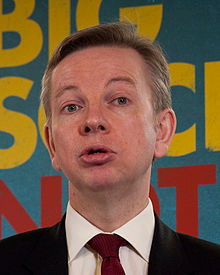
Recently, English children aged 10-11 had to take their SATs (tests that children take every few years to check the school isn't useless). The English test included a test of their spelling, punctuation and grammar, a new thing introduced by the wildly unpopular and widely-derided Secretary of State for Education, Michael Gove.
Michael Gove:
as much of an idiot as he looks.

I am, of course, in favour of these things being taught in schools. It seems sensible to me that children should learn how to write well and how to understand the language they speak. It would be even better if they learn how language works and were taught linguistics. This can be done, and I once read a very good proposal for how to implement it, which I now can't find. But anyway - that aside, yes, teach children how to spell. Good.

The problem is how Gove wants this taught and tested, as with all his reforms (his changes to history make the curriculum just a list of facts and figures, according to history teachers, because he felt that children were learning too much about Martin Luther King and not enough about ancient kings and queens of England).

Michael Rosen has written about this at great length and David Crystal has added his comments, so I won't add my thoughts here, but basically it's teaching children meaningless terminology out of context, which is at best confusing and at worst wrong. See the Crystal link for examples. It means that people end up with fixed rules that they don't fully understand and can't apply - one of the comments on the Crystal piece:
My son (an American) had a high school Advanced Placement composition teacher who would take points off for every "passive" sentence in a composition. Actually, what she did was go on hunts for instances of "was" and "is", and would deduct points even if the sentences weren't passive.
What I wanted to add to the conversation was this: is it actually useful to teach children grammar?

I know that's blasphemy to anyone of a certain age or temperament, but I'm serious. And I say that as someone whose job is basically grammar. What would the answer be?

If we teach it the way we do now, then I would be of the opinion that we don't teach it till they're older - 13 or so. Then they can cope with learning these unfamiliar terms and rules. But I also think we shouldn't teach it the way we do now, as if there are hard and fast rules. Knowing grammar is useful if you want to learn another language (although it is entirely possible to do it without, if you learn in an 'immersion' style), so perhaps we should introduce it earlier. Many people my age, who weren't taught English grammar at school, learnt all they know from their French lessons. In that case we could do it differently, showing children that there are basic categories of words and they're combined in certain ways, but that language is only real when it's used, and it behaves in interesting ways and the real skill is in learning how to investigate it.

Or, as an alternative, we could just not. I wasn't taught much grammar, as far as I remember. When my generation was at school it just wasn't on the curriculum. It hasn't done me any harm. If you need it or like it, you'll learn it later, and if you don't, well, there is literally no situation in real life where you will desperately need to know if a word is a noun or a verb.

There is one aspect of grammar that does affect real life, and that's using 'correct' grammar - you have to do that if you don't want people to think you're uneducated and not give you a job. That is important, but it's a different thing from learning grammar. That's learning the rules of how to use a particular register of the language to conform to a certain social group. There's no question that schools are failing children if they don't teach them how to do this, because like it or not, it's a vital life skill to be able to speak and write according to the standard language.

And you know what? Schools don't teach children this. I mark essays and there are so many mistakes in them, most students clearly haven't grasped all of the rules. There are maybe 5-10% of essays that are really well-written in any bunch. The rest are mostly not terrible, but they aren't great. This was shocking to me, because I assumed that most people who have managed to reach this stage of education have learnt this stuff along the way.

BUT I do not advocate more grammar lessons in school to remedy this problem. I've taught first-year syntax for long enough to know that if an 18-year-old struggles with grammar, a ten-year-old isn't going to fare any better. It's just going to make them hate writing and feel stupid.

I conducted a poll among my most writerly non-linguist friends - the ones who studied English literature. Some of these people have PhDs in English literature, or will soon, some make a career or hobby out of writing. They know their stuff. Almost all of them said that they don't have conscious knowledge of grammar, it's 'just instinct'. Even the stuff that these children are supposed to know, they wouldn't be confident if they were tested on it. But they can do it, and surely that's the important thing - who cares if you know what a gerund is, if you can use one right?

The way that they (and I) all learnt grammar was by reading a lot. If you read a lot, you pick up good grammar, is my hypothesis. Now of course it is possible that some child might read a lot but still not 'get it'. It might just be that these people picked it up easily AND liked reading, and one is not a cause of the other. I'd like to hear from you if you read a lot but still don't write well, or naturally write well but never read much.

I'm not pretending that this is an easy solution: a lot of children don't like reading and you can't force them to do it, or they end up hating it. I'm just saying, the way Gove is doing it is stupid. Maybe they do have to teach it explicitly. But if they're going to, then they should at least listen to the people they consulted, who specifically advised against the approach they've taken.

And I would bet Gove ten quid that he wouldn't be able to correctly identify, say, the subject of a sentence every single time, but it's not done his career any harm.

Monday, 23 April 2012

Baboons can read!

Or rather, baboons can learn to recognise words and then learn the frequency of particular letters in them to predict if a new item is a word or not.

What they did was let baboons play with a computer in return for treats (so they could choose not to play at all if they didn't want to, or play a lot if they were greedy buggers.). They were presented with a whole load of words, all four letters long, all with a vowel and three consonants (as far as I can tell - I don't have access to the original paper). Some of the words were real, and some were non-words like virt or dran. The non-words were, I think, possible words (that is, they conform to the rules of the phonology of the language (phonotactic constraints). I don't know which language - the study was done in France but the phonotactic constraints of French and English are not all that different). The baboons had to press a button if they thought it was a real word, and another if they thought it wasn't. I don't think any of them did any better than chance at first, but they were given a treat if they guessed right until they had seen the words enough times to remember them and guess right 80% of the time. 

This is Dan the Baboon, class swot. He remembered 300 words:
Dan the Baboon
Note that this isn't reading - that means identifying a word as a word (connecting it with a sound and/or meaning). This is just object recognition, which I think is the authors' point - that reading isn't a linguistic skill, but rather object recognition and then we have other linguistic processes going on to make the next step, which baboons don't have. Fortunately, otherwise they'd start writing us notes and making demands for better treats or more fun computer games.

Once the baboons knew a load of words, the researchers gave them new ones to look at. Now, they could guess when a word was a real word at slightly better than chance, or 60% of the time. Apparently, they were recognising letter combinations like 'th' and assuming that new words with that letter combination were also words. (Note that Language Log has comprehensively dissected and basically trashed this claim, but I don't have access to the paper so I'm going to have to take the conclusions as they say.)

So the baboons seem to be able to break the words down into their letters, or at least smaller parts. I don't know if this is a new finding. The authors say it's like how you can recognise a table you've never seen before, because you know how a table basically looks, with legs and a top and the relations between the parts.

I don't think these baboons are so clever though. I want to know how they'd do with a non-word that had the letter combination 'th' - presumably they'd wrongly think that it was a word.

They would also (I'm fairly sure) do badly if they were asked to identify possible vs impossible non-words. This is what I mentioned before: impossible words violate the phonotactic constraints of the particular language. So blod is a possible (but not real) English word, but bkod is not. The baboons would not know this (of course, as they aren't associating the words with sounds and they don't speak English (they're French baboons) and they don't have any concept of phonotactics anyway). I don't know if they could learn to recognise them either, though - I think it might be too complex and the rules just too arbitrary. Even for Dan. 

Monday, 7 November 2011

Odd abbreviation reveals spelling over phonetics?

It was my friend's birthday the other day so we met in a pub for lunch, which is the accepted correct way to celebrate a birthday. Another friend hadn't been to the pub before and an interesting misunderstanding ensued.

We were going to a place called LYH. It's a nice pub, though you wouldn't know it to look at it from the outside. It does good grub and nice beer. This particular friend not only hadn't been there before but hadn't even heard of it before. However, we have been several times to another pub, called Mr Lynch. (Also a nice pub, though different - less about the beer, more about the partying, but still good grub.) This friend thought that in my text message 'LYH' was an abbreviation for 'Lynch'. Don't panic folks, she realised in time and made it to the correct venue. But the question is, how did this misunderstanding occur?

I wouldn't have abbreviated that word anyway, as it happens, but if I did, I think it'd be to 'Lch' or something similar. It would have included the important sounds of the word, the initial and final consonants in this case. The particularly odd thing about abbreviating it to 'Lyh' would be that the last letter, the 'h', doesn't even represent a sound of the word 'Lynch'. In broad phonological transcription, the word is [lɪntʃ]. That last sound, the 't' and the long 's', together make the sound we write as 'ch'. At no point in saying the word 'Lynch' do you make the sound [h], which is the sound you make if you say 'huh'. This is evident if you try to say 'Lyh' as a word - doesn't sound good, does it? 


So it would have been a strange choice for me to abbreviate to if I was going off the sounds in the word. But this highlights the fact that in written communication we can dissociate ourselves from the sounds of words and refer only to the spelling. Some people do this more than others, I think, though I don't know what makes the difference. Perhaps those who read more do it more. You know sometimes on 'Come dine with me', the participants read an unfamiliar item on the menu, say it's 'taramasalata', and instead of reading out what's there, they instead guess a word they know, like 'tiramisu'? I think it's the opposite of that. 

Wednesday, 2 November 2011

Kindle is for lowbrow, hard copy for highbrow?

That's the main message of this Telegraph article, which did some kind of statistically dodgy survey and found that while 71% of the books (real ones) on respondents shelves were 
autobiographies, political memoirs and other weighty non-fiction titles,
the most popular books on Kindle are - surprise - the popular genres like mystery, thriller, romance and fantasy. It's supposedly because if you're using an ereader, people can't judge a book by its cover, as it were. It frees readers from the shackles of their intelligent, thoughtful public image and allows them to indulge their mucky desires for fluffy pink romance and heaving flesh.