Excitingly, I managed to get invited to a screening of Arrival last week, a good six weeks before it's due out on general release. I went with a handful of other linguists, so we enjoyed the complimentary booze with a bunch of (we assume) critics and then settled down to watch a film that we were somewhat trepidatious about. The main character in this film is a linguist, and this doesn't always give a terribly accurate impression of our business. However, some of my companions had read the short story it's based on, The story of your life by Ted Chiang, and were hopeful that the film would do this story justice.
It did, as it happens, and I'd recommend it if you like thoughtful scifi with aliens, stern US military types and a romantic side-plot. Personally I'm not a huge fan of all these things; the romantic side-plots can do one as far as I'm concerned, but in this film it worked well and contributed to a really clever twist to the story.
Right. David Adger has written a nice post about the language of the aliens and how 'alien' it really is. I'm going to focus on a few points where linguistics was a focus of the film and how it was treated.
The language in the film, Heptapod (the aliens have seven tentacle-feet things), is a visual language. There is a spoken language as well, but the linguist protagonist, Dr Louise Banks, decides that the visual language is the one she can work with to communicate with them. I can't remember why she thinks that, now, but it probably would have been harder to synthesise the spoken language to communicate with them (and she certainly couldn't produce it herself). (Note to self: don't try and write film reviews after having seen them and then drunk lots of wine a week previously.)
This language is formed by the heptapods squirting a sort of squid-ink-type substance in circular shapes with irregular edges, like coffee cup rings. These irregular bits are not actually irregular, of course, as they are what conveys the meaning. Each ring is a sentence (I don't know if we found out if they have complex sentences, with more than one clause). These symbols (the Independent calls them a 'complex form of hieroglyphs', though I'm not sure why) are holistic: they're produced as a whole, not made up of obvious parts. This is important to the story, as it is representative (in fact the cause) of the way the heptapods see the world: time is non-linear to them. However, they're not inseparable. In translating the language, with a good deal of computer analysis, the scientists identify tons of nodes in the rings that map onto meaning. When Louise talks to the heptapods, she creates rings from four or five segments. Clearly, there is combinatorial stuff going on here. I think the story talks more about how it works, so I'll know more about that once I've read it.
I liked the way Louise and her job are portrayed, for the most part. She is called a 'linguist', not any other job title, and she really is one. Near the start of the film, we see her giving a lecture on comparative romance linguistics. She employs what are, as far as I'm aware, linguistic fieldwork methods in her efforts to understand the heptapod language (she proceeds very quickly, but maybe that's because she has the US military and its computers behind her). Linguistics is referred to as a science and compared favourably to maths at one point by the theoretical physicists (not sure what he was there for).
***slight spoilers***
At one point, she told the kangaroo story, which Wikipedia relates like this:
Cook and Banks were exploring the area when they happened upon the animal. They asked a nearby local what the creatures were called. The local responded "Kangaroo", meaning "I don't understand you", which Cook took to be the name of the creature.The row of linguists sat in stony silence at the punchline. However, when she reveals it not to be a true story a moment later, we had the last laugh.
***spoiler over***
Some things were a little bit less accurate. For one thing, her house was amazing. What mid-career female linguist is paid that much money? Perhaps she was well-paid for the work she'd done when seconded to the army previously.
She also speaks all the languages. I mentioned at the start that she was lecturing in comparative romance linguistics. Perhaps this isn't her specialism; heaven knows I lecture in all kinds of things that I don't know an awful lot about. But we do know that she was able to help the military with some Farsi interpreting. When the Colonel turns up on her doorstep and asks 'Do you speak Mandarin?', the answer is apparently 'yes'. There's possibly an explanation of this later in the film, but at that point it feels like a very lucky coincidence and playing into the stereotype of what linguists do (i.e. speak all the languages).
At one point, it seems that she is going to be unsuitable for the work they want her to do. She asks them if they're going to see some other guy next (let's call him Linguist B as I didn't make notes) and says, 'Ask him the Sanskrit word for war and its translation' (which as my colleague noted doesn't make much sense, but I guess I know what they meant). He comes back and says that Linguist B said it means something violent, and what does she say it means? She says 'a desire for more cows'. A quick internet search shows that this is generally known, although I'm afraid I lack the desire to fact-check it. This plays into the Sapir-Whorfianism that runs throughout the film, whereby language shapes the way you think. It doesn't actually make much sense to say the Sanskrit word for 'war' means 'a desire for more cows'. Either it literally means that but is used to mean 'war', in which case it means 'war', or else it isn't the word for 'war'. Sanskrit speakers definitely have the ability to wage war, so it's not that they don't have a concept of it due to the lack of a word for it.
But still. At one point she is explaining why she needs to go through a ton of basic stuff like pronouns when all they want to know is 'What is your purpose on earth' and we get a great linguistic explanation of everything that's involved in understanding and therefore answering that question. We also get a nice 'problem of translation' point when it hinges on whether a certain word means 'weapon' or 'tool' (and the answer to which it is is pretty cool by the way).
I'm happy with it, as a linguist and as a scifi fan. Go and see it. It's good.
Aside: Reviews are less linguistically well-informed. Apart from the aforementioned use of 'hieroglyphs' in the Independent, the Guardian says this:
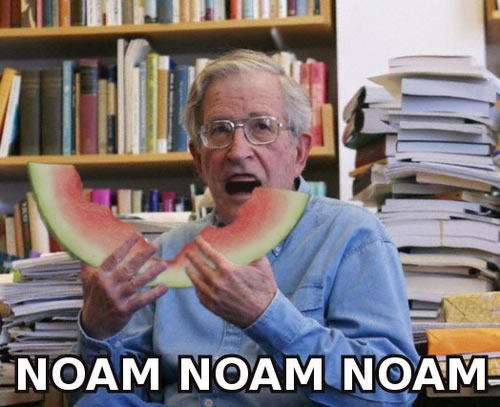
Why, you ask, did they not approach Noam Chomsky, with his understanding of “deep structure” in language? Perhaps Prof Chomsky did not care to help America’s military-intelligence complex.I assume they've said this just to make a sort of political joke, but this is such a stupid question it should never have been asked. I also have an understanding of 'deep structure' in language, having studied it for 12 years or so now, and I can assure you it doesn't give you a magical ability to understand unfamiliar languages. If anything, it might make him less able to work with a language that may not conform to this deep structure (see David's post linked earlier). Linguistic fieldwork is a fiendishly difficult task that takes years of training and practice to do well, and it's something that Chomsky has not specialised in. In fact, he's often criticised for doing precisely the opposite.