Showing posts with label English. Show all posts

Monday, 14 December 2020

Untranslatable even by a universal translator

One of the most important things to the storylines of the long-running TV series Star Trek is that there's a universal translator. For those who don't know, it's a scifi series set in the future, when basically social problems are sorted on Earth and everyone has enough to live on and people can just go into space because they want to and so there are these space ships that belong to the Federation that just go around space and meet people and solve their diplomatic issues or sometimes, like, just relieve their loneliness or meddle in their affairs or whatever it might be. They get involved in fights much more often than you'd think, given their mission. So they're obviously always encountering races that they've never met before who all have their own language and culture and often disastrous/hilarious misunderstandings ensue, but they can always speak each other's language. I imagine this is because it would be dull if every week they main plot line was basically Arrival. So this thing is part of their ship, or in their kit (there are lots of series) and it means that what it sounds like is everyone speaks English most of the time. 

Sometimes there are bits of language that aren't translated. So often you hear Klingon spoken - in the current reimagining, we saw lots of scenes without humans in, on board a Klingon ship, and there it made sense to have them speaking Klingon (after all, someone's gone to the bother of inventing it) and subtitle it. 

Image of the characters standing facing each other for the process of T'Kal-in-ket
Another episode in the current series had the people 1000 years ahead of where our main character had come from speaking 'Pidgin'. That was an instance where the translator had evidently done a partial job. Pidgins arise in contact situations and typically have a 'lexifier' language which provides the vocabulary (in the context of slavery, where many pidgins and then creoles arose, this would be the colonisers' language, such as English) and another language influences the grammar (a West African language in the slavery context). (Well, this is one way of thinking about it. Let's go with it for now and you can read about creoles yourself if you want to - you should.) The 'Pidgin' (probably actually a creole, as it seems to be stable) in the series isn't discussed but it's probably developed from some kind of lingua franca, as there seems to be a lot of trading going on. The universal translator seems to have been able to pick out some features and translate them but not all, as it doesn't translate it to English. The question of why this particular language remains untranslatable whereas all the other unfamiliar languages don't is a puzzling one - it's not because it's in the future, as it copes with all the other languages they encounter. Perhaps it really is a pidgin, and therefore doesn't yet have fully stabilised patterns and rules, and so is not reliably translatable? Or perhaps they thought we wouldn't notice this inconsistency that was convenient for the story. 

Then, recently, the main character Michael Burnham sets up some kind of formal conversation where she needs an advocate. The process is called T'Kal-in-ket, and her advocate is called a shalankhkhai, which we learn was called sha-set but they now use this Romulan term, and it has to be someone from the Qowat Milat order of warrior nuns. Now, we often encounter borrowings in the series, and they're simply absorbed into the story and we're all good - that's how it works in real life too, when we talk about eating avocado or drinking pinot noir or wearing dungarees. But the characters from 'our' gang didn't know these words and they all had to be explained to them and the explanations were things like 'a type of advocate'. In other words, these were 'untranslatable' words, the kind of word that refers to a specific concept that doesn't have an exact match in English (or whatever you're translating to), so you need to explain it. Other examples are schadenfreude, or saudade, or hygge, and so on. Similar examples in real life are job titles like Sultan or Tsar, where it doesn't quite correspond to King or Prime Minister or President or something. Others are titles like 'Mrs' - this is frequently the translation given for 'Frau' in German (on forms, for instance). This is infuriating to English-speaking customers who are not married and would use 'Ms', as 'Mrs' can only mean a married person in English, whereas Frau, Madame, SeƱora, etc simply mean an adult woman rather than a girl, so they are not good translations. (If Frau or Mme were the option, that would be fine!) 

I don't know what language our crew are meant to be speaking - each their own language, I suppose, as they have a universal translator. I'd like to see a bit more of the translator running into difficulties and thereby causing a linguistic subplot. 

Monday, 11 February 2019

Don't touch the actors and they won't touch you


The 'normal' way of making a conditional in English is with an 'if'-clause:
If you hurry up, we'll be in time for the train.
We'll be in time for the train if you hurry up
There are plenty of others too, of course (As long as you keep walking, we'll be in time for the train) and of course -- isn't it always -- it's much more complicated than this, but there's also a cool way of doing conditionals with and and or.

Consider this warning, which I saw at Dreamland in Margate at their Screamland Hallowe'en thing a couple of years ago:
Don't touch the actors and they won't touch you.
Image result for screamland
Poster for 'Screamland' in Margate
You could interpret that as an instruction combined with a simple statement of fact: the instruction is not to touch the actors, and the statement is a reassurance that they won't touch you, independent of the instruction. That might in fact be what is intended here, because even if you do touch the actors, they're probably still not supposed to touch the visitors.

But we're funny things, humans, always looking for connections, patterns, reasons, and causes. Those two things being joined makes us want to think that there is some meaningful link between them. It's like if someone says The car is making a funny noise and Jen borrowed it yesterday. You can be pretty sure they're blaming Jen for the funny noise the car is making, and not just telling you two unrelated facts about the car.

Generally, in an and sentence, both bits are the same type: both statements, for instance, in which case they must both be true (so for the sentence about the car to be true, it must be true that it's making a funny noise and that Jen borrowed it -- notice that the inferred link that Jen was to blame does not have to be true). Or they might both be instructions, in which case you're expected to obey both (at the same time or in order), as in Sit down and shut up. Our example sentence, about the actors, is a mix of an instruction and a statement. So we might be expected to obey the instruction and for the statement to be true. I don't know about you but I don't really know where I stand right now, as there is no obvious link between my obedience and objective truth.

It would make so much more sense if, say, the truth of the statement was conditional on me obeying the instruction. So if I don't touch the actors (obey the instruction), then it will be true that they don't touch me. And all of a sudden, we have a conditional like the 'if'-clause type I mentioned right at the top, but with and instead.

Can we do it with or, a disjunction? Well, yes we can, but it comes out as a warning or threat rather than a deal or an agreement.
Don't bother the tigers, or they'll attack you. 
Now, we still have to obey the instruction but if we don't, then the second part will be true: a punishment, rather than a reward for our obedience.

We can even do it with neither at all, just so long as it is a proper threat and not just a warning:
Touch my stuff, I'll beat you up. 
Now the instruction is an elliptical conditional. There's probably an understood 'If you' at the beginning, or else the link between the parts is the same as with and: if the first part is 'obeyed' (the person does carry out the action), then the second part is true.

Sunday, 23 September 2018

Subject omission is gendered in English and Swedish

My student, Helen Pettersson, recently completed her MA dissertation on null subjects in English and Swedish text messages. She constructed some fake Whatsapp conversations, presented them to participants online, and asked for their judgements on various types of sentence. She wanted to know whether Swedish behaves like English in its acceptance of null subjects in colloquial registers, and as a sub-question, whether text messages are more like spoken English or like the more elliptical 'diary' register (things like Saw self in mirror today. Felt was growing fatter, which is OK in a diary but not in speech). Well, spoilers, in all the contexts she tested, English and Swedish are quite similar. But there was one way in which they differ, and it wasn't the topic of her dissertation but it is quite interesting.

Some of her stimuli presented a message with no prior context (it wasn't a reply to another text message) and asked her respondents what they thought the missing pronoun was: was it I, you, he, she, it, we, you (plural) or they? These were sentences like Might watch a film later. We expected that the majority of people would choose I, because that's what we know null subjects most commonly refer to in English, probably because it's the most accessible referent (you're more likely to be talking about yourself than someone else). But we also thought that there would be some variation, as it's perfectly possible that it could refer to someone else.

Here are the results for Swedish:


Mostly I (jag), as expected, with a smattering of the others, mostly He and She. Funnily enough, there are quite a few more participants who went with he when the sentence was about having broken a mirror - perhaps because boys are clumsy? 

And here are the results for English: 


There are lots more votes for they than in the Swedish data, and I wonder if this is because people were allowing it to be singular they, as in the pronoun used when it's an unspecified person involved with no known gender or possibly even number, as well as the third person plural pronoun. But in addition, just look at how many more votes the masculine pronoun got than the feminine! This is really a striking difference from Swedish, and I'm not aware of any particular reason for this, which makes it all the more intriguing.

Wednesday, 7 June 2017

Three mistakes in one sentence

This is the first in a short series of posts about things I've noticed in my current book, The Leopard by Jo Nesbo. I'm reading the English translation by Don Bartlett, published by Vintage. It's originally written in Norwegian so some of the things I write about might be influenced by that, I suppose.

Here, Harry Hole, the main character, takes issue with his colleague's grammar. This is not just a quirk of Hole; the other things I'll be blogging about are similar grammatical observations from other characters in the book, so I can only assume Nesbo is the one who is a stickler for precision.


The second two mistakes are factual errors, or judgement differences, so I'll leave those aside. The first, though, is Harry claiming an agreement error. He thinks that the verb should be singular is rather than plural are, to agree with the clausal subject [punks shooting good policemen] rather than the closest noun, the plural policemen. This is a common error; I'm forever correcting it in essays. It's easy to do because there's a suitable noun just before the verb, and our brains have forgotten that the real subject was ages ago, and take the easy option of the closest noun.

He's absolutely right if the subject really is that clause. Why clauses should be singular and not plural, when they don't really seem to be the kinds of things that can be singular and plural, is an interesting question in itself. We might say that it's semantically a singular event, the event of shooting described in the clause. More plausibly, I would say, is that when something can't have number (it's 'underspecified') we default to the singular, which is the unmarked option in English (and in languages generally).

What if, though, the subject is punks? It could be. Then the subject still has a clause, but instead of it being a clausal subject describing an event [punks shooting good policemen], it's a noun punks with a relative clause modifying it: punks [who are shooting good policemen]. What about that, eh? Then we do want plural agreement on the verb and it should be are.

But here's a thing: we can replace the noun punks with a pronoun, which in this case would be they or them, as it's 3rd person plural, and look! It's totally bad with they no matter what form the verb takes, and it's only good with singular agreement when it's them.
*As far as they shooting good policemen is concerned
*As far as they shooting good policemen are concerned
*As far as them shooting good policemen are concerned
As far as them shooting good policemen is concerned
The lack of the option of nominative case (they) shows that this isn't a real subject of the gerund (or rather, that the 'subject' of a gerund is not the same as a normal clausal subject). If there was no modifying clause, we could use they, and then we'd have to use plural agreement: As far as they are concerned. So part of this pattern is actually an artefact of the fact that you can't have a modifying relative clause with a pronoun. Note that if we put back in the who are that I showed as understood earlier on, it is obligatorily plural agreement, and it also demonstrates very clearly that punks is outside the relative clause.

I really do think it could be either singular or plural, depending on the structure. Not that this matters, much, but it does show firstly that subtle distinctions can illustrate different underlying syntax, and secondly that it's not a good idea to be too nitpicky about grammar in case a linguistics blogger comes along and takes issue with your correction.

Wednesday, 24 August 2016

Bear cats aren't cats. Or bears.

This tweet appeared in my timeline today:
All of this is useful and important information, and it's cool how things get to be named things that they aren't, but the linguistic point I wanted to make is in relation to the last one.

Each of these has two parts to its name, either an adjective plus a noun (slow+worm, horny+toad) or two nouns (killer+whale, bear+cat). (I've analysed 'killer' as a noun here, but I suppose it might be an adjective too - it doesn't much matter.) In each case, it's the second part that tells you the type of thing that it is (or isn't): a worm, a toad, a whale, a cat. That's because when you put two things together in language, you (nearly) always have one that's the 'head' and the other part modifies the head in some way. Here, it tells you what type of worm/toad/whale it is: a slow one, a horny one, a killer one. This is a general fact of English: the Right-Hand Head Rule.

This means that even when the two parts of a compound are nouns and either could theoretically be the head (a bear cat could be a type of cat or a type of bear), we interpret the right-hand element as the head. This is evident from the wording of the tweet, where we're told they're not a type of cat, and the fact that they're also not bears is added as a humorous parenthetical, just in case we were tempted to think that.

Wednesday, 6 January 2016

Ne translatez pas les languages

A friend posted this photo on facebook the other day:


A number of highly intelligent people then missed the point of the joke and began to comment on how bad the translations are. I think they're pretty good imitations of the languages in question, with one big error: the 'German' looks (unmistakably) more like Dutch in the second half of the sentence.

These are not intended to be translations, of course, or rather they're deliberately not accurate. They're just meant to amuse the English-speaking audience by including funny words to compound the humour of the warning in English ('avoid pouring on crotch area'). After all, we love nothing more than when a foreign language does something in a funny way (cf. Welsh popty-ping for 'microwave' or German Handy for 'mobile phone') so it's nice to imagine that these might be for real.

Let's begin with the French. The grammar is fine, as far as I know: you'd make an imperative in French with the negative and the 2nd person plural inflection, just as it's done there. The phrase dans l'area seems OK to me, too. The vocabulary used just isn't French, that's all. The verb for 'pour' should, I think (Google Translate helped) be verser so you'd have ne versez pas. I don't know if you'd also need a pronoun in there (don't pour it) or not. And, of course, no French person ever says ooh-la-la, but it's stereotypically French and referring to ones' crotch that way goes nicely with the French reputation for romance.

Next, the 'German'. This one caused a bit more controversy in the comment thread, because it very obviously isn't German. My German is less good than my French, but I'm pretty certain the word order here is wrong as well as the vocabulary and morphology. I think you would say literally 'drop you not...' rather than 'not drop...', which is what we appear to have here: nein is German for 'no'. Then the verb is obviously just English again, with droppen instead of pourez. I think they've simply selected words that have a combination of letters that resemble the language in question (so French has a word pour, for instance, but it doesn't look very Germanic).

Next, though, I think we've got a nice case of representing an accent in words that look like (or indeed exist in) the language. So ze haut kaffe does not mean 'the hot coffee' in German (haut apparently means 'skin', for instance, and the German for 'coffee' is in fact kaffee, which they could have used instead), but it looks German-ish and sounds like someone saying the hot coffee in (some kind of representation of) a German accent. It reminds me of this a bit. Notice also that the 'German' has an overt object with article, while the French has nothing at all ('don't drop _ on the crotch area' vs 'don't drop the hot coffee on the crotch area').

Then it most definitely switches to Dutch-looking words, if we hadn't already. Dutch word order is a little bit more familiar to English speakers as well, I think, although I know even less Dutch than I do German. Anyway, here we've got a dead giveaway for Dutch: that word oont. It just has a Dutch-like feel to it, though I don't know why (double 'o'? final 't'?). And then finally the lovely phrase, ze knakkers. Again, this is definitely Germanic and in fact Google Translate does give 'knackers' as the translation of this as a German word (it gives 'frankfurter cherry' if you tell it knakkers is Dutch!).

Good work, coffee-cup-humour-producing-person!

Friday, 18 December 2015

Words-combining

German is famous for its compounds. I'm not sure this is fair, really, because as far as I can tell it just doesn't write the spaces (I'm being facetious - but there is a conceptual issue here). No matter. It is famous for them. I said to my first years the other day that while English can't have plurals within compounds (eg it's toothbrush, not teethbrush, even though it's a brush for your teeth), German can. And this is true: bookshelf in German is Bücherregal, literally booksshelf. But it's not that simple. This is language we're talking about, after all.

German and English can both have irregular plurals in compounds, as well as singulars. English can have teethmarks, for instance (although personally I would prefer toothmarks). But neither language can have regular plurals in compounds, so we have mice eater but not rats eater and Bücherregal but not Autosberg ('cars heap'). (Links go to articles testing this idea.) The difference is that German has many more irregular plurals: their default (=regular) plural is the -s suffix that I mentioned in my Euros post. All the others, which put together are way more common, are in effect irregular.

Tuesday, 7 April 2015

Daily Fail fails to ask a linguist (again)

It's no surprise when a newspaper publishes an article about language and fails to ask a linguist. They rarely do. It's even less of a surprise when the newspaper is the Daily Mail and the 'article' is actually just a summary of a website (note to newspapers: this is not journalism. It's lazy. Especially when you get to it two weeks after the rest of the internet has already seen it).

This 'article' summarises a reddit thread for us, which is actually quite handy because reddit threads are horrible things to read. The questioner wanted to know what the hardest English words to pronounce are. Here's the top ten, as reported by the Mail:

  1. Worcestershire
  2. Specific
  3. Squirrel
  4. Brewery 
  5. Phenomenon
  6. Derby
  7. Regularly
  8. February
  9. Edited
  10. Heir

The Mail then helpfully made some very condescending comments about how specific and squirrel are 'apparently easy' and brewery and edited 'seem rather straightforward to the average Brit', while February and phenomenon are 'notorious tongue twisters even for native speakers'.

So far, so utterly, utterly dull and vacuous.

Among the linguistically interesting things to note here is the fact that there are two types of difficulty: hard to articulate, and hard to predict. Derby is very easy to say for most people, but it's hard to predict its pronunciation from its spelling. Similarly heir and, of course, Worcestershire, which has the further problem of being long and daunting.

On the other hand, specific, squirrel, brewery, February and edited are all pronounced more or less like they're spelt, but it's actually saying them without stumbling that can prove tricky. They have consonant clusters like [skw], and lots of [r] sounds and 'glides' [w] that occur between vowels, making them hard to keep control of. February causes native speakers less trouble than the Mail would have you believe, because we don't try to pronounce both those [r] sounds.

[r] in general crops up a lot here, probably because a lot of the contributors to the list speak a first language like Chinese where [r] and [l] are not two different sounds, but rather two 'versions' of a sound ('allophones'). English contrasts these sounds (so read and lead are different words), but doesn't contrast the two 'k' sounds in car and key, for instance (so you can't the difference unless you're trained to do so). If your language treats [r] and [l] as being as similar as those English considers those two 'k' sounds, you can imagine the difficulty regularly or squirrel is going to cause you.

Likewise, edited contains a string of short, similar vowels separated by [d] or [t]. Those two sounds are very similar to each other, differing only in terms of whether they're 'voiced' or not ([d] is, [t] isn't) and again, many languages don't contrast these sounds. In many English dialects (e.g. US English), they are actually pronounced more or less the same in this word. You end up with some sequence of rapid tapping of the tongue against the back of the teeth which is over almost before you realise you've begun it.

(Incidentally, no one in real life pronounces the name of the sauce as Worcestershire - everyone calls it 'Worcester sauce'. Apparently this is frowned upon by the company that makes it, but it's true.)

Monday, 16 June 2014

English and American

I happened to be on a site where someone had asked what the difference is between Parmesan and Parmigiano-Reggiano (which are the same thing), and they got this answer:
Parmesan is the English and American translation of the Italian word Parmigiano-Reggiano.
This isn't the first time I've seen something like 'the English and American word for X' or similar, but it is jarring to me.

The thing that makes me have to stop and re-read it is of course that I'm interpreting English as the language, while the writer seems to be treating it as the country, and simultaneously conflating England and Britain/the UK. I know that to people in other countries, it doesn't seem very important that England and Britain are not the same thing (in Britain, we do a similar thing with Holland/the Netherlands) and furthermore, there is no adjective relating to the UK (UK-ish?), which would really be the more correct name anyway (to include Northern Ireland). But to me, England and the UK are not at all the same thing, and it is odd to say that something is English when it's clearly also British. This is a pragmatic implicature: you should give as much information as you are able, and here you're withholding some information (namely that the term is also used in other countries). And then what about Canada, Australia, Ireland and so on? Surely it's better to refer to English as a language here than to be unnecessarily specific about countries.

But I think there's more to it. Look at how it says 'English and American translation'. Most Americans are not idiots, contrary to the national stereotype that we like to believe in, and they know that they speak English rather than American. But a mixture of strong patriotism and some genuine confusion (actual people I know have been asked what language they speak when visiting America) means that it's sometimes tempting to write 'and American' to avoid people thinking you're just talking about England. I think many people probably do half-think of American as a language, even if they know that it's English really. And, of course, we might classify it as a separate language, if we so chose: language boundaries are not only determined by mutual intelligibility, as any linguistics student knows.

Wednesday, 14 May 2014

Gwynne's at it again

The odious Neville Gwynne is at it again, publishing books. This time, he's written a Latin book. He's so pompous, my immediate instinct is to disagree with anything he says, so when I saw an advert for it in the paper that said learning Latin would improve your English, I refuted it loudly and firmly to anyone who would listen.

I love Latin, and I think everyone should learn it. A friend who was subjected to the refutation pointed out to me several ways in which learning Latin can improve a person, and he actually mentioned things that most people never think of, such as scientific analysis (I think he said this, anyway - he said biology, so I suppose he may have meant that you'd understand binomial classifications better, which is true, but it would also help you with doing anything that requires careful, logical, rigorous analysis). This friend also agreed with Gwynne that Latin would improve your English, however, and until today I thought that I heartily disagreed with this point of view.

Latin grammar is sometimes held up to be 'better' than English, or alternatively the basis of English grammar. Although Latin grammar is a beautiful thing, it is not better and nor is it the root of our language. Gwynne says that Latin is the source of 'well over half' of English. This is sheer nonsense. I think he must be counting words, because I can accept that half of English vocabulary comes from Latin - we did borrow a lot when we were conquered by the Romans and then the French (I say 'we' - I've no idea whether I'm one of the conquerors or the conquered, or even if there's any way to tell at this distance). But even then, if you count tokens rather than types, it's nowhere near half. What that means is, rather than count the number of Latin-based words in the dictionary, you count a word each time it appears in use rather than only once. More common words tend to be Germanic rather than Latin, so the number of Latin-based words in any text is not likely to be half. Take my first paragraph: based on my instincts regarding the words' origins, only 10 of the 61 words are Latin-based. Hardly half. And then, words are so far from being the whole of language it's simply preposterous to say such a thing when our grammar is basically not Latin in any way whatsoever. So this is why I disagreed with the notion that knowing Latin improves one's English: a) There aren't really any similarities and b) it assumes that some people speak 'bad' English, and as a linguist I have to be a little bit forceful about making sure people know that there is no such thing (only inappropriate styles).

So, anyway, today I went on good old Amazon's 'look inside' thingy. And whaddaya know, I agreed with a lot of it (except that part about the influence of Latin on English). Let's look at what he says are the benefits of learning Latin:

  1. 'To know the source of any word is to understand it better'. Well, in some ways this is not true. Take a word like 'foliage'. Does it help you to know that it comes from the French for 'leaf'? I'm not sure it adds much. What about a word that's changed a lot over time, like 'nice'? It doesn't really help you use it any more accurately if you know that it comes from the Latin word for 'ignorant, unaware', although is is interesting and telling people this kind of this in detail has the nice side effect of getting rid of unwanted company at parties. And what about 'enormity', which is so misused, if you believe the pedants? Well, it has the meaning of a terrible crime, but is supposedly used wrongly by people who don't know any better to mean 'hugeness'. Do you know where it comes from? The Latin word for 'hugeness'. Clearly, we cannot base modern usage on etymology. But on the other hand, it might make your vocabulary more nuanced if you know the origin of some words. Gwynne gives the example 'radically', which comes from the Latin radix, 'root'. 'Radically' therefore means 'from the roots', which doesn't help me use it any better but might help me to think of it when I need a work that means that. 
  2. Translation from English to Latin requires you to reorganise the sentence, for which you need to understand how the sentence was put together. This is absolutely true and I have no quibble with it - it is good to understand how the mechanics of grammar works, and it does help you to write better sentences. 
  3. You must revise your translations thoroughly so they read well. Also true. This might make your writing more elegant, as you will be practising writing elegant translations and editing prose. However, the Latin is merely a means of doing this, and is not essential to the process. You might just as well translate any language, or even simply rewrite English passages. 
  4. The meaning of the Latin words and phrases we use in English will be 'very much clearer than if you were to rely solely on what a dictionary says as to their meaning'. Possibly. We don't use them all literally, so it won't always help, but I imagine it helps to remember what they mean if you recognise them, rather than simply having to memorise them. For instance, there's a mnemonic to get 'eg' and 'ie' the right way round, but I can never remember the mnemonic. I do know, however, that 'eg' stands for exempli gratia 'for example' and 'ie' stands for id est 'that is', so I get them right. (Side note: never follow 'eg' examples with 'etc' if you're writing an essay for me.) 
One benefit I'd add which Gwynne doesn't mention is spelling. I think if you know the root, you are more likely to spell certain words right. For instance, 'separate' is commonly misspelt 'seperate', but it comes from the Latin parare. Since I learnt that, I've never spelt it wrong.

So, unexpectedly, I'm broadly in agreement with Gwynne for once. Everyone should learn Latin right away.

We can't finish on such a positive note though. People will think I'm going soft. Here, have some criticism: Gwynne makes a number of mistakes regarding linguistic facts. Even without looking for them, I spotted two glaring inaccuracies, both, I think, a result of paraphrasing Wikipedia without understanding it properly and therefore introducing error. Here's the first:
Latin is the direct ancestor of, between them, the five so-called Romance languages (Italian, French, Spanish, Portuguese and Romanian) of the largest European language group, and of both of the official South American languages (Spanish and Portuguese).
Even ignoring the fact that it's odd to list Spanish and Portuguese twice (we could give him the benefit of the doubt as there are many differences between the European and South American varieties), this is a strange sentence. Those five are the Romance languages with the most speakers, but he implies that they comprise an exhaustive list of the Romance languages, which is not true. There are lots more. He also implies a contrast between 'the largest European language group' and the South American languages, but the language group he refers to is presumably Indo-European, and this is a classification based on relatedness, not geography, so Spanish and Portuguese are part of it regardless of where they are spoken. And perhaps the biggest inaccuracy of all here is his use of the phrase 'both of the official South American languages', which can only mean that there are two official South American languages, and those two are Spanish and Portuguese. This is wildly wrong: English, Dutch and French are all official languages in South American countries, and oh yes, there are lots and lots of indigenous languages, which Gwynne, in the grand tradition of the superior white man, overlooks. A brief glance at Wikipedia lists Quechua, Aymara and Tupi Guarani in Bolivia, Guarani in Paraguay, more than 60 indigenous languages with official status in Colombia, and so on. None of this is relevant to Gwynne's point, but getting the facts so wrong doesn't fill the reader with confidence about his linguistic expertise.

Here's the second, in a footnote:
The language that Latin replaced [in Britain] was the Celtic language.
No. It wasn't. There is no such thing, and there wasn't when Latin was around either. There are several Celtic languages, and although they all derive from a common ancestor, that was a heck of a long time before Roman Britain. I mean, really, the fact that I'm only giving Wikipedia references here tells you how easy it would have been to check a few of these claims.

[Update: I noticed that later in the book, he says that 'no modern language comes close to approaching Latin in difficulty'. I can't even be bothered to explain why this is idiotic, so I'll just invite readers to share their contenders for 'a language more difficult than Latin' (for an English speaker, presumably, as difficulty of learning varies depending on your native language).]

Friday, 28 March 2014

Why everyone who works with language needs linguistics

Someone on a blog I read the other day posted this question, asking for advice:
Does anyone know any tricks to know when English -ed is pronounced as [d~t] as in “begged” and “knocked” versus [ed] like “petted”?
Some of my students have issues and I don’t know how to help them.
(I haven't linked to the actual blog because I don't want to seem like I'm criticising them personally.)

You might think that people who teach language know linguistics. Most people seem to think that linguistics *is* teaching languages. In fact, lots of linguistics graduates go on to do language teaching, but they are far outnumbered by language teachers who don't have a linguistics background. TESOL MA programmes frequently have a core linguistics component, but people who've chosen to do TESOL but not linguistics are probably not that interested in linguistics anyway.

The reason I mention this is that the question above is taught on any first-year linguistics course as the absolute go-to example of phonologically-conditioned allomorphy in English. Typically, we point out that native English speakers do this subconsciously and consistently, and it's an example of how there are rules and we can discover them by careful investigation, as well as to teach the theoretical concept.

Of course, speakers of other languages with different rules will not do this subconsciously, because the rules of their language might not automatically force the same result as English. They'll need the rule taught to them. The fact that someone who (presumably) is teaching English doesn't know how to explain this simple fact is quite shocking to me, but I doubt the asker is alone. A few basic linguistics classes would make life as an English teacher so much easier, I can't even imagine why it wouldn't be standard.

Friday, 6 December 2013

Legal language: 'it's just semantics'

I read this utterly depressing article about the legal problems of rape cases in India. (Note that I'm not passing judgement on any particular country being better or worse than any other in this regard - I'm not a lawyer. But this is in the news, and it made me think.) It describes, among other things, the fact that some sexual assault crimes are described using very out-dated terms: 
A non-penetrative sexual act is still described as "outraging the modesty of a woman" - a relic of a penal code written by the British in 1860.
"Because of the language, it has often led to judgments where courts have held that a woman did not have 'modesty' which could be outraged," says law professor, Mrinal Satish.
"Such judgments are few and far between nowadays, but the continuance of the archaic language is itself problematic."
Language has become very important here: an old-fashioned term is allowing defendants to get away with serious crimes. Sometimes, I think that as long as people agree on what a word means, that's what it means, and we ought not to get hung up on it. But here it's having a serious effect on real life and has consequences. If ever there was one, this is an argument for prescribing language. (I've written about other instances before.)

It reminded me of this LanguageLog post from last month. In it, they discussed a claim made in The Economist:
In Urdu there is no word for rape. The closest direct translation is "looting my honour". 
LanguageLog and its commenters swiftly demolished this 'no word for X' claim, just as they have done many times before. It's complicated, but if everyone knows and agrees that a particular word means rape, then there is a word for rape. Take English, for instance. The word comes from the Latin word rapere, or 'seize', 'carry off', etc. But no trial is going to turn on whether an accused rapist actually carried their victim off somewhere - all speakers of English agree that the word means something very different from its original 'literal' meaning (and it already had the 'modern' meaning in Latin, by the way). From what the knowledgeable commenters on LanguageLog say, the situation in Urdu is similar:
The legal term is "zina bi'l-jabr" (aggravated fornication), and everyone who speaks Urdu knows what it means. 
The difference in (some parts of) India seems to be that some judges accept the specious 'literal meaning' argument. People who think that saying 'it's just semantics' implies that the question is unimportant are wrong. 

Wednesday, 3 July 2013

Swansea question tag on 'the Call Centre'?

I couldn't sleep a few nights ago and watched a truly horrific programme called 'The Call Centre'. It's a 'structured reality' programme, which basically means getting real people to provide cheap, low quality, soap opera type entertainment. It's set in a call centre in Swansea and most of the young call centre workers have very strong Swansea accents. It's a really distinctive accent so I began to enjoy the programme for its linguistic appeal, if nothing else.

Accent is the thing we notice most about the way people from other areas of the country speak, but dialect is not only a matter of accent. Accent is only the sounds: things like what vowel you use in 'bath' or whether you tend to use a fully aspirated /k/ sound in the middle of 'chicken'. Dialect is 'accent plus'. It includes lexis (words), morphology (whether you say 'I've gone' or 'I've went'), and syntax (whether you can say 'Hasn't she not?' or just 'Hasn't she?').

The Swansea accent is great, but what struck me was a matter of syntax. I don't know if it really is a feature of the Swansea dialect, but what I heard was what sounded like an invariant question tag 'inne' (not sure how to spell that, but it sounds like 'innie').

A tag question is one that ends in a tag, like 'isn't it', 'wasn't she', 'aren't they' and so on. These tags vary to match the subject and verb of the main clause, so you get 'That's nice, isn't it?', 'She was good, wasn't she?', and 'The students are keen, aren't they?' Invariant tags, as the name implies, don't vary. We see ones like 'right', 'yeah' and 'no', but we also see ones that look like they should vary. 'Innit' is the famous one: 'He's a good worker, innit?' (rather than 'isn't he').

This 'inne' that I heard, twice in one episode, sounds like a reduced form of 'isn't he'. If you're going to have an invariant tag, then you just pick one of the available tags, and 'isn't he' is just as good as 'isn't it' (well, I would have a preference for 'it', but preference has never had much to do with language).

The thing is, I only heard it twice in that one episode. I watched another one (for research...) and didn't hear it again. Any Welsh readers know if it's widely used?


Saturday, 13 April 2013

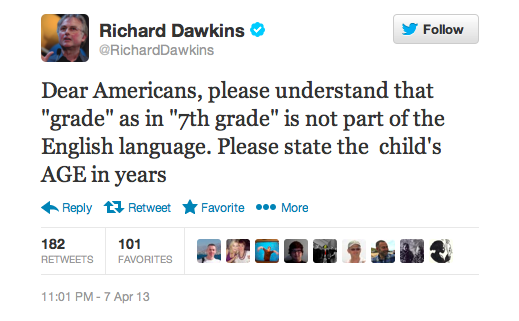
Dawkins on 'not English'

You know, Richard Dawkins is a clever chap, I think he writes well and I've enjoyed many of his books. But sometimes he says such stupid things, it's like he wants people to misunderstand him.

Take this tweet:
'Grade' as in '7th grade' is not part of the English language
I mean, honestly, what a thing to say. He's making a perfectly good point, namely that if you're writing for an international audience it's more useful to state the age of a child in years rather than using a US-specific system. (In fact, because in the US children can skip or repeat a year in school, it is sometimes relevant to refer to the stage in their education that the child has reached. However, for the majority of children, this is not the case.) He clarified this, along with the statement that for a US audience, he has no problem with referring to grades. None of this is controversial.

So why on earth did he put it in such a stupid, guaranteed-to-cause-a-row way? Does he like getting into fights so much that even innocuous opinions must be stated in a controversial manner?

The bit I'm referring to, if it's not blindingly obvious, is the bit where he says that 'grade' is 'not part of the English language'. It... but... it... well, it obviously is. How can it not be? American English, or the collection of dialects of English spoken in that part of the world, are most definitely English. And if 'grade' (in this sense) is part of at least some of those dialects, then it is part of English.

It's possible that Dawkins was using some rather unusual definition of English. If you take any English speaker, let's say me, then we can agree that I speak English, I hope. And if you take another English speaker, let's say Richard Dawkins, then we can also agree that he speaks English. And so on and so on for any English speaker in the world. But our two Englishes are not precisely the same. In the case of me and Dawk, they're not far removed from each other. We're both speakers of British English dialects, although his is a bit more old-fashioned than mine. But if you compared Dawk and a teenage speaker of English from, say, California or South India or Grenada or Kiribati, then you're going to find a few more differences between the dialects. One might, then, wish to say that something is only 'English' if it is found in all dialects of English. This is a silly way to define English because it leaves you with about three words and a smattering of grammar and no sounds with which to pronounce them (I exaggerate, of course, but not much).

You can say the opposite, and say that something counts as 'English' if it is found in at least one English-speaker's dialect. But then you run into trouble defining English, as it can get a bit circular. You could also say that there is no such thing as English, merely a collection of idiolects (personal dialects) which converge with each other to a greater or lesser extent, some of which are mutually intelligible and some of which are not. Some people do say this, I think, but it's a somewhat extreme position to take. It's largely a philosophical problem, and for practical purposes one usually needs to define English in some partially arbitrary way. On any of those definitions, American English still counts as English and Dawkins is being a numpty.

Friday, 8 March 2013

Pub crawling

There's a game for various iDevices called The Simpsons: Tapped Out, in which you have to rebuild Springfield. It's good; I'm obsessed. 

Every now and then it gets seasonal updates, and today it got an update for St Patrick's Day, which seems to be a bigger thing in the US than it is in England, where no one particularly cares about it. (I expect they do in Ireland.) Anyway, in the game, to introduce the new storyline, Homer says this: 


Notice that he says 'The day we all pub crawl to celebrate St Patrick', using 'pub crawl' as a verb. This strikes me as ungrammatical. I'm quite fascinated by this because 'pub crawl' must certainly be a British expression, borrowed into US English for the purposes of British-style (or perhaps Irish-style, in this case) pub crawling. It's my impression that in US English, the usual term for a drinking place is a 'bar'. We do use this word in UK English too, but it's not used for the more traditional pub-type places, only for the trendier type of establishment. And of course it is the place in a pub where one is served.

So what of this 'pub crawl' verb then? Well, the origin of the expression is clear: a compound noun was formed from a zero-derivation of the verb 'crawl' plus the thing that is crawled, to indicate an occasion of 'crawling' pubs. Zero-derivation is when you change the category of a word without changing its form, and is fairly common in English for the purpose of verbing nouns and nouning verbs. This noun 'pub crawl', however, seems to have been zero-derived back again into a verb in Homer's idiolect. I don't think compound nouns are very commonly turned into verbs at all in English: we have lots of compound nouns from verbs, like tin-opener, but hardly any verbs ('babysit' is an example, backformed from 'babysitter'). In fact, Homer seems to be particularly fond of them. In my morphology class, I use an example from the Simpsons of a very rare instance of a process called 'noun incorporation', and this is an exactly comparable example, also spoken by Homer:
Did I ever tell you about the time I babyshot my boss?
Here, the instrumental noun 'baby' is incorporated into the verb, giving a complex verb 'babyshoot', meaning 'to shoot someone via one's baby'. What I want to know is who in the Simpsons writing team is putting these verbs into Homer's language? I'm a big fan of their work, whoever they are.

Wednesday, 26 December 2012

Is Coldplay singular or plural?

A good example of the variation permitted between singular and plural for semantically plural but grammatically singular entities like bands in (British) English:


Here we have 'offends' with the singular agreement, and in the very same sentence the plural verb 'are' (contracted to 're).

We also have a pronoun 'they' which can be used for both singular and plural referents, at least in colloquial usage and probably in many formal registers too. However, it's prescriptively plural, and this can affect its usage in funny ways. For instance, it's unusual to hear 'themself' and spellcheckers don't allow it, even when referring to a singular antecedent in a sentence like 'a student has left their file here. They'll be kicking themselves later'.

It's impossible (for me, at least) to refer to a band as 'it'. This is a bit surprising seeing as a band can be singular, as noted above. I don't know the reason for this. But it means that we have to use 'they' and we have a singular verb 'offends' in the tweet above, followed by the frequently singular 'they', followed by the plural 'are', all of which should be one or the other. But because at no point is there a mismatch between two adjacent items, the long distance mismatch comes out just about ok. 'They' mediates between the singular and plural verbs and both are deceived into thinking they're in the right number form.

Friday, 21 December 2012

What came upon a midnight clear?

On Thursday, Jeremy Paxman asked this question in the Christmas university challenge: 'according to the carol, what came upon a midnight clear?'. Stephen Bayley, who as my parents noted made a bit of a tit of himself otherwise, correctly said 'it'. This was not accepted as the right answer, however. What Paxman wanted was 'that glorious song of old'. Here's the lyrics:
It came upon a midnight clear,
That glorious song of old
'That glorious song of old' is, in fact, the understood subject of the preceding clause. But it's extraposed (put outside) and the grammatical subject is 'it'. 'It' stands in here for a subject that is too long or (in this case) doesn't scan in the usual subject position.

Harsh, Paxo, very harsh.

UPDATE [23/12/12]: One of the twitterlinguists, @drswissmiss, pointed out the following:
And she is, of course, correct. As I was typing the post I was thinking about the status of it - and one thing it isn't is an expletive. An expletive subject is something that English (among other languages) does when it just needs to fill in a gap. If you take a suitably seasonal verb like snow, then in Italian you can say nevica, 'snows', whereas in English you need to say 'it snows'. What snows? Nothing snows, and the Italian reflects that by not requiring a subject. English has this thing that it has to have a subject, so it bungs in this meaningless filler it. There does the same job in There's no easy way to say this, and you can check: it's not felicitous to ask 'Where's no easy way to say this?', so you're clearly not referring to a place when you say there.

But in the carol, something did come upon a midnight clear: the glorious song of old. So it is not an expletive it, it's a referential pronoun (i.e. a pronoun that refers to an actual thing rather than being a filler). That's why I called it extraposition in the original post. But that's not the full story. Because it does refer to the noun phrase 'that glorious song of old', we can say that it is co-referential with it (it refers to the same thing in the world). This is right-dislocation (putting some noun to the right of where it would normally be). When you do right-dislocation, you leave behind a pronoun to fulfil the grammatical requirements of the language (English's afore-mentioned need for a subject of some kind) and to point you in the right direction to get to the real subject.

You can also get left dislocation, which is pretty common. In some of the Romance languages it's called clitic left dislocation because the noun is moved to the front and a 'clitic' (a kind of pronoun which has certain special properties) is in the place where the noun 'should' be. Here's Spanish (example from Karlos Arregi's paper here):

Estos libros, Juan los leyó ayer.
These books, Juan read them yesterday (literally 'Juan them read'). 
The object of the verb is estos libros 'these books', but it's fronted. This often has the effect of making the noun into a topic or the focus of the sentence. In English we usually do this to contrast with something else ('these books he read, but those other ones he hasn't started'), but in Romance languages it's used for more purposes. Some languages, known as topic-prominent languages and including many (or all?) sign languages, put the topic of every sentence at the beginning (usually without a clitic though) simply to indicate that it is the topic of the sentence.

Back to the carol. I don't actually know enough about the syntax of dislocation to say whether the dislocated noun phrase is 'really' the subject of the clause. There is some evidence that the pronoun and the noun phrase are connected in this type of construction: for instance, if the language has case inflections on nouns, they may have the same case ending. (Non-linguists, move on to the next sentence; for linguists, here's a thesis chapter arguing that the pronoun in Czech left dislocation is a spelled out copy of the dislocated element.) OK, non-linguists, back in the room.

To settle this question once and for all, I'm going to refer to playground logic:
'Antidisestablishment' is a very long word. How do you spell it?
Answer: I T.  

Monday, 29 October 2012

A @name

Twitter has a search bar thing and in it, it says "enter a @name or username". Now, I've been pronouncing @name as "at name", because that to me is an "at sign". I don't know if twitter is calling it something else. That's what the article "a" rather than "an" suggests. But what could it be calling it?

In other languages, it's called things like "monkey tail", "elephant's trunk", "little dog", "snail" and other animal-based names reflecting its shape. But in English it's really only called the "at sign".

So twitter, why you no obey phonological rules?

Monday, 30 April 2012

Think foreign, think rational

Well this is weird. Apparently, if you think in a foreign language when you're making a decision, you're more likely to make a rational, deliberate choice than to go with your gut instinct.

The premise is that these two contradictory scenarios are both plausible, so which one is right?:
  1. Thinking in another language takes up cognitive power, so there aren't enough little grey cells left for decision-making, and you go with your gut.
  2. Thinking in another language forces you to think quite consciously and deliberately, so you don't have as much freedom to make impulsive choices.
The experiment was based on Daniel Kahneman's famous study of framing: people are presented with a problem which involves them having to make a decision about saving or losing lives. There are two options, one of which means saving 200 out of 600 lives and the other means taking an all-or-nothing chance which will either save everyone or no one. Most people play safe and save 200 people. The framing part is that it's also presented in terms of losing lives, in which case they can either lose 400 out of 600, or take the all-or-nothing chance. Now most people prefer to take the risk. (Well, wouldn't you rather be the person that tried to save all the lives than the person who deliberately killed 400 people? Never mind that the person that chose to save 200 people was doing exactly the same thing.)

This means that people fluctuate wildly depending on how the problem is worded (framed), and allow their emotions to make illogical decisions when faced with a really hard choice. If you could remove that element of 'gut instinct', people would make the same choice each time (whichever choice it was). So if 2 above is right, this fluctuation should disappear or be much reduced. If 1 is right, it should remain.

In this new experiment, the same scenario was presented to groups of people in their first language (English) or their second language (Japanese). Graph a shows the number of people who chose the 'safe' option (chose to save the 200) in English and in Japanese. The black bar is when it's framed as saving lives, the grey when it's framed as losing them. You can see that in Japanese (L2), the number of people choosing that option remained constant, showing that they made more conscious, deliberate choices in their second language. (Graph b shows another similar experiment done on Korean speakers who'd learnt English, giving the same result.)

They even tried it with a small-risk, real-life experiment to see if it was the same, and in the process proved just how stupid people are. They gave students who had L1 English and L2 Spanish $15. For each dollar, the choice was to keep a dollar, in which case they had a dollar, or to gamble it. They might lose it, but if they won, they would get their original dollar back plus $1.50. So there is a very short-term risk, but the risk is low and the payoff worth a gamble, surely. And there's the added fact that if you gamble all your $15, you're pretty much likely to come out a couple of dollars better off. If you win nearly half the time, say 7 times out of 15 bets, you'll lose $8, but you'll win $10.50, leaving you with $17.50. Only 54% of students took the bet when it was presented in English, but when they had to use their second language, 71% of them did.

This shows that students aren't good at maths, and that people are really really scared of risk and will make irrational decisions in order to avoid it. Reduce their irrationality, and you get less risk-averse and more logical students. But then, why would you want that?

Friday, 27 April 2012

Special objects

Sorry for the proliferation of sign-related posts this week, but I keep seeing them. There's this sign in the lavs in the building where I work:


As you can see, it's an instruction to ladies to throw sanitary products in the special sanitary bins, not down the loo (if they really want us to do that they should provide more than one bin and put them inside the cubicles instead of outside). It tells us that in English, Chinese and Arabic, because it's in the school of modern languages and there are lots of Chinese and Arabic students about.

It also tells us the same again in English, with different wording. It's considerably more polite and almost affectionate in the wording ('please dear ladies') than the first English text, and it also differs in using the euphemism 'special objects'. It has one error in it, using singular 'it' to refer back to the plural 'special objects', although this doesn't necessarily mean it was written by a non-native speaker. Otherwise, there is nothing wrong with the English versions that couldn't be fixed with a couple of punctuation marks.

But WHY are there two English versions? My guess is that the second is a translation of the Chinese. I really don't know why this would be the case, but that's how it reads to me. I think the English was written first, then translated into Chinese (and Arabic) and then, for some reason, translated back to English. I'd love someone who reads Chinese to tell me if that's true.

Alternatively, the second English text might have been written first by a Chinese speaker, and then some native English speaker told them it was a bit polite for a sign and rewrote it in a more 'English' way, and somehow both ended up being used.

(By the way, I've assumed Chinese simply because there are a lot more Chinese students in this school than Arabic, so it's just a probability. The above could equally apply to Arabic instead.)