Showing posts with label swearing. Show all posts

Friday, 1 May 2026

Literally non-literal, when literally asked about literalness

Someone on Reddit was trying to identify the fibre their yarn was made from, and someone suggested burning a bit of it since burning hair/wool has a very distinctive smell, while acrylic yarn will melt. The following conversation ensued after this burn test was carried out. 

OP: It did in fact smell like ass. 

Commenter A: I am not being sarcastic when I ask this: do you guys mean literal ass? Or does it have a specific smell thats just bad

Commenter B: They are being quite literal. Burning wool and hair smell awful. 

As further comments noted, if your literal ass literally smells of burning hair, you have issues to deal with that are more pressing than what your yarn is made of. Commenter A is clearly asking whether the smell is the same smell as that of ass: in other words, is like ass to be taken literally as meaning the same as ass. Commenter B meant something like 'The apparently extreme description of the badness of this smell is not an over-reaction; it really is very very bad and the intensifier 'literally' is appropriate here'. In other words, they meant that like ass was to be taken literally as meaning as bad as ass

I suppose it's not dissimilar to the phrase He works like a dog: it could mean that he is easily distracted, highly motivated by treats and responds to whistling (=the same as a dog), but more likely means that he works hard for little reward (=as much as a dog). 

Monday, 18 July 2022

Performing a flying fuck

At our students' graduations this week, a colleague told me about a (non-canonical) ballet step which, because of the particular way that it's performed, is called the Flying Fuck. 

(As an aside, we had a conversation about how many of the names of dance steps are bodily, sexual or generally risqué, something that is also true of one of the types of dance that I do.)

So as you probably know, there is an expression, I don't give a flying fuck. It means that you don't care at all. For anyone who's using this blog to learn English (ill-advisadly, maybe), it's pretty rude so go carefully. 

In this expression, a flying fuck is what linguists would call a Negative Polarity Item or NPI. These are words that don't sound grammatical in a sentence without a 'licensor', often a negation, hence the name. So we can say (1) but not (2), where there is no negative word in the sentence to license the NPI and it sound really weird: 

(1) I don't give a flying fuck about his career prospects. 

(2) *I give a flying fuck about his career prospects. 

There are actually more licensors than just negation. Lots of NPIs can be licensed by expressions like exactly two. We can see this with another NPI, any

(3) *Some people have eaten any salad. 

(4) Exactly two people have eaten any salad. 

NPIs are tricksy and puzzling. There are several different theories to explain why they work the way they do, all of which are appealing in some way, and none of which quite satisfy completely. For example, some theories of how NPIs work predicted that flying fuck would not be licensed by exactly, as it's what is sometimes known as a 'minimiser', but it actually sounds ok to me: 

(5) Exactly two people give a flying fuck about his career prospects. 

I think this fact would be predicted under what seems to me to be the most widely-accepted (current) idea, however, which is known as 'non-veridicality' and is essentially about (4) being more specific than (3), though in more technical terms than that. 

But especially interesting to me is the fact that because this is the name of a ballet step, the exact same expression can completely lose its NPI status, and doesn't need licensing at all: 

(6) They performed a perfect flying fuck.

(7) The dance opens with a flying fuck. 

I like this sort of almost-literal interpretation of the expression to repurpose it for the name, at which point it becomes just a bog-standard phrase like any other. 

The literature on this is very fun to read, by the way, because it's full of phrases like I don't give a flying fuck so I recommend it. 

Monday, 28 June 2021

Would the heckers like

I'm not sure if this counts as an eggcorn, which is a phrase that is reinterpreted based on some apparent meaning. It can often reveal some aspect of a speaker's accent or grammar that can be interesting to a linguist. One I like is 'taken for granite', an eggcorn for 'taken for granted', partly because for me this is nowhere near phonetically similar. This one is famous enough that people use it to make jokes, like the cartoon Rick and Morty, and I've written about it before

The reinterpretation makes sense, because it could be something like 'set in stone' (hence granite), and it shows that some varieties have several phonological things that I don't, such as the quality of the first vowel being identical in those words, and the reduction of /nt/ to /n/, and something about the final sound as well. 

So I don't know if this is an eggcorn or just a more general kind of reinterpretation. This image of a wind turbine with wilting sails comes with a caption saying,

I told em, you gotta water these things every day, would they listen? would the heckers like

Image of a wind turbine with drooping sails, and the caption 'I told them, you gotta water these things every day. Would they listen? Would the heckers like.'

The phrase, as I understand it, is Would they heck as like. Therefore, the reanalysis here is from something that means 'They would be as likely as heck to do that' to something like 'The heckers wouldn't do that'. 

A bit more formally, the original is Would they [heck as like] where [heck as like] is an expletive replacing the verb listen - compare Would they fuck, or Would they my arse. The reanalysis (assuming this is the right way round!) is Would [the heckers] like, where heck is part of the subject the heckers (compare the fuckers), the verb is just elided (not pronounced because it's understandable from the previous phrase) and like is a final particle giving something like emphasis. 

This only works if you typically reduce they quite a bit, and also if you have a non-rhotic accent (don't pronounce the 'r' in heckers). I suspect the former is more likely if you also drop the h so you get a glide between the and 'eck(ers), but that is just my speculation. Oh and also it relies on the extreme flexibility of expletives and their ability to work as any part of speech! 

Tuesday, 18 April 2017

Let's go Fuckoffee

I went to London last week and walked past this coffee shop, which I had heard of because it pops up on google maps. It's called Fuckoffee. (Incidentally, I've cropped out a woman wearing the same yellow leather jacket that I've got - she can fuckoffee an' all.)


The name is obviously intended to capture attention by incorporating a swearword. It works - I haven't heard of any other random coffee shops in London. But it's also a clever pun that only works if you have the exact non-standard thing that I'm researching right now: a missing preposition!

If you have the standard version of what I'm talking about, you'd say
Let's go to Costa 
or
Let's go to Fuckoffee
when you were suggesting coffee places to go to. But if you have this non-standard form, which is found in London and in various other UK places, it means you can miss out the preposition to when you're talking about certain locations or institutions, such as a familiar coffee shop. So you might say
Let's go Costa
or
Let's go Fuckoffee
which, for most people with a native London dialect, will sound exactly like Let's go for coffee.

Saturday, 14 January 2017

On the rudeness of 'bint'

Last November I read The Goldfinch by Donna Tartt. It was really good, incredibly readable (I whizzed through it) and engaging and moving. That's the book recommendation; from here on in there's very bad language so stop reading now if you don't like that.

Here's a bit of the text from the book:

As you can see, Boris uses the word bint, which is unfamiliar to the main character Potter. When he asks what it means, Boris (who is Russian and very linguistically adept in various languages including English slang) says 'Same as a cunt, basically'. This book is set in the USA, so maybe things are different there, but the two words definitely do NOT mean the same to me.

Cunt is so rude that I never say it (unless I'm writing a blog post about it...). I never say bint either, but it's extremely familiar to me from growing up in Newcastle, where it's an everyday part of the language. It really isn't taboo; children say it, adults say it around children, it's not frowned upon as a 'bad word'. The only reason I never say it is that it feels very derogatory towards women. It's generally used in a critical way, and often in a phrase like stupid bint. It doesn't feel affectionate to me. It's from Arabic (I only just found this out) - the same word means 'daughter' in Arabic. According to Wiktionary, the Yemeni community in Tyneside meant that it entered the dialect in that area, and it supports my sense that it's pejorative, as does the OED, which notes that it entered English from the language of British servicemen in Egypt in the two world wars.

But it's really, really not as taboo as cunt, I promise. The OED has the difference between the two as being 'colloq.' versus 'coarse slang'. Cunt is often cited as the most offensive swearword in English. This Independent article reports on a study that puts it in the top three. And yet, somehow, I dislike bint more, because it has this added sense that the pejorative sense comes from the femininity of it: it's an insult because it's a word for a woman, rather than because it's used towards one.

I should say that I'm talking about Standard English. It is true that for some people, cunt is an extremely common word, used all the time, and not used offensively. Among friendship groups it may be used as an affectionate or neutral term for other members of the group. And in Glaswegian dialects it's commonly used in an entirely neutral way, classed as a pronoun by my linguist friend Gary Thoms. Here's a video he shared with me, illustrating exactly this (and note that this usage frequently escapes the censors, because of a mix of the non-aggressive use and the accent):


Thursday, 17 March 2016

Covert swearing

Following on from my last post about mishearing words in connected speech, here's an example of when I deliberately do this: covert swearing.

Covert swearing demonstrates that the taboo of swearing is not about the words themselves, or at least not the sounds of those words. I frequently utter the very same string of sounds found in the worst swearwords, but it's not swearing. We all do it, in fact: it's just that I do it on purpose. I don't know why I do this, but I find it amusing in a daft way.


To ease you in to the idea with an example that is inappropriate but not actually swearing, I'll always say penis instead of pianist. They sound more or less the same. Once you've smooshed together the vowels (basically, you don't really pronounce the second vowel in the first syllable of pianist) it's just a matter of reducing the consonant cluster at the end, which you might well do in connected speech anyway. I don't think people notice me doing this, or if they do they don't let on. I therefore sometimes say to people that Elton John is a penis.


More inappropriately again, when I say if I can... I'll more often than not reduce the initial vowel to nothing, and the second and third ones to schwa, so it sounds like /fəkən/, or in other words exactly the same as fucking (try and just pronounce the consonants and you'll get the idea). I'm almost certain people don't notice this, or they would surely say something. 


And so on. Nice demonstration that words are not just sounds: there has to be deliberate intention to say some particular word as well as the correct string of sounds. And in fact, the sounds can be extremely different from the carefully-pronounced version, as long as the intention is there and there is enough context to allow understanding. See this old post for an example. This is also why every now and then there's a toy-swearing story in the newspapers. 


I'm going to have to stop doing it now I've revealed it, though, else it'll feel weird. 

Monday, 6 January 2014

Another Sweary Blog Post

A fellow linguist tweeted (ages ago):


To me, this is ungrammatical. For me, the pattern goes like this, where the asterisk next to (4) means it's ungrammatical:

  1. Answer some emails
  2. Respond to some emails
  3. Answer the fuck out of some emails
  4. *Respond to the fuck out of some emails
Answer and respond are a pair of verbs that have nearly identical meanings but behave differently in terms of their syntax. Answer needs a noun phrase complement like some emails, while respond also has to be followed by the preposition to. The structure is nearly the same in both cases, where the verb has some kind of phrase as its complement (that's what the brackets mean):
[answer [some emails]]
[respond [to [some emails]]]
If we add in the emphatic the fuck out of, then the fuck becomes the object of the verb, and we get something more like this:
[answer [the fuck] [out of [some emails]]]
It should be understood as meaning that the fuck, whatever it is, is the thing that is removed from the emails due to their being answered so comprehensively.

So if, like for the tweeter, it's grammatical with respond as well, then we must have an identical construction: the fuck is the complement of the preposition to, and we've got this:
[[respond [to the fuck]] out of some emails]
But for me, respond to the fuck doesn't work so well. It doesn't even have the idiomatic meaning of 'doing something so well it removes all the fuck from it', which we saw above. out of some emails has to be an adverbial phrase, I think, being something the location of the whole action. You'd have to respond the fuck out of some emails, and in fact that is much more acceptable to me.

Monday, 21 January 2013

Ian McMillan and arse

Ian McMillan, the poet, does a lot of stuff on the radio about language. He's keen on accents, particularly Yorkshire ones, and recently I listened to a programme from August in which he tootled about in search of an isogloss; specifically, the house/arse isogloss.


As the blurb notes, an isogloss is 'a kind of linguistic boundary line where accent and dialect changes'. Of course isoglosses are not fixed and absolute, so McMillan's early desire to hear someone stand on one side and say 'house' and stand on the other side and say 'arse' is doomed to remain unfulfilled.

The main point of the programme is that (according to McMillan) in some parts of South Yorkshire they pronounce 'house' as 'house' and in others they pronounce it 'arse'. That's /haʊs/ versus /a:s/, in the International Phonetic Alphabet that linguists use to represent sounds. (In fact, when McMillan says 'arse', it's more like /ɑ:s/, as it is for most southerners. However, he consistently pronounces it with a long version of the vowel in 'man' when he's imitating the pronunciation. Think Jim in the Royle Family.) You'll note from the symbols used that although the two words seem very different, all that's happening is that the 'standard' version has a diphthong (two sounds) and the 'arse' version simply ditches the second sound of the diphthong. We can call it monophthongisation, if we want to win at Scrabble.

McMillan is off, with a musician friend and a local linguist in tow, to try to find these people with 'one of Britain's strangest linguistic features' (I can assure you, it's not even close to that honour). What follows is a lot of highly unscientific questioning of bemused pensioners outside the post office as they turn up to collect their pensions. One, when McMillan asks him if he says 'arse', says 'no, I wouldn't like to swear'.

Anyway, there's a bit of linguistics in there, as we learn about isogloss maps (though it would have been good to follow up with an explanation of how they're drawn and why the line on the map is an idealisation of reality, and why you can't really find it in the real world). McMillan gets a bit mixed up at times, thinking that at the isogloss he should find people who say 'arse', whereas the isogloss is the border. It's precisely there that he might not find them - if he wants those, he needs to look in the heart of the area enclosed by the isogloss. The linguist says that it's likely to be old people who have this pronunciation, and it would have been nice to have been told why that is. But McMillan is a powerful character and most of the time must necessarily be given over to his impressions of other Yorkshire accents, which he clearly enjoys doing.

Something that struck me was that when McMillan was taking care to say the two different pronunciations properly, he would pronounce the /h/ on the 'house' version, and yet when he said it in his normal speech he very often didn't pronounce the /h/ (as is common all over Yorkshire). Even more interestingly, he sometimes merged the two vowel sounds a bit, and sometimes sounded very much like he was in fact saying 'arse', despite claiming to say 'house'. I'd really like someone with a bit more phonetics ability than me to check that he really does say 'house' when he thinks he does.

In the end (spoiler alert), they end up finding people saying 'arse' much further north than they expected (Hillsborough), and McMillan is happy he's found them and all is well. It's an entertainment programme, not a documentary, and we should take what we can get when it comes to linguistics on the radio. Worth a listen, if you're at all interested in poets from Barnsley saying 'arse' at pensioners, peppered with gobbets of linguistic stuff.

As an aside, I noticed an interesting pronunciation of 'house' the other day. McMillan is a Yorkshireman so he wouldn't set foot in the north-west, of course, but Stuart Maconie happened to say the word in a conversation with Mark Radcliffe on their BBC6Music radio programme. They were discussing the MediaCityUK complex in Salford, from where they broadcast, and mentioned the television building, which Stuart called 'Telly House'. He pronounced 'house' like 'ice' (/ɑɪs/ in IPA). I don't know where that's from. According to Wikipedia, Stuart's from Whiston in Merseyside, hung out in Wigan as a youngster, and now lives in Birmingham, and of course he spends every weekday afternoon with a load of Lancashire folk. It could be any of them. Perhaps if I tweet him this link he'll let me know what he thinks.

Friday, 16 November 2012

Getting overexcited and swearing

We all know that linguists love to swear and lecturers love to shock their new students, so yesterday in my introductory lecture on morphology, I had the students try to work out the rules of expletive infixation. That's when you do this:
fan-fucking-tastic
abso-bloody-lutely
Now obviously the students found this completely hilarious and had a whale of a time swearing at the tops of their voices in the lecture. At one point I though the neighbours might come round to complain.

Importantly, though, as well as swearing a lot, they actually got on and did the exercise, and did it well. It stands to reason that the best way to get them excited about and interested in a language data exercise is to make it be about something they find interesting in the first place. Earlier in the week, they'd had to do the same type of exercise, working out how noun pluralisation works in Armenian and Spanish, and they did not like that so much. They did it, and made a decent job of it, but they clearly didn't find it exciting in the same way.

Partly this is natural, but a true linguist also gets excited about noun pluralisation rules. We find it REALLY COOL that there are rules about how this stuff works, that native speakers of a language don't know about consciously, but do perfectly subconsciously. We love to find out what the rules are and try to understand this magical language ability that allows us to communicate with each other so effectively. The rules for doing language could be anything in the world, but they aren't! They're consistently of particular types, and some other types of rule are just never ever found anywhere.

I notice the same issue when I give talks to non-syntacticians. What I'm presenting is obviously fantastically exciting stuff - there's this real issue that is there, and needs explaining - and yet it doesn't seem to excite everyone in the same way. How can we get across that this is really fascinating? Why doesn't everyone appreciate just how amazingly brilliant language is?

Monday, 20 August 2012

Pussy Riot and swearing in the media

The other day, Ben Zimmer at Language Log covered the way that Pussy Riot (the name of a Russian punk band currently in the news) can be rendered into Russian (the band is Russian, but the name is in English). Then Arnold Zwicky blogged about the way that the New York Times is coping with having to write naughty words in its articles. He takes this Guardian blog post as a jumping-off point.

I was wondering about this myself. The thing is that it's a sort of pun, or at least a double entendre. It's what the whole point of Mrs Slocombe was in 'Are you being served':


So that means that the word itself can be said quite freely without causing offence, provided that it means 'cat' rather than... its other meaning. After all, here it was being said on a pre-watershed sitcom as long ago as the 1970s. But as Zwicky notes, the 'cat' meaning is pretty much non-existent these days. We all know it means that, but it's rarely used to mean 'cat' (perhaps because of its rude meaning). Furthermore, the band presumably mean it to have its naughty connotations, as they're a punk band and that's what punk bands do. They have a handy get-out by being able to say that it's simply a name about cats, which is apparently what they told the police it meant. So if the word is ambiguous, and has these two separate meanings, does it mean the rude one if that's what its authors intended it to mean? Does it mean 'female genitalia' here? Or is it a word that can mean that, but not necessarily? I don't know. I kind of feel like it does.

Anyway, according to the blog posts mentioned above, the US papers are struggling a bit and basically not banning it, but trying not to mention it more than absolutely necessary, and definitely not in headlines. From what I can tell, in the UK, the media are more than happy to use the name in the papers, on the radio and on TV (and everywhere else). This means that the lovely lunchtime newsreaders have to say 'pussy' quite a lot, and are essentially using rude words in the news.

Monday, 16 April 2012

Fuckin A and the importance of commas

I saw this image on the internets illustrating this poor chap's inability to use commas (and knowledge of the difference between the spelling of comma and coma, an important distinction). 
After sniggering at the inappropriate mental image, I actually had trouble working out what the original meaning was. The comma is supposed to go after I have to watch him, I think (although a full stop would be better, probably), so 'Robby' has to watch his grandpa tonight. Then he says fuckin a man, tonite is gunna suck.

Well that's odd, I thought. Surely, if I know anything about anything, fuckin a is short for fuckin awesome (sorry about the inordinate amount of swearing in this post, by the way). And you would not be saying that it was awesome if you then said it was going to suck. Which he does. It's sarcasm, I suppose, but I missed it because people like this are not normally known for their use of sarcasm (by 'people like this' I'm generalising horribly over all people who write like this, but it's true).

So I looked it up on Urban Dictionary, because that's where you get incomplete and inaccurate information about colloquial expressions, and it said that it does stand for awesome, but that you can use it whether the situation is good or bad. The entry never mentions the word 'sarcasm', though, so I wonder if it's not sarcasm but in fact just generalisation or broadening of an expression from an exclamation of pleasure to an exclamation of any strong feeling. Knowing the intonation would help, but as I don't associate with teenagers I can't say it's a usage I'm familiar with in real life. Or irl, as the internet would say.

Sunday, 19 February 2012

Grammar... sort of.

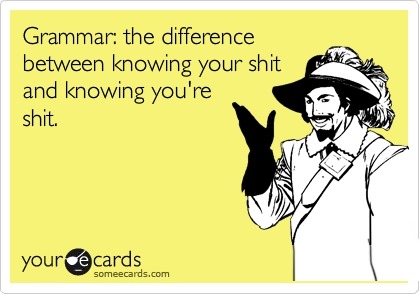
Ok, so like, I am not a prescriptivist, blah blah blah, but I do tell people how to use apostrophes for a living, so I found this momentarily funny. 
But then I found it annoying because that ain't grammar. It's punctuation, and perhaps also spelling. If it was grammar, people who make this mistake would be genuinely mixing up
CP[2.sg BE.pres.sg shit[ADJ]] (a clause with a second person subject, the copula and an adjectival complement)
and
NP[2sg.poss shit[NOUN]] (a noun phrase consisting of a possessive second person determiner and a noun).
Methinks they are not. They just don't know how to spell the right version of two homophonous but otherwise distinct forms.

That's how to kill a joke.