This exchange appeared in my facebook the other day. I don't know any of the people involved, and as always, I'm just commenting interestedly, not making fun or criticising them.
The image shows a conversation in response to someone mentioning 'practicing', with that spelling. Assuming that things haven't changed since I learnt this, that's a valid spelling in American English. British English would traditionally prefer 'practice' for the noun (as in We went to practice tonight) and 'practise' for the verb (as in Are we practising tonight?). In practice (ha!) this is very variable and it's probably one of those things that's on the way out really, and both spellings can do both jobs.
What interested me about the above, though, is that even though 2 out of the 3 people having this discussion obviously care about this spelling rule (otherwise they wouldn't be discussing it), they don't seem to be very clear on which it should be.
Person 1 says 'practicing with a c, though' indicating that they know it's spelt incorrectly, and sharing a link to that effect. Person 2 doesn't really notice the spelling comment (unless I'm missing some more subtle joke?) and comments on the content of the original post, spelling it with an 's' for both the noun and the verb (Some sides don't practise [verb] wilst half drunk, so it could well be 'intoxicated dance practise [noun]' for a newbie...). Then Person 3 brings it back to spelling and quotes the rule, presumably in response to Person 2 as much as the OP, to which Person 1 replies, agreeing, and saying I think it's nicer to think of it as morris 'practice' rather than 'practise'. I realise it's incorrect :).
But it's not incorrect! Both spellings are right depending on which 'morris practi{c/s}e' is intended (noun or verb). And here, the commenter is probably actually correct, because with the pre-modifying 'morris', it is far more likely to be the noun, so 'practice' is the right spelling to use.
And – most baffling – why is it 'nicer to think' of it with a 'c'??
Showing posts with label American English. Show all posts
Monday, 29 July 2019
Monday, 16 June 2014
English and American
I happened to be on a site where someone had asked what the difference is between Parmesan and Parmigiano-Reggiano (which are the same thing), and they got this answer:
The thing that makes me have to stop and re-read it is of course that I'm interpreting English as the language, while the writer seems to be treating it as the country, and simultaneously conflating England and Britain/the UK. I know that to people in other countries, it doesn't seem very important that England and Britain are not the same thing (in Britain, we do a similar thing with Holland/the Netherlands) and furthermore, there is no adjective relating to the UK (UK-ish?), which would really be the more correct name anyway (to include Northern Ireland). But to me, England and the UK are not at all the same thing, and it is odd to say that something is English when it's clearly also British. This is a pragmatic implicature: you should give as much information as you are able, and here you're withholding some information (namely that the term is also used in other countries). And then what about Canada, Australia, Ireland and so on? Surely it's better to refer to English as a language here than to be unnecessarily specific about countries.
But I think there's more to it. Look at how it says 'English and American translation'. Most Americans are not idiots, contrary to the national stereotype that we like to believe in, and they know that they speak English rather than American. But a mixture of strong patriotism and some genuine confusion (actual people I know have been asked what language they speak when visiting America) means that it's sometimes tempting to write 'and American' to avoid people thinking you're just talking about England. I think many people probably do half-think of American as a language, even if they know that it's English really. And, of course, we might classify it as a separate language, if we so chose: language boundaries are not only determined by mutual intelligibility, as any linguistics student knows.
Parmesan is the English and American translation of the Italian word Parmigiano-Reggiano.This isn't the first time I've seen something like 'the English and American word for X' or similar, but it is jarring to me.
The thing that makes me have to stop and re-read it is of course that I'm interpreting English as the language, while the writer seems to be treating it as the country, and simultaneously conflating England and Britain/the UK. I know that to people in other countries, it doesn't seem very important that England and Britain are not the same thing (in Britain, we do a similar thing with Holland/the Netherlands) and furthermore, there is no adjective relating to the UK (UK-ish?), which would really be the more correct name anyway (to include Northern Ireland). But to me, England and the UK are not at all the same thing, and it is odd to say that something is English when it's clearly also British. This is a pragmatic implicature: you should give as much information as you are able, and here you're withholding some information (namely that the term is also used in other countries). And then what about Canada, Australia, Ireland and so on? Surely it's better to refer to English as a language here than to be unnecessarily specific about countries.
But I think there's more to it. Look at how it says 'English and American translation'. Most Americans are not idiots, contrary to the national stereotype that we like to believe in, and they know that they speak English rather than American. But a mixture of strong patriotism and some genuine confusion (actual people I know have been asked what language they speak when visiting America) means that it's sometimes tempting to write 'and American' to avoid people thinking you're just talking about England. I think many people probably do half-think of American as a language, even if they know that it's English really. And, of course, we might classify it as a separate language, if we so chose: language boundaries are not only determined by mutual intelligibility, as any linguistics student knows.
Friday, 11 April 2014
It's the last day of term today! That means no more teaching for this year. Wow. In honour of this, we had a party for our students on Wednesday which was really fun:
I also learnt something interesting. We use the term 'fresher' colloquially to refer to a first year student, particularly when it's the start of the year and they're arriving for the first time (so you have a freshers' fair, etc). I always assumed it was a shortening of the American term 'freshman', which we don't use here but which is totally standard over there. Turns out that maybe it is, but they don't use 'fresher' there - only the full form. So it seems like we somehow borrowed a clipped form which doesn't exist in its original context without ever borrowing the full form.
Monday, 17 March 2014
This 'public service announcement' exists:
Why on earth would it be Patty rather than Paddy, I hear you ask? Well, it's a simple case of homophony. Two identical-sounding words, one pronunciation, confusion abounds.
What's that? They're not homophonous? Not to you, maybe. Yer average British English speaker will pronounce these with a /t/ and a /d/ respectively, or possibly a glottal stop instead of the /t/. Yer average American, on the other hand, will have what's called a 'flap' or 'tap' instead of the /t/, and this sounds so much like a /d/ it's pretty much indistinguishable and they're pronounced exactly the same.
I'm ashamed to say I don't know how yer average Irish person would say them - my instinct is telling me there's variation between the flap and the /t/ and /d/ distinction, but I don't know. But then any Irish person is likely to know how to spell the name of their patron saint in any case, one would hope.
Saturday, 13 April 2013
Dawkins on 'not English'
You know, Richard Dawkins is a clever chap, I think he writes well and I've enjoyed many of his books. But sometimes he says such stupid things, it's like he wants people to misunderstand him.
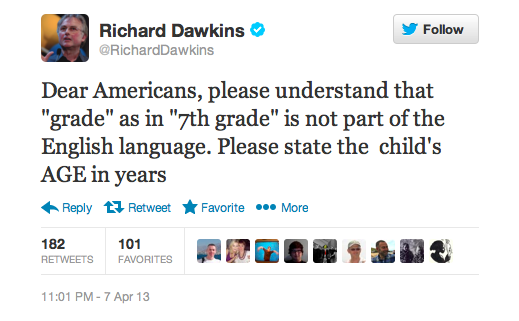
Take this tweet:
I mean, honestly, what a thing to say. He's making a perfectly good point, namely that if you're writing for an international audience it's more useful to state the age of a child in years rather than using a US-specific system. (In fact, because in the US children can skip or repeat a year in school, it is sometimes relevant to refer to the stage in their education that the child has reached. However, for the majority of children, this is not the case.) He clarified this, along with the statement that for a US audience, he has no problem with referring to grades. None of this is controversial.
So why on earth did he put it in such a stupid, guaranteed-to-cause-a-row way? Does he like getting into fights so much that even innocuous opinions must be stated in a controversial manner?
The bit I'm referring to, if it's not blindingly obvious, is the bit where he says that 'grade' is 'not part of the English language'. It... but... it... well, it obviously is. How can it not be? American English, or the collection of dialects of English spoken in that part of the world, are most definitely English. And if 'grade' (in this sense) is part of at least some of those dialects, then it is part of English.
It's possible that Dawkins was using some rather unusual definition of English. If you take any English speaker, let's say me, then we can agree that I speak English, I hope. And if you take another English speaker, let's say Richard Dawkins, then we can also agree that he speaks English. And so on and so on for any English speaker in the world. But our two Englishes are not precisely the same. In the case of me and Dawk, they're not far removed from each other. We're both speakers of British English dialects, although his is a bit more old-fashioned than mine. But if you compared Dawk and a teenage speaker of English from, say, California or South India or Grenada or Kiribati, then you're going to find a few more differences between the dialects. One might, then, wish to say that something is only 'English' if it is found in all dialects of English. This is a silly way to define English because it leaves you with about three words and a smattering of grammar and no sounds with which to pronounce them (I exaggerate, of course, but not much).
You can say the opposite, and say that something counts as 'English' if it is found in at least one English-speaker's dialect. But then you run into trouble defining English, as it can get a bit circular. You could also say that there is no such thing as English, merely a collection of idiolects (personal dialects) which converge with each other to a greater or lesser extent, some of which are mutually intelligible and some of which are not. Some people do say this, I think, but it's a somewhat extreme position to take. It's largely a philosophical problem, and for practical purposes one usually needs to define English in some partially arbitrary way. On any of those definitions, American English still counts as English and Dawkins is being a numpty.
Take this tweet:
![]() |
| 'Grade' as in '7th grade' is not part of the English language |
So why on earth did he put it in such a stupid, guaranteed-to-cause-a-row way? Does he like getting into fights so much that even innocuous opinions must be stated in a controversial manner?
The bit I'm referring to, if it's not blindingly obvious, is the bit where he says that 'grade' is 'not part of the English language'. It... but... it... well, it obviously is. How can it not be? American English, or the collection of dialects of English spoken in that part of the world, are most definitely English. And if 'grade' (in this sense) is part of at least some of those dialects, then it is part of English.
It's possible that Dawkins was using some rather unusual definition of English. If you take any English speaker, let's say me, then we can agree that I speak English, I hope. And if you take another English speaker, let's say Richard Dawkins, then we can also agree that he speaks English. And so on and so on for any English speaker in the world. But our two Englishes are not precisely the same. In the case of me and Dawk, they're not far removed from each other. We're both speakers of British English dialects, although his is a bit more old-fashioned than mine. But if you compared Dawk and a teenage speaker of English from, say, California or South India or Grenada or Kiribati, then you're going to find a few more differences between the dialects. One might, then, wish to say that something is only 'English' if it is found in all dialects of English. This is a silly way to define English because it leaves you with about three words and a smattering of grammar and no sounds with which to pronounce them (I exaggerate, of course, but not much).
You can say the opposite, and say that something counts as 'English' if it is found in at least one English-speaker's dialect. But then you run into trouble defining English, as it can get a bit circular. You could also say that there is no such thing as English, merely a collection of idiolects (personal dialects) which converge with each other to a greater or lesser extent, some of which are mutually intelligible and some of which are not. Some people do say this, I think, but it's a somewhat extreme position to take. It's largely a philosophical problem, and for practical purposes one usually needs to define English in some partially arbitrary way. On any of those definitions, American English still counts as English and Dawkins is being a numpty.
Wednesday, 12 September 2012
I doubt that you would suspect this
A recent Language Log post pointed out a humorously ambiguous headline:
The joke is of course that it sounds like the kebab van drove over and duffed up the hapless teen, with the by phrase expressing the agent of the jaw-breaking incident. The intended meaning is the one in which by is a preposition, and the by phrase locates the teenager at the time of the attack (ie he was by a kebab van). Much lolz ensues.
This wasn't the only humour to be wrung from the language in the headline: commenter Bobbie made the following quip, which was immediately either genuinely or wilfully misunderstood by Victor Mair:
Bobbie is taking advantage of the fact that in English, we can say that you have broken your X (if X is a body part) and it does not mean that you did the breaking. There's a term for that which I can't remember just now. Anyway, so Bobbie says what (s)he says, implying that it is unlikely to be the case that the teenager did it himself. Victor Mair's comment was initially baffling to me, because of course American English speakers wouldn't use suspect instead - that would mean the exact opposite! Other commenters said much the same lower down the comment thread.
Some of those commenters also noted that doubt used to mean roughly what suspect means. It's sense 6d in the OED, marked as archaic, and from the examples there, you can see how the semantic shift could have happened. Just add it to the long list of English verbs whose meaning has completely reversed over time.
Subscribe to:
Posts (Atom)