Showing posts with label German. Show all posts

Friday, 24 April 2020

Asking questions to share knowledge on twitter

Anyway, back to linguistics after all the disquisitions on the state of HE. Susie Dent posted a nice fun fact about the word two on twitter.
The first reply was best: it said simply 'Twix'. But the other replies were really interesting to someone who has recent experience of doing linguistics in public and aspirations to do more of it.

There are lots that are comments, reactions, unrelated replies, of course. The ones I'm interested in fall into two groups: questions, and related facts. Both of them fulfil the same locutionary role: to show that the tweeter has some knowledge of language, to convey enthusiasm, and something else slightly undefinable about interacting with celebrities that you don't know personally on twitter.

The related facts, first. Let's give these gentlemen the benefit of the doubt and assume that they were not mansplaining Susie (i.e. assuming that they, as non-experts in this field, can educate her about her literal field of expertise). So they're doing something else – the fact is to add to the original one, give more detail, add more context, and it's for the benefit of other readers of the original tweet. This is not how 'replying' works in normal conversations, but it's how it often works on twitter.


Then there's the questions. Some of them are simply information seeking – the fact prompted the asker to seek more information about something that occurred to them. But many of them also have a secondary purpose of showing off a bit, being a bit clever, making an observation and wanting to share it but also doing that in a deferential, face-saving way, to indicate that they are aware that Susie Dent is an expert and already knows this (a question implies that the asker believes the answerer knows the answer).

(This one is also cute and interesting because they don't mean that the /tw/ would be pronounced /twə/ in the word two, but to say the sound /tw/ on its own you would say /twə/, with an unstressed vowel at the end to make it pronounceable, and I like this a lot.)

This one is a perfect example of the 'question as knowledge-sharing' tactic (though I think in this case the answer is no):

Monday, 14 January 2019

Upstarting

We were in Brussels just before Christmas for a little holiday, and we visited a couple of lambic breweries while we were there. One of the brewers at Verzet was great and took the time to show us all round it and tell us loads about the process and their beers.
Some of the barrels at the Verzet brewery
(named after their music heroes)

He was talking about the background of the guys who work there, and he said at one point that one of them helped upstarting a brewery, meaning 'helped to start up' a brewery.

In Flemish, there are what's called 'separable verbs'. These correspond to English verbs that have a preposition-like particle as part of it, so in this case start up. The Dutch version is opstarten. You can see that the 'up' part is a prefix, so it's literally 'upstart'. Flemish does have the option of separating that prefix from the main bit of the verb, more like the English equivalent, but it doesn't always separate (based on some rules of what kind of sentence it is). You can see that he basically just anglicised the word (it's called a 'calque' when this happens).

An interesting aside: I say Dutch in the paragraph above because that's what Google Translate has, and I think that the Dutch of Flanders is not different in this respect. Where there is a difference, according to this site,* is exactly when you separate the verb. The verb remains joined together when it's the only verb in the clause, it seems. When there's another verb, as in our sentence (He helped to start up a brewery), it's more likely to be separated in the Netherlands (he helped to start a brewery up) and more likely to remain intact in Flanders (he helped to upstart a brewery).

*If you, like me, like reading about grammar, this seems to be a really comprehensive grammar of Dutch that you can download as a PDF. 

Wednesday, 24 May 2017

A luxury attic

Not long ago, a friend of mine was moving to Germany and looking for flats. She complained, on facebook, that the only kind of apartment to rent was Dachgeschosswohnung. I'm not great at German yet, so I let facebook translate it for me and it said that this word meant 'penthouse'. I took this to mean that she couldn't afford anywhere, as they were all luxury places and out of her budget, as this is the connotation of 'penthouse' in English.

What the word actually means is 'top floor flat', literally, and it's basically an attic. Now, while a penthouse is a top floor flat, it's not at all the same as an attic, which has a sloping roof and is small and non-luxurious, which is exactly what she meant when she made her complaint. Literal translation, yes, but a very different interpretation of the type of accommodation it refers to.

Monday, 5 December 2016

The bestest

In my German class last week we learnt about comparatives and superlatives. German is simpler than English in this respect, as it always adds a suffix: -er for comparatives, -(e)ste(n) for superlatives. For superlatives, there are two ways of doing it. You either say am intelligentesten or die intelligenteste.

As usual, there's a really simple rule that my book didn't tell me and I had to go looking for. You use the am kind when it's predicative (not followed by the noun it modifies), as in Laura is the most intelligent, and you use the other kind when it's attributive (followed by the noun), as in She is the most intelligent woman in the room.

Some of the exercises I had to do involved wh-questions, like Which hotel was the nicest?. We can analyse these (in some theories) as having an understood hotel following nicest: we know that it means the nicest hotel. This is more evident with a question like Which biscuits did she bake?: it corresponds with She baked which biscuits, which relates to the answer She baked these biscuits.

Note, though, that we can't so easily put the wh-phrase back with the hotel question: *(It) was the nicest which hotel just doesn't work at all. This perhaps explains my observation. I had predicted that maybe when you have a wh-question, you'd use the der/die/das form, because there is an understood noun and it's sort of attributive. Sadly for me and my homework answers, this turned out not to be the case, and you use the am form there. Not so sad for the theory, though, because maybe this is precisely because of the impossibility of 'putting back' the wh-phrase to the position following the adjective.

Tuesday, 25 October 2016

The gender of Brexit

A friend of mine recently drew my attention to this article about the gender of the word Brexit in various European languages. It notes that the word is masculine in French and German, but feminine in Italian. The Independent's version of the story points out that it's also masculine in Polish, Flemish, Catalan and Welsh.

Italian has a justification for making it feminine, in that the word it's based on, exit, is feminine when translated into Italian (uscita). This is a terrible justification, in my view, as it isn't the word uscita - it's the borrowed word exit, and there's no reason on earth why they should have the same gender. As someone in the comments noted, you can have two words for the same thing with different genders, and gives the example of das Auto (neuter) and der Wagen (masculine), both meaning 'car' in German. It's word that have genders, and exit is a different word from uscita. However, it's the Accademia della Crusca, Italy's language body, that has decreed this and they have fixed principles on the matter, so they must stick to them.

If a new word is similar to an existing one, then it'll tend to behave like that one. An invented verb like gling might have an irregular past tense glang, on analogy with sing. We might be tempted to pluralise POTUS (President of the United States) to POTI on analogy with other words ending in -us, like cactus.

If there isn't an easy parallel to draw, then I'd expect it to be masculine, as it is in the other languages mentioned. In Spanish and Italian, for instance, nouns end in -o or -a. This doesn't, so we have to just pick a gender. As the article says, most new words get masculine gender. This isn't, however, because 'Spain, being a Latin country, opts for male', as the Guardian lazily jokes. It's because whenever you have sets of things in grammar, there is a marked and an unmarked option. Consider number: we add something (usually -s in English) to show that a noun is plural, and without that, we assume it's singular. Singular is 'unmarked', plural is 'marked'. Consider positive and negative sentences: we have a word to show that the sentence is negative, but nothing to show that it's positive. Negative is 'unmarked', positive is 'unmarked'. The unmarked option is the default option.

When it comes to gender, masculine tends to be the unmarked option. If you have a group of friends in Spanish, then if they're all male, they're amigos. If they're all female, they're amigas. If they're mixed, then they're amigos (masculine). Now, whether this reflects a deeply sexist mindset, whether it has contributed over many generations to sexist thinking, or whether it's totally unrelated, probably remains an unsolved question. But it does mean that new words get masculine gender in most languages.

Welsh appears to be taking a very pragmatic approach to the matter: it's masculine because if it was feminine, it would have to have 'consonant mutation', which is when certain nouns change the sound they begin with under certain conditions. It's just easier to make it masculine.

Tuesday, 9 February 2016

German lunchtime

Sorry for the gap - marking nearly killed me but I made it out the other side. I haven't got long but I thought I'd share what I learnt in my German class today: Germans eat lunch at midday, no matter what time they eat lunch.

What?

Well, the German for 'to have lunch' is zu Mittag essen, or 'eat at midday'. I asked whether you would still say this even if you have lunch later (which I usually do), and the answer was 'well, midday is usually lunchtime' but that yes, you would say it anyway. So in my homework I have written Um 1 Uhr esse ich zu Mittag, which literally means 'at one o'clock I eat at midday'.

Wednesday, 6 January 2016

Ne translatez pas les languages

A friend posted this photo on facebook the other day:


A number of highly intelligent people then missed the point of the joke and began to comment on how bad the translations are. I think they're pretty good imitations of the languages in question, with one big error: the 'German' looks (unmistakably) more like Dutch in the second half of the sentence.

These are not intended to be translations, of course, or rather they're deliberately not accurate. They're just meant to amuse the English-speaking audience by including funny words to compound the humour of the warning in English ('avoid pouring on crotch area'). After all, we love nothing more than when a foreign language does something in a funny way (cf. Welsh popty-ping for 'microwave' or German Handy for 'mobile phone') so it's nice to imagine that these might be for real.

Let's begin with the French. The grammar is fine, as far as I know: you'd make an imperative in French with the negative and the 2nd person plural inflection, just as it's done there. The phrase dans l'area seems OK to me, too. The vocabulary used just isn't French, that's all. The verb for 'pour' should, I think (Google Translate helped) be verser so you'd have ne versez pas. I don't know if you'd also need a pronoun in there (don't pour it) or not. And, of course, no French person ever says ooh-la-la, but it's stereotypically French and referring to ones' crotch that way goes nicely with the French reputation for romance.

Next, the 'German'. This one caused a bit more controversy in the comment thread, because it very obviously isn't German. My German is less good than my French, but I'm pretty certain the word order here is wrong as well as the vocabulary and morphology. I think you would say literally 'drop you not...' rather than 'not drop...', which is what we appear to have here: nein is German for 'no'. Then the verb is obviously just English again, with droppen instead of pourez. I think they've simply selected words that have a combination of letters that resemble the language in question (so French has a word pour, for instance, but it doesn't look very Germanic).

Next, though, I think we've got a nice case of representing an accent in words that look like (or indeed exist in) the language. So ze haut kaffe does not mean 'the hot coffee' in German (haut apparently means 'skin', for instance, and the German for 'coffee' is in fact kaffee, which they could have used instead), but it looks German-ish and sounds like someone saying the hot coffee in (some kind of representation of) a German accent. It reminds me of this a bit. Notice also that the 'German' has an overt object with article, while the French has nothing at all ('don't drop _ on the crotch area' vs 'don't drop the hot coffee on the crotch area').

Then it most definitely switches to Dutch-looking words, if we hadn't already. Dutch word order is a little bit more familiar to English speakers as well, I think, although I know even less Dutch than I do German. Anyway, here we've got a dead giveaway for Dutch: that word oont. It just has a Dutch-like feel to it, though I don't know why (double 'o'? final 't'?). And then finally the lovely phrase, ze knakkers. Again, this is definitely Germanic and in fact Google Translate does give 'knackers' as the translation of this as a German word (it gives 'frankfurter cherry' if you tell it knakkers is Dutch!).

Good work, coffee-cup-humour-producing-person!

Friday, 18 December 2015

Words-combining

German is famous for its compounds. I'm not sure this is fair, really, because as far as I can tell it just doesn't write the spaces (I'm being facetious - but there is a conceptual issue here). No matter. It is famous for them. I said to my first years the other day that while English can't have plurals within compounds (eg it's toothbrush, not teethbrush, even though it's a brush for your teeth), German can. And this is true: bookshelf in German is Bücherregal, literally booksshelf. But it's not that simple. This is language we're talking about, after all.

German and English can both have irregular plurals in compounds, as well as singulars. English can have teethmarks, for instance (although personally I would prefer toothmarks). But neither language can have regular plurals in compounds, so we have mice eater but not rats eater and Bücherregal but not Autosberg ('cars heap'). (Links go to articles testing this idea.) The difference is that German has many more irregular plurals: their default (=regular) plural is the -s suffix that I mentioned in my Euros post. All the others, which put together are way more common, are in effect irregular.

Wednesday, 16 December 2015

German suddenly makes Esperanto make sense

As you know, I'm learning German and dabbling in Esperanto. Esperanto is primarily based on romance languages as far as the vocabulary goes, with a bit of English and German thrown in, and its cases are a bit like German. One thing that was bugging me about Esperanto was that when I learnt about subordinate clauses, there was always a comma after the main verb. Like this:
I hope, that I get something nice for Xmas. 
This is weird to me, as it's just not the way we do it in English and I can't help reading it with a strange Shatneresque style. But I have discovered that German does this (romance languages do not, at least in my experience), so it appears to be another aspect of Esperanto borrowed from German rather than the romance languages.

Tuesday, 17 November 2015

Euros and the emergency plural


I'm learning German - I don't think I said. It's quite fun, although you never learn much at an evening class because there are lots of people of mixed ability and you can't ask the teacher important linguistic questions because it's not fair to expect non-linguists to know the answer to such things.

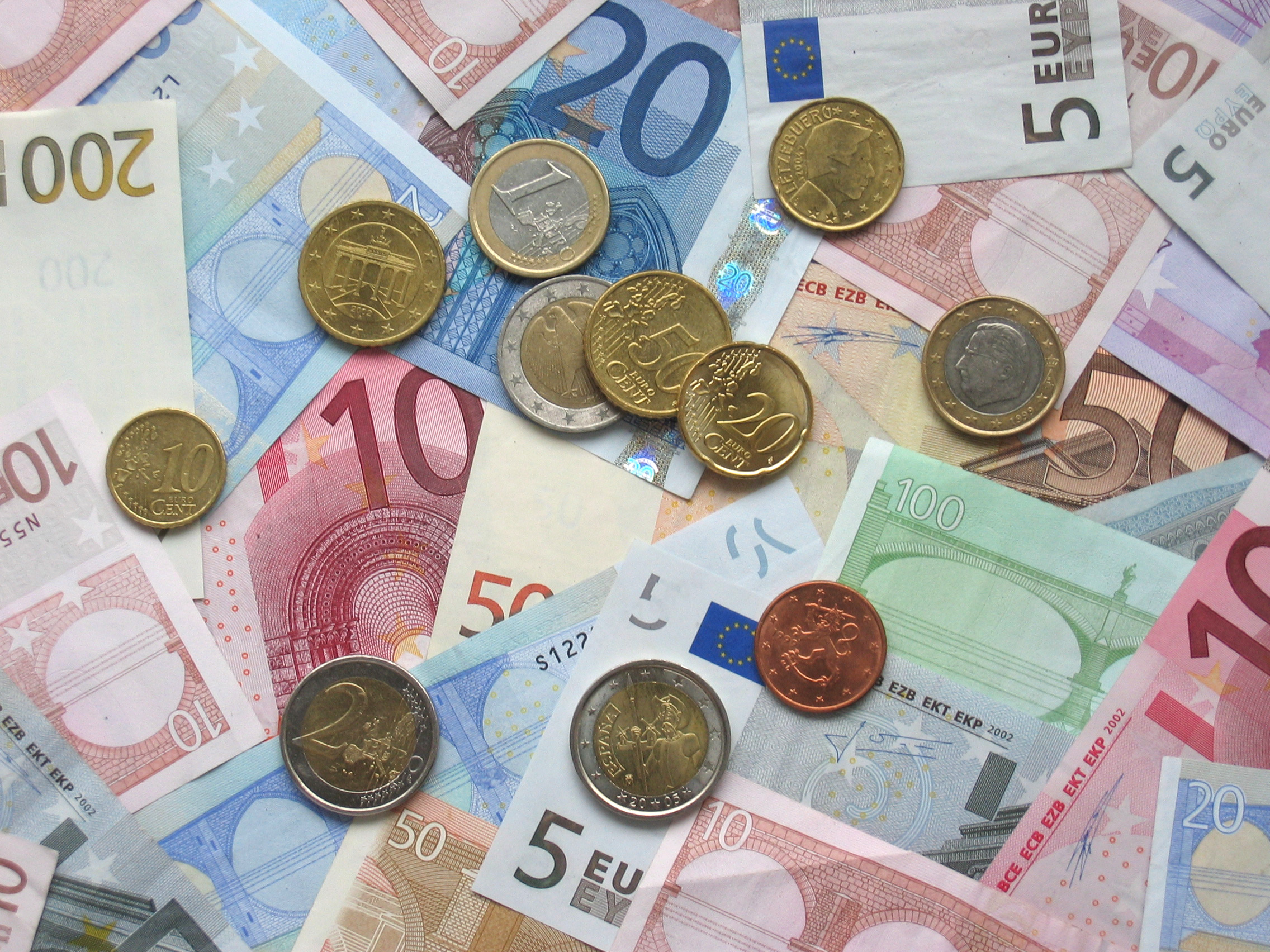
Anyway today, we learnt about currencies and big numbers, among other things. Germany obviously uses the euro as its currency, which is Euro in German. I checked, and it's not pluralised. Languages vary on what they do with the plural, so in Spanish you have 1 euro and 10 euros, but in Italian you have 1 euro and 10 euro, not 10 euri (which just looks weird). I think the most interesting thing about this is the difference between British English, which is spoken in a country where the euro isn't used and pluralises it (10 euros), and Irish English, which is spoken in a country where it is used (so it's a much more frequent word) and doesn't pluralise it (10 euro). I don't know what Northern Ireland does - I'm sure someone will tell me. I remember noticing it when an Irish friend-of-a-friend and thinking it was funny to hear an English speaker do what I'm used to hearing in other languages.

German doesn't pluralise it, as I say. Nevertheless, my teacher today definitely said '10 euros' at one point. A slip of the tongue, no doubt, or perhaps it is pluralised in some non-standard variety that she is not teaching us. But either way, it's interesting for a morphology reason. Steven Pinker published a book in 1999, too early to mention the pluralisation of euro because it had only just been introduced. But he did talk about German plural suffixes. -s is 'by far the least common' of the several possibilities (-e, -er, -en, -s, or nothing), but it is the Notpluralendung, or 'emergency plural' (p.222). It's the one you pick if the word is new, or doesn't normally pluralise. That's why it turns up on foreign words or names, and, in this case, on Euro.

Sunday, 13 September 2015

Gezellig

The Morris group that I dance with did some workshops for some Dutch children this week. One of the girls said that the evening was gezellig - and she asked me did we have this word? Well, we don't, of course. I tried to kind of mutate it into English and got this far:

  1. -ig is an adjective suffix, meaning -y or equivalent. 
  2. ge- is a kind of verbal past tense thing, I believe, so this is an adjective formed from a verb

But then I got stuck (it also turns out I was wrong about the ge- bit anyway).

Just from the way it sounded, I suggested 'cosy', even though it didn't seem right in context. I looked it up when I got home and 'cosy' is one of the things it can mean, but the internet also tells me that this is an 'untranslatable' word.

Untranslatable words, it seems to me, come in two or three flavours. There's one kind where a language happens to have a word for a very specific concept. This is not untranslatable; it's just that language X encodes something in one single word that language Y does with a phrase. See, for example, German schadenfreude or Japanese origami (I have no idea how much Germans or Japanese people actually use these words). In this case, as with many others, the way we get round not having a word for this concept is to just borrow it. We also do this with foreign things like food (risotto, wasabi, pak choi, tea...).

There's also words where the translation isn't exact, although there's a bunch of words with similar meanings. See the Language Log entry on 'accountability', for instance. Prepositions are also a problem - they never seem to translate quite right from one language to another, partly because they don't have 'meaning', as such, but rather a grammatical function. These must be annoying for translators and make learning languages a little bit harder/more interesting, but we can learn what the nuances are.

Then there's the kind that seem somehow exotic because they refer to some concept that we hadn't thought about before. These have a great appeal on the internet. I suspect this is because they tend to refer to highly emotional states of mind. Nostalgia would be a good example of this in English, and saudade in Portuguese. They are often claimed to say something about the temperament of the nation that uses that word, so Portuguese or Brazilians are typically melancholic or nostalgic. We know the fallacy of attributing a characteristic to a whole nation, but nevertheless we like to do it because it helps us to label people.

Gezellig is said on Wikipedia to 'encompass the heart of Dutch culture', so it's a good example of one of these 'untranslatable words'. Wiktionary says it means 'companionable, having company with a pleasant, friendly atmosphere, cosy atmosphere or an upbeat feeling about the surroundings'.

It also says it comes from gezel, which means 'companion'. So much for my etymological analysis.