They were off on a residential visit somewhere so meals were involved, so they started talking about their various fussy eating foibles. One said she couldn't eat steak, to which the teacher responded with admirable restraint 'It's OK, we're not having steak'.
Another was alarmed when she heard one of the meals would be spaghetti bolognese (or 'skabetti', as the teacher called it, which I always find an adorable pronunciation), because she doesn't like spaghetti. Fortunately for her, it turned out that the spaghetti to be used was in fact fusilli (the spiral one), which she did like. For me, spaghetti is specifically the long, thin, solid, cylindrical ones, and any other pasta shape has to be called by its own name (or just 'pasta'). But spag bol is special, because it's the pasta meal most British people encountered first, so it's kind of a meal in itself. I'm not quite sure how to describe its cultural role, actually, for people that don't already have the same cultural knowledge of it. I mean, Heinz sells it in tins, is probably the most meaningful thing I can tell you about it. So I suppose for her, spaghetti isn't a thing in its own right and it could be used as the generic term for pasta as long as it's with that particular sauce.
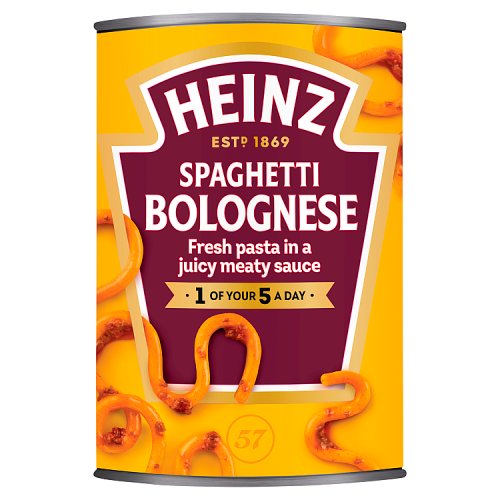 |
| Tin of Heinz spaghetti bolognese |
Pasta words are one of those semantic fields where there's a lot of overlap and variation, by the way - 'noodles' for me has to be in an Asian dish, like chow mein, so even though they're long and thin, I couldn't call spaghetti noodles. For some people 'noodles' covers all kinds of pasta-type foods.


