Monday, 16 November 2020

Kerry the marry

Starbucks is featured on this blog often enough lately that I'm starting to think I should ask for a promotional fee (for the record, I drink Starbucks only when I stop at a service station and there isn't another coffee place because, for reasons explored in another post, their coffee is not catered to my tastes). 

Here's their Christmas advert: 

Starbucks seasonal advert with three creamy drinks (toffee nut crunch latte, jolly baked apple latte, and peppermint mocha) and the slogan 'carry the merry'

The slogan is 'carry the merry', meaning that you're carrying around a drink full of Christmas spirit. Someone posted on twitter the other day that they bet linguists were all excited about it and I was thinking that it's a *bit* interesting that the adjective merry is the object of the verb, but not that exciting surely? and then days later I realised that this is an example of the merry-marry-Mary merger. 

This is a sound pattern that's incredibly well described and studied so we don't need to go into it here, but suffice to say that for most North American speakers, those three words sound identical (there are regional patterns where only two of them do, or none, or it varies). In the UK, other English-speaking countries, and in the parts of the US without this merger (e.g. Philadelphia), the three words are pronounced differently, as they are for me. (I think this generalisation is true; there may be other varieties with the merger or part of it but I'm not a specialist in this area.) 

It affects words with a vowel coming before an /r/ so carry is also affected, and the slogan would rhyme for many Americans. For their customers without this particular merger, it's assonance instead. 

I think that the fact that I didn't even notice it despite someone saying it was linguistically interesting shows just how much this goes below the radar. When someone has a different accent from you, you accommodate really easily and hear vowels especially as being 'the same' as your own. It sounds a bit odd if you try to imitate their vowel sounds so we just accept that these very different sounds are 'the same' in some way and in many cases can't even hear that they're different. There was a bit in Vocal Fries last year where host Carrie Gillon describes a time when she asked her professor to say her name correctly because he was pronouncing it with a British-type vowel, and she said 'say it as if it's spelt Kerry'. This really surprised me because although I can hear how (my) Kerry vowel is closer* to (her) Carrie vowel than (my) Carrie vowel is, I distinctly hear her name as Carrie and not Kerry, probably in part because I've seen it written down. (This type of confusing sentence is also why lexical sets were invented.) 

*If you're interested, it sounds closer because it literally is closer: they're produced in a more similar area of the mouth, at the front, with the difference just in the height of the tongue, whereas the British** Carrie vowel is produced with the tongue further back in the mouth. 

**These things are different again in Scotland which has a different set of vowel rules, so some of what I say about the UK applies here but not all of it. 

Monday, 9 November 2020

I declare this blog post to be interesting

Donald Trump lost the US election last week to Joe Biden. You might have missed it, it's not like it was literally all anyone was talking about all week. We even stopped talking about coronavirus for a bit. One of the things that characterised his unhinged campaign was an insistence on the election being fraudulent, and also that he had definitely got more votes. Because of the way the system works over there, states are 'called' for one or the other candidate once it's past reasonable doubt about who will win (e.g. the number of votes still to count isn't enough to change the current outcome). This means that anyone could call a state early, and they might be right, because it's 50/50, but they might also be wrong because they're just guessing, so you want to look at the basis on which they're calling it. 

Trump tweeted this, and Twitter immediately marked it as false or misleading: 

You can see he uses the word hereby in his claim for Michigan, which adds an air of authority and legality to the claim, although no actual legality of course. 

Hereby is a word meaning 'as a result of this utterance', so if you say I hereby declare this play park open, then you have opened the play park by uttering those words. You can also, if invested with the right authority, hereby forbid barbecues in this area before 6pm. This is what's known as a 'performative' speech act, because by uttering the thing, you are performing that act: claiming, declaring, promising, naming, and so on. Hereby is useful for legal documents, because it also means 'as a result of this document', so it means something like 'by signing this document you agree to this rule', and also that if the document is later overturned, so too is the thing that was hereby excluded/forbidden/claimed. 

In everyday speech it's actually less useful because the verb does most of the work, and the legality or validity is provided by the situation. If you don't have the right authority, you can of course still declare it, forbid it, whatever, but it doesn't have legal standing. So if you stand in your neighbour's garden and hereby declare that this is your property, it doesn't magically become your property. However, you have still declared it, and you would have even if you hadn't said hereby. There is no difference between 1 and 2 except for some posturing, and perhaps an implication that you're just now claiming it in (1), whereas in (2) perhaps there is some prior claim on it that you're bringing up now (it was promised to you by the host earlier on, perhaps). Your claim being upheld is dependent on the agreement of your friends. Similarly, there's no difference between (3) and (4), and the validity of your declaration is dependent only on you being some local dignity who's been asked to officially open the shopping centre; it isn't open if you just pass by a half-built complex and shout this at your friend. 

  1. I hereby claim this last slice of pizza. 
  2. I claim this last slice of pizza.
  3. I hereby declare this shopping centre open. 
  4. I declare this shopping centre open.

In a sentence like the one in my post's title, where I declare something subjective, then the validity is dependent on people agreeing with me. This is why statements like this are better if they declare something objective, but are also used to give additional (sometimes false) weight to opinions or baseless claims. My post might be dull as anything, or only some people might agree, but me declaring it to be interesting sounds like I have some authority to make a factual statement about it. 

So Trump claims Georgia and North Carolina just as much as he does Michigan, even though he doesn't say hereby for those ones, and the speech act is the same. The legality or validity of it is dependent not on his claiming them, but on the number of votes counted. At the time of writing, the former two are still not called by Associated Press, and of course his claim for Michigan came with a big censored 'if' clause about voter fraud, so no doubt he will be pursuing that one. 

Monday, 2 November 2020

Panic! in the pandemic

I had my first social distancing argument on Saturday. As I was queuing to pay for kippers at my local farm shop, a woman who apparently had no concept of personal space, never mind pandemic space, was right up behind me. I took a step forward, and she closed the gap again. Then I asked her to keep her distance (politely, I thought), and she sneered at me, shook her head, and told me not to panic. Panic! 

Panic, which I just now learnt is named after the god Pan, who'd shout when he woke from his naps and make the sheep scatter in fright, is a sudden fear provoking anxiety so strong it causes a fight-or-flight response. If you've ever had a panic attack, you'll know how strong a physical experience it is. Even if we're not using the medical or scientific definition, but a looser sense, it's still a pretty physical thing involving running about, not thinking straight, irrational decisions, things like that. 

Panic is not politely asking people to follow the guidelines we've been told to follow in order to stem a pandemic. (Pandemic is not named after Pan, sadly.) It's not a sustained, reasoned, relatively calm course of action. Yes, those of us keeping distance from others may be feeling anxiety, but it's not the sudden desire to flee and shortness of breath and racing heartbeat of panic. 

I've heard this word used a lot about people's rational (to me) responses to the pandemic, though, generally from right-wing or anti-lockdown or anti-mask commenters. They are the ones who think the virus isn't that bad, and that we should just go on as normal, perhaps 'protecting the vulnerable'. If you have this view, then a more appropriate word than 'panic' would be 'over-reaction'. 

Using the word 'panic' is just like when you're having an argument with someone and they say 'you're being hysterical', whereupon the correct response is to shriek 'I'm NOT being hysterical' and storm out slamming the door behind you. It makes you seem unreliable and undermines your actions, making them seem ridiculous or unreasonable. It's a dirty, underhand tactic but it works well. 

And yes, when the woman said that to me, I replied 'I'm NOT panicking' and stormed out. 

Monday, 26 October 2020

Book review: 'The language lover's puzzle book' by Alex Bellos (Guardian Faber, 2020)

Full disclosure, as I don't normally do reviews in this blog, so publishing this one might be seen to carry a certain amount of weight: the author sent me a copy of this book with a suggestion that I might possibly write about it if I liked it. I did like it, so I am. 

Alex Bellos, Guardian puzzle-setter, has compiled 100 linguistic puzzles – sets of facts about languages from all over the world, with brain-teasers for the reader to solve – with some context about the languages. All of the puzzles are fully work-out-able from the information presented, so in this sense it's a pretty good approximation of what some of our introductory courses look like. I've even used some of the very same puzzles in this book in first year seminars before. They're mostly taken from previous Linguistic Olympiads. This is why I was looking forward to reading it, because for the last few years I've organised a 'markathon' for the advanced papers for the UK Linguistics Olympiad, and so I was already well aware of the fiendishness of some of the puzzles. Happily, Bellos hasn't included the very hardest ones in the book, so they're all manageable, though some are really tricky and would take you a while to do with pencil and paper. 

The way I approached the book was not to try to solve every puzzle as I read through the book. (You could do that, and it would keep you going a really long time, so it's good value if you're looking for a Christmas stocking filler, which I assume is the intended market.) Instead, I cast an eye over a puzzle to get the idea of it, and then flipped to the answers once I'd spotted the principle (or if I couldn't work it out quickly). For me, the interest was more in the linguistic knowledge rather than in the process of solving the puzzle, although some of them were very satisfying in that regard too. For that reason, I actually found having the answers in the back of the book a bit of a nuisance and would have been happy to have at least the bones of the explanation directly following each puzzle, to provide context and grammar facts with perhaps the full walkthrough in the appendix. But that's me, a linguist, not a puzzle-solver. For the average reader it's probably helpful to have the linguistic details separated out from the cultural context. But is that playing into the unhelpful separation of grammar and its speakers, that formal linguists are sometimes charged with? I don't know. 

It's really hard to write a book like this, where you convey the delight of linguistic variation, without falling into the trap of exoticising or depersonalising the languages you're talking about, detaching them from the people who speak them every day when you talk about them as an object to marvel at. I was well aware of this myself when I was asked to be the linguistic expert on a radio comedy panel show earlier this year. Even though the whole production team was consciously committed to not being racist, and fully aware of the perils of accidentally doing so, I know we didn't fully manage it. We avoided some potential clangers, to be sure, but I know we didn't get it right. Can you ever? I'm not sure. And I also think that it's good for there to be books out there that present this delight in diversity rather than just banging on about how wonderful language is without ever going beyond English, so there must be a trade-off, I suppose. In this book, there are the inevitable untranslatable words, Chinese compound words, and other tropes. There are a few scare quotes that I wouldn't have thought necessary (enclosing 'writing system' or 'texts', when the un-scare-quoted terms would have been accurate). Alexander Graham Bell's contribution to Deaf education is also discussed in a positive light, with no acknowledgement of the eugenicist views he held regarding Deaf people and the negative legacy of the methods he used. There are no signed languages included either, with the one exception of Cistercian sign language. But in the main, the material in the book is presented in the spirit it's intended: fascination with languages and the different ways they can do things. Languages are presented from all over the world, and although Europe is over-represented (especially English, which is a conscious decision on the author's part) and Africa rather under-represented considering the linguistic diversity there, it is a world tour.  

Most of the puzzles don't require you to have any linguistic knowledge at all. Some of them need you to make an educated guess about what a language might be like, but a lot of them are simply pattern-spotting and logical deduction.  Puzzle 10 was a nice example of one where you needed to simply match up the patterns, spot the links, but then make a couple of educated guesses about things that didn't quite fit: it demonstrated very neatly the complications that natural languages can bring. And the twist in that puzzle was a joy. I learnt some language facts from the book, including about counting in Japanese and Danish, and I also learnt other non-language stuff too: things about mathematical symmetry, and botanical notation for describing petal structure, and was reminded of the bizarre language to describe coats of arms. 

There's a strong focus on writing systems, as you might expect, with chapters on alphabets and scripts and invented writing systems and codes of various kinds. There are also chapters on terms for family members, counting systems and dates, which reflect the kinds of things that Linguistic Olympiad puzzles are about (and which you can make a self-contained puzzle about). I was impressed by how coherent the themes are, though occasionally something unexpected popped up - puzzle 45 is a fun puzzle about garden path sentences, in the chapter about kinship terms, linked just by including the phrase the old man. 

I'll be adding this to my department's recommendations for prospective students. It's linguistically accurate, as far as I can tell (bar the definition of parts of speech in the 'technical' chapter on grammatical features that differ most from English), with input from linguists and native speakers. And I'll also be passing my copy on to a teenager who I think will like it, having just taught himself Esperanto. I think it would work for someone who likes logic puzzles just as well as someone who likes language-related trivia, though, and definitely for someone who likes learning languages just for the sake of it. 

Monday, 19 October 2020

Greyhound-dialect puzzles yam

Because I have two long dogs (a greyhound and a galga) I follow long dog content on instagram, and I'm always slightly intrigued by their distinctive dialect. Here's a representative example: 

Photo of a greyhound in front of Lindisfarne castle with the caption: Flapsy earsies and lots of sheeples 👀🐑 Dey didn't like yam vewy much - don't worries, ze feeling was mutual!!

The posts are always written from the dog's perspective, and the dogs have this slightly childish manner of speaking (which is fair enough, they're only young) so they use diminutives like earsies and cutesy words like sheeples in the post above. Their spellings presumably reflect their phonology, so here you can see that this dog has vewy for very, indicating a common variant of the /r/ sound, especially in children. That one isn't necessarily universal, but what is universal to greyhounds is the 'th-stopping' you can see in Dey for They, where 'th' sounds are pronounced as /d/. This dog doesn't have it in all relevant contexts, as elsewhere he says ze for the rather than de or da, which would be more usual. Some of these things are also found in other dog dialects and even beyond, in cat varieties. Others are quite specific to greyhounds. 

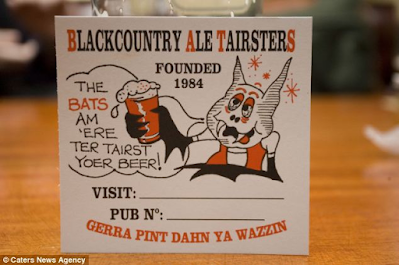
The thing that I spotted the other day was this yam. Yam is well-known as a feature of the Black Country dialect, around Wolverhampton and Dudley, where it's a variation of the verb be. In Standard Englishes you get am just for first person singular (I am). In many varieties you get levelling so that was or were is used for all the forms in the past tense (I were) or even is in present (you is). I think this is a form of levelling too: am is used for other persons than 1st singular, as in the message from the Black Country Ale Tairsters (tasters) below: The BATs am 'ere ter tairst yoer beer!. 

Beer mat featuring a cartoon of a boozy bat and the message 'the bats am 'ere ter tairst yoer beer'

Then you get it running together with the pronoun in speech and you've got yam. I did all that from memory (sorry, lots of teaching prep to do this week) so the details might be wrong, but that's about the size of it. But what it isn't, is yam being the pronoun itself. That's what the greyhounds are doing, they're using yam in place of me in standard Englishes, not in conjunction with the verb to be. It's not a one-off from Finn the greyhound either, it's pretty standard Greyhound. So they've innovated or borrowed a new first-person pronoun. 


Monday, 12 October 2020

Get off of my timeline

Twitter is a never-ending source of language peeving. Lately, a twitter user expressed eagerness to see the 'correct' use of off of. Well, joke's on her because there is no correct use. 

Regular readers will know that this is a linguistics blog, and as such, we're not in the business of dictating correct usage, preferring instead to document and ponder upon usage such as we find it. I wouldn't normally say that there's no correct use, because normally we'd be contrasting standard and non-standard uses and I'd be pointing out that both are valid in their respective contexts. 

The standard equivalent of off of is just off, as you are surely aware. Merriam-Webster says 

The of is often criticized as superfluous, a comment that is irrelevant because off of is an idiom. 

Which is pleasingly snarky, I think. 

Our friend the twitter user responded to all the many people who helpfully gave her examples of off of used in a phrase (such as the Rolling Stones' lyric Hey, you, get off of my cloud) by asking what of is doing - what does it mean, what does it contribute? 

Cover of the Rolling Stones' Get off of my cloud, with a photo of the band leaning against a wall and the writing in bright 1960s colours

Answer: nothing, just like it always doesn't. Lazy of, never contributing any meaning. 

Off of is a preposition (not two prepositions, as it looks like, because it doesn't have two separate bits of prepositional meaning). Or if you like it's an adverb and a preposition - I don't really like but it works as follows. Compare it with on and on to: We drove on (=We continued on our journey) and We drove on to Peterborough (=We drove further until we reached Peterborough). Now to is linking up the verb with the object Peterborough, indicating movement towards it, and on adverbishly indicates continuation of the action. On to can be contrasted with onto like so: We drove on to Peterborough (=We drove on until we got to Peterborough) vs We drove onto the ramp for the ferry, where onto indicates movement to the top surface and doesn't at all mean the same thing as We drove on until we got to the ramp for the ferry. 

There's no comparable difference for off and off of that I can think of. Hey you, get off my cloud works just as well sentence-wise, if not scansion-wise. And helpfully we do the opposite with out/out of: in Standard British English, at least, you would say get out of the house, not get out the house, but both are used and there is literally no reason for the pattern being the opposite way round. I told you. Of is a great word but it's contrary and wilful. 

Monday, 5 October 2020

100% fake leather

One of the knitting websites I use has the parts to make handbags, including firm bases which you can crochet around to get a more sturdy design. I refuse to believe they didn't know what they were doing when they described this as 'a lovely and practical round bottom', but that's not why I'm showing it to you. 

Screenshot of a listing for a bag or basket bottom reading 'A lovely and practical round bottom for your homemade basket or bag.  The bottom is made of 100% leather and is available in different colors and sizes.  Material: 100 % PU leather'

The material is described as 100% PU leather. PU means polyurethane, which means that it's artificial leather, not made from animal skin. This also means that it's absolutely inaccurate to describe it as being 'made of 100% leather', as they do immediately above. 

Or is it? 

Adjectives can be classified as being intersective, subsective, and privative (there's a couple more too but that's all we need for now). 

Intersective ones are so-called because their meaning is the intersection of two things: the adjective and the noun they describe. So, semanticist Barbara Partee gives carnivorous as an example because a carnivorous mammal describes things that are in the intersection of the set of 'things that are carnivorous' and 'things that are mammals'. 

Subsective adjectives are a bit trickier but not much: they describe a subset of the noun. Partee's example is skillful, because a skillful violinist is a subset of violinists - the ones who are skillful. It doesn't describe someone who is both skillful (independently) and a violinist, because it doesn't describe their skillfulness in any other field (e.g. skiing), only violining. (This is also the basis of my good dalek observation, by the way.)

Then we have privative adjectives, which are neither an intersection nor a subset, but actually negate the property of the noun they describe. A fake diamond is not a diamond at all, only something pretending to be one. In our round bottom example, it's not made of leather at all - it's fake leather. 

But Partee cites the acceptability of both the following examples to show that this cannot be the whole story: 
A fake gun is not a gun. 
Is that gun real or fake? 
In the second example, the item in question is still described as a gun. And actually most of the examples that ran through my mind for a privative adjective are more like this: a fictitious detective is still a detective (unless you want to tell Poirot), and a counterfeit banknote is still a banknote, of sorts, isn't it? 

So we need to think of these kinds of adjectives as being subsectives, really. Or if you prefer, the noun encompasses all the things that are putatively or ostensibly that thing: detective includes real and fictional ones, as well as impostors who pretend to be detectives to scam you. Banknote includes not just legal tender but fake notes put into circulation by counterfeiters. And leather includes not just the kind made of animal hide, but includes imitation leathers as well. 

Perhaps more accurately, we would want to say that in different contexts leather has both a broad meaning and a narrow or strict meaning (this is why you get words like SALAD-salad, to indicate the narrow sense). Then we have to step away from semantics into the realm of pragmatics and communication, and note that the customers for whom it's most relevant to know that the item is made of PU leather are vegans, and for them it's actually not helpful to use this broad definition of leather in the description, because they would buy products made only from the subset of imitation leather.