I recently treated myself to this book for the princely sum of 5p (plus £2.80 delivery from America - really, you can't say fairer than that). It's called Sister Bernadette's Barking Dog, though unless you have been through the US education system you might not be able to tell that from the cover:
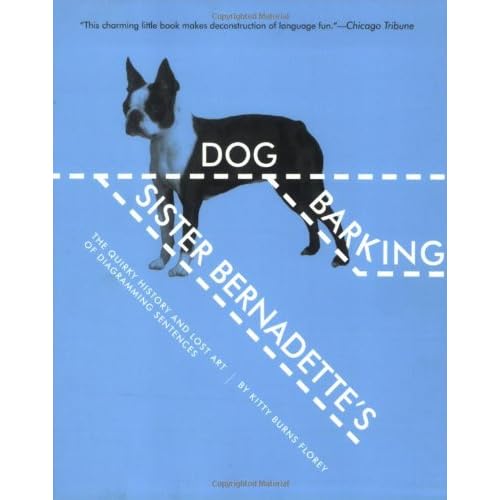
It's about sentence diagramming, which, when I first heard the term, I thought was the same thing as what we do in syntax, representing the structure of sentences as tree diagrams. Apparently not: it's a different way of doing a similar thing, and US kids were taught it in school until quite recently (I think around the same time they stopped teaching grammar in UK schools). It's a nice little book, and I'll review it at some point, because I did find it quite interesting.
But today's post is about a passing mention on page 116-7. In a chapter in which the author, a copy editor named Kitty Burns Florey, ponders incorrect usage and whether diagramming sentences could help to eliminate it, she says this of Lynne Truss's punctuation book Eats, Shoots & Leaves:
...as exemplified in Truss's ridiculing of what she considers bad English - including the attempts of immigrants to use it (resulting in such less-than-hilarious errors as "Plum's 49c a pound"...Florey then devotes a paragraph to her admiration for people whose first language is not English, and the cuteness of their errors. I think this is a fairly uncontroversial stance; in this largely monolingual country, I at least (a monolingual speaker surrounded by amazingly competent non-native speakers and polyglots) share this admiration. And Lynne Truss is ridiculing foreign greengrocers? Not fair.
Now I do happen to have my copy of Eats, Shoots & Leaves to hand. Lynne Truss is a massive prescriptivist, at least in the realm of punctuation, by anyone's standards (and actually, if you are going to be a prescriptivist, you might as well be a punctuation prescriptivist because at least it is a contrived system with entirely invented rules and no natural existence other than its sometimes arbitrary relation to prosody). She says things like this:
Someone wrote to say that my use of "one's" was wrong...and that it should be 'ones'. This is such rubbish that I refuse to argue about it.Well, OK, fine, but she has just spent several pages arguing about other incorrect apostrophisation, so this seems a bit like sticking your head in the sand. Anyway. Not the point. The point is, I'm not saying she isn't a prescriptivist; that's the whole point of the book. But does she really go so far as to ridicule immigrants' attempts to use English? My memory of the book told me no. And anyway, it's entirely written in British English, even as far as the lack of a serial ('Oxford') comma in the title, which in most US publishing house styles would be Eats, Shoots, & Leaves, so why would she refer to the price of anything in cents?
So obviously I checked. There is a long chapter on the apostrophe, and in that chapter she does refer to greengrocers' famous misuse of it (which the "plum's 49c" example must surely be an example of). However, at no point does she even mention immigrants, or the price of plums, and she also writes this:
The only illiteracy with apostrophes that stirs any sympathy in me is the greengrocer's variety.So not only does she not mention immigrants and not use the quoted example, she excuses errors such as the one she supposedly ridicules.
I did consider, of course, that the US version of the book might be different. It seemed unlikely that it would have been completely rewritten, but perhaps a word changed here or there for US readers might give an unintended interpretation. These days, we can check this kind of thing because Amazon allows you to search inside a book. I did, and at no point in either edition does the word plums come up, however you punctuate it. In fact, the editions appear to be exactly the same, even down to the same pagesetting.
Did Florey read the book wrong? Did she misunderstand something that was never there? I can't see how she possibly could. Are greengrocers mostly immigrants where she comes from? Round my way they're exclusively English. Just a case of misremembering? Maybe, but I can't help thinking that if you're accusing someone of something, you should double-check they do actually do it.
(By the way, Florey is just as big a prescriptivist as Truss. I think you have to be, to be a copy editor. She spends the next few pages after this comment railing against ain't, youse and double negatives as 'seriously low class'.)

