Showing posts with label prescriptivism. Show all posts

Wednesday, 21 October 2015

Not as much hedgehogs

On the RSPB's website there's this rather charming text (emphasis mine):
Many of us feel there are fewer bumblebees bumbling around our flowerbeds, less sparrows flitting between our gardens and not as many hedgehogs sniffing around our green spaces. 
We might also add 'not as much' to complete the set.

Of course, a pedant would say that less is ungrammatical for a countable noun like sparrows, and that both ought to be fewer. Similarly, it would be 'wrong' to say not as much if it were followed by something like hedgehogs, but in this paragraph it provides a nice variety in the expression used.

Friday, 13 December 2013

You sure?

This blog post neatly illustrates how one person can have strong opinions about a particular usage and yet have absolutely no awareness whatsoever of how they themself use the word in question.

Friday, 1 November 2013

Linguists have accent opinions too!

Linguists have to spend quite a lot of time explaining that they don't correct people's grammar, and trying to prevent people from judging each other based on the language they use, and trying to explain that one standard language is not inherently better than a non-standard version or a different standard version.

But you know, we're people too, and we have human opinions. This was an exchange between two linguists:


As you can see, the second linguist, as well as the one mentioned in the first tweet, have negative opinions of their own regional dialects. I also know another linguist who said that she didn't think she'd be taken seriously as an academic if she used the accent she grew up with.

It seems that we need to distinguish between disliking an accent and thinking that it's wrong or worse than the standard. We know that all dialects (and indeed languages) are equally valid, equally correct and equally suitable for use. This is where we differ from many non-linguists, who often think that a person speaks in a non-standard way because they're lazy or stupid. We also know that objectively, accents don't sound stupid or unfriendly or untrustworthy: those are values projected onto speakers of that dialect by the listener. We're like non-linguists, though, in thinking that some accents are simply not as suited to our own preference. And we also know how much people judge you based solely on the way you speak - more reason than any other to moderate your accent if you think people might regard it unfavourably.

Thursday, 7 June 2012

Talking to real people

Today I gave a talk to some real people. Actual non-academic real people. Normally, we only ever have to explain our research to people who already have a good specialist (or at least basic) knowledge of our topic and the background and framework that underpin it all. Everyone understands the technical terms you use, and you can make certain assumptions and everyone will go along with them.

But it does one good sometimes to step outside the warm bath of academia and see what impression you can make on people who don't have a rigorous grounding in the niceties of Minimalist syntax (for example). How are you going to explain what the Final-Over-Final Constraint is to an audience if they don't know what a head is? Or a VP? Or what 'final' means?

NECLL Current BrochureI was participating in the Explore programme run by the Centre for Lifelong Learning. They ran a training day for postgraduates at universities in the region aimed at helping us to present our research to a public audience. This is something that I'm interested in, because linguistics is so hopelessly unknown and misunderstood in the popular media, and yet everyone is interested in it. Programmes and newspaper articles about language go down an absolute storm, but the only linguist anyone's heard of is David Crystal. Yes, they've heard of Chomsky too, but not for his linguistics. Your average person knows more about how the Large Hadron Collider works than their own language.

The interest that people have in language was illustrated today, after my talk, when the audience had a chance to ask questions and make comments. They all had something to say, offering interesting facts about other languages, or making observations about the way language is used now or might be at some other time. From their feedback it seems that they found my topic interesting. Wow. Some readers of this blog will be wondering how on earth I made my dry, dull, theoretical syntax PhD into a talk that didn't send them to sleep. It is of course all due to my captivating speaking persona.

But seriously, these are people that learn for fun, so they're willing to put a bit of effort in (although they don't want to feel like they're back at school). However, I knew that for an audience with zero assumed knowledge of syntax, I had to lose a lot of the technicalities but not lose the quality. From the practice run we did at the training day, I found that some people panic at the sight of anything vaguely technical-looking. They pretty much switched off when they saw trees and abbreviations, even though I did try to explain them clearly. For that reason, I did away completely with tree diagrams and replaced them with an analogy of a mobile. I've used that analogy for years, after pinching it from a lecturer, and it works well. Then I entirely removed labels like VP and TP and just did without them. It's convenient for linguists to use them but it turns out you don't need them. Then I filled the talk with cats. People like cats.

I followed the principle we'd learnt at the training day, that rather than start with the general background, it's good to dive straight in to the interesting fact and show some kind of visual (or otherwise memorable) prop. I showed maps from WALS illustrating different patterns of word orders, and how question particles don't look the way they're meant to. It's not the most fascinating graphic in the world, but it's better than a lot of text. I also tried to end on something that they could engage with, and compared my analysis to spurious claims about languages lacking some characteristic or other. I thought that was something they would likely have read about, and have thoughts about, and they did - that sparked some nice discussion. I wish I'd thought to use the Hopi example that came up in the questions, though.

Marcus du Sautoy looking all mathsy
I think that in the middle, some people still got a bit lost. Maybe I didn't explain everything as fully as I should have, or maybe I tried to cover too much and could have sloughed off a bit more syntax. But overall, I was pleased with how it went. I'll work on those things for next time someone's fool enough to put me in front of humans again, and this time next year I'll be the Marcus du Sautoy of linguistics.

Just nobody, not ever, suggest I host this gameshow (I would derail it with anti-prescriptivism):

Monday, 7 May 2012

A strange case of misattributed prescriptivism

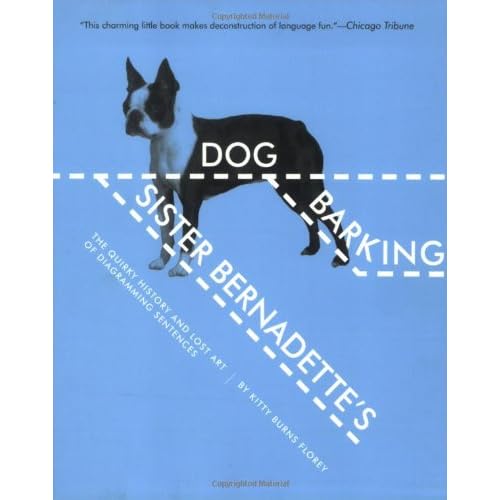
I recently treated myself to this book for the princely sum of 5p (plus £2.80 delivery from America - really,  you can't say fairer than that). It's called Sister Bernadette's Barking Dog, though unless you have been through the US education system you might not be able to tell that from the cover:


It's about sentence diagramming, which, when I first heard the term, I thought was the same thing as what we do in syntax, representing the structure of sentences as tree diagrams. Apparently not: it's a different way of doing a similar thing, and US kids were taught it in school until quite recently (I think around the same time they stopped teaching grammar in UK schools). It's a nice little book, and I'll review it at some point, because I did find it quite interesting. 

But today's post is about a passing mention on page 116-7. In a chapter in which the author, a copy editor named Kitty Burns Florey, ponders incorrect usage and whether diagramming sentences could help to eliminate it, she says this of Lynne Truss's punctuation book Eats, Shoots & Leaves:
...as exemplified in Truss's ridiculing of what she considers bad English - including the attempts of immigrants to use it (resulting in such less-than-hilarious errors as "Plum's 49c a pound"...
Florey then devotes a paragraph to her admiration for people whose first language is not English, and the cuteness of their errors. I think this is a fairly uncontroversial stance; in this largely monolingual country, I at least (a monolingual speaker surrounded by amazingly competent non-native speakers and polyglots) share this admiration. And Lynne Truss is ridiculing foreign greengrocers? Not fair.

Now I do happen to have my copy of Eats, Shoots & Leaves to hand. Lynne Truss is a massive prescriptivist, at least in the realm of punctuation, by anyone's standards (and actually, if you are going to be a prescriptivist, you might as well be a punctuation prescriptivist because at least it is a contrived system with entirely invented rules and no natural existence other than its sometimes arbitrary relation to prosody). She says things like this:
Someone wrote to say that my use of "one's" was wrong...and that it should be 'ones'. This is such rubbish that I refuse to argue about it.
Well, OK, fine, but she has just spent several pages arguing about other incorrect apostrophisation, so this seems a bit like sticking your head in the sand. Anyway. Not the point. The point is, I'm not saying she isn't a prescriptivist; that's the whole point of the book. But does she really go so far as to ridicule immigrants' attempts to use English? My memory of the book told me no. And anyway, it's entirely written in British English, even as far as the lack of a serial ('Oxford') comma in the title, which in most US publishing house styles would be Eats, Shoots, & Leaves, so why would she refer to the price of anything in cents?

So obviously I checked. There is a long chapter on the apostrophe, and in that chapter she does refer to greengrocers' famous misuse of it (which the "plum's 49c" example must surely be an example of). However, at no point does she even mention immigrants, or the price of plums, and she also writes this:
The only illiteracy with apostrophes that stirs any sympathy in me is the greengrocer's variety. 
So not only does she not mention immigrants and not use the quoted example, she excuses errors such as the one she supposedly ridicules.

I did consider, of course, that the US version of the book might be different. It seemed unlikely that it would have been completely rewritten, but perhaps a word changed here or there for US readers might give an unintended interpretation. These days, we can check this kind of thing because Amazon allows you to search inside a book. I did, and at no point in either edition does the word plums come up, however you punctuate it. In fact, the editions appear to be exactly the same, even down to the same pagesetting.

Did Florey read the book wrong? Did she misunderstand something that was never there? I can't see how she possibly could. Are greengrocers mostly immigrants where she comes from? Round my way they're exclusively English. Just a case of misremembering? Maybe, but I can't help thinking that if you're accusing someone of something, you should double-check they do actually do it.

(By the way, Florey is just as big a prescriptivist as Truss. I think you have to be, to be a copy editor. She spends the next few pages after this comment railing against ain't, youse and double negatives as 'seriously low class'.)