Showing posts with label Conservatives. Show all posts

Monday, 18 April 2016

You and your family's best interests

There's been a leaflet sent round lately about the EU referendum happening in the UK. The government has sent this leaflet to all households, setting out the case for remaining in the European Union. Here's how it puts it:
The Government believes it is in you and your family's best interests that the UK remains in the European Union.
A friend mentioned on facebook that he was disappointed that despite the £9m spent on this leaflet, it contained this grammatical error. I begged to differ: this is stylistic variation, not a mistake.

He argued that it should be your and your family's best interests, as both conjuncts should be possessive. This is right, as you should be able to leave either out and it still be grammatical.

But there's two complicating factors here. The first is that the possessive your is kind of already a combination of you plus 's, so perhaps the 's is redundant. I don't actually think this is the case, because I think there's another reason why it's OK to say you. 

It's to do with the nature of 's. This is what we call a clitic, which means that it's phonologically dependent (has to attach to) another word, but is not as tightly linked to the word as a suffix like the plural s. While the plural suffix can only attach to countable nouns, the possessive can attach to a much wider range of things. The only requirement is that the noun it refers to be within the phrase it attaches to. This means that we can have phrases like the following, where the possessive attaches to something other than the possessor, and sometimes not even a noun:
The woman with the long hair's dog
The guy I was talking to's friend
The girl dressed in blue's mother
It's a little more complicated with coordination, of course, as we have to have the 's referring to both conjuncts. But I think that's OK. Language Log have discussed this before, and examples like this are all right:
I and my friend's work (a bit clumsy in my opinion, but not bad)
Me and my friend's work (perfectly well-formed)
So, unusually, I'm with the government on this one, both in terms of their grammar in in staying in the EU.

Monday, 24 March 2014

Helping 'them'

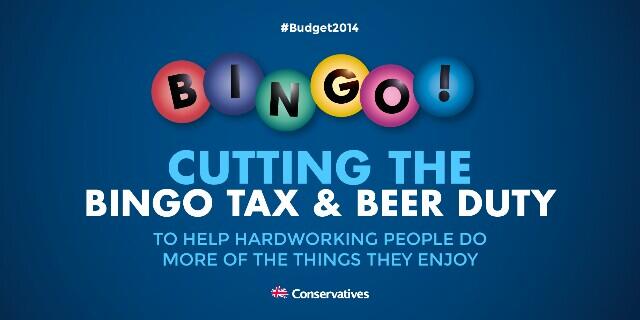
You'll probably have seen this by now:


It's - I was astonished to discover - not a parody. It's real. Not a parody. A real image produced by the Conservatives to publicise the benefits of their recent budget to 'hardworking people'. As you can see from the poster, this amounts to reducing the cost of bingo and beer. 

Actually, I have no opinion about bingo tax, but scrapping the beer escalator is a good thing, as far as I can tell, as it reduces the financial strain on smaller breweries. It doesn't actually help any individual drinkers, though, as they've only taken a penny off the price of a pint. Even I don't drink that many pints. I estimate I'd be better off by about £12 a year if the brewers passed the penny saving on to my local and my local passed on this penny saving to me (just kidding - that's how much better off I'd be if I drank 100 pints a month, which I don't. Honest). 

Anyway, the shocking fact that the Tories have done something right amongst all the wrong things they've done is beside the point. This is a linguistics blog, not a beer blog. There is so much wrong with this poster that I can't address it all, but there are two things about it that I will mention: the phrase 'hardworking people' and the pronoun 'they'. 

'Hardworking people' is an unfortunately overused phrase among all the major parties. I have no idea what it means or who it refers to. I'm a hardworking person. Is it me? Maybe. Are the Conservative MPs themselves 'hardworking people'? I'm sure they'd like to think so, but the wording of this poster doesn't seem to say so (more on that shortly, when we come to 'they'). Unfortunately, beer and bingo are stereotypical pursuits of the working class, and I fear that this is what they mean this time by 'hardworking people'. In this sense, it's very much a euphemism, because 'working class' really means 'poor people' and there are rather a lot of people currently out of work and therefore not doing very much 'work' at all. Whether they're drinking beer and playing bingo, I don't know. 

So, 'they'. Owen Jones in the Guardian describes this as 'the fatal pronoun'
The fatal pronoun is "they": it looks like a conscious attempt by well-heeled Tories to distance themselves from the great unwashed, who are presumably all getting hammered in bingo halls. This is the real "plebgate".
They is a versatile little word. It's very useful as a gender-neutral alternative to he and she, handy when you don't know someone's gender or would rather not specify one of those two. In its 'usual' use, as here, it's the third person plural pronoun, in nominative case (ie the one used as the subject of the sentence). It refers to some group of people who include neither the speaker nor the hearer. And that, perhaps, is the problem here. Clearly, the Conservatives (the 'speaker' of this sentence) do not consider themselves to be among 'the hardworking people', but neither do they consider the reader (the 'hearer' of the sentence) to be 'hardworking people' either. So who are 'they'? The 'little people', those who well-meaning people would like to help but really aren't one of us at all. 

The alternatives are no good either, by the way: the first of these is better, but still feels patronising, and the second is just clearly nonsense. 
'To help hardworking people to do more of the things you enjoy.' 

'To help hardworking people to do more of the things we enjoy.'