Showing posts with label books. Show all posts

Monday, 26 October 2020

Book review: 'The language lover's puzzle book' by Alex Bellos (Guardian Faber, 2020)

Full disclosure, as I don't normally do reviews in this blog, so publishing this one might be seen to carry a certain amount of weight: the author sent me a copy of this book with a suggestion that I might possibly write about it if I liked it. I did like it, so I am. 

Alex Bellos, Guardian puzzle-setter, has compiled 100 linguistic puzzles – sets of facts about languages from all over the world, with brain-teasers for the reader to solve – with some context about the languages. All of the puzzles are fully work-out-able from the information presented, so in this sense it's a pretty good approximation of what some of our introductory courses look like. I've even used some of the very same puzzles in this book in first year seminars before. They're mostly taken from previous Linguistic Olympiads. This is why I was looking forward to reading it, because for the last few years I've organised a 'markathon' for the advanced papers for the UK Linguistics Olympiad, and so I was already well aware of the fiendishness of some of the puzzles. Happily, Bellos hasn't included the very hardest ones in the book, so they're all manageable, though some are really tricky and would take you a while to do with pencil and paper. 

The way I approached the book was not to try to solve every puzzle as I read through the book. (You could do that, and it would keep you going a really long time, so it's good value if you're looking for a Christmas stocking filler, which I assume is the intended market.) Instead, I cast an eye over a puzzle to get the idea of it, and then flipped to the answers once I'd spotted the principle (or if I couldn't work it out quickly). For me, the interest was more in the linguistic knowledge rather than in the process of solving the puzzle, although some of them were very satisfying in that regard too. For that reason, I actually found having the answers in the back of the book a bit of a nuisance and would have been happy to have at least the bones of the explanation directly following each puzzle, to provide context and grammar facts with perhaps the full walkthrough in the appendix. But that's me, a linguist, not a puzzle-solver. For the average reader it's probably helpful to have the linguistic details separated out from the cultural context. But is that playing into the unhelpful separation of grammar and its speakers, that formal linguists are sometimes charged with? I don't know. 

It's really hard to write a book like this, where you convey the delight of linguistic variation, without falling into the trap of exoticising or depersonalising the languages you're talking about, detaching them from the people who speak them every day when you talk about them as an object to marvel at. I was well aware of this myself when I was asked to be the linguistic expert on a radio comedy panel show earlier this year. Even though the whole production team was consciously committed to not being racist, and fully aware of the perils of accidentally doing so, I know we didn't fully manage it. We avoided some potential clangers, to be sure, but I know we didn't get it right. Can you ever? I'm not sure. And I also think that it's good for there to be books out there that present this delight in diversity rather than just banging on about how wonderful language is without ever going beyond English, so there must be a trade-off, I suppose. In this book, there are the inevitable untranslatable words, Chinese compound words, and other tropes. There are a few scare quotes that I wouldn't have thought necessary (enclosing 'writing system' or 'texts', when the un-scare-quoted terms would have been accurate). Alexander Graham Bell's contribution to Deaf education is also discussed in a positive light, with no acknowledgement of the eugenicist views he held regarding Deaf people and the negative legacy of the methods he used. There are no signed languages included either, with the one exception of Cistercian sign language. But in the main, the material in the book is presented in the spirit it's intended: fascination with languages and the different ways they can do things. Languages are presented from all over the world, and although Europe is over-represented (especially English, which is a conscious decision on the author's part) and Africa rather under-represented considering the linguistic diversity there, it is a world tour.  

Most of the puzzles don't require you to have any linguistic knowledge at all. Some of them need you to make an educated guess about what a language might be like, but a lot of them are simply pattern-spotting and logical deduction.  Puzzle 10 was a nice example of one where you needed to simply match up the patterns, spot the links, but then make a couple of educated guesses about things that didn't quite fit: it demonstrated very neatly the complications that natural languages can bring. And the twist in that puzzle was a joy. I learnt some language facts from the book, including about counting in Japanese and Danish, and I also learnt other non-language stuff too: things about mathematical symmetry, and botanical notation for describing petal structure, and was reminded of the bizarre language to describe coats of arms. 

There's a strong focus on writing systems, as you might expect, with chapters on alphabets and scripts and invented writing systems and codes of various kinds. There are also chapters on terms for family members, counting systems and dates, which reflect the kinds of things that Linguistic Olympiad puzzles are about (and which you can make a self-contained puzzle about). I was impressed by how coherent the themes are, though occasionally something unexpected popped up - puzzle 45 is a fun puzzle about garden path sentences, in the chapter about kinship terms, linked just by including the phrase the old man. 

I'll be adding this to my department's recommendations for prospective students. It's linguistically accurate, as far as I can tell (bar the definition of parts of speech in the 'technical' chapter on grammatical features that differ most from English), with input from linguists and native speakers. And I'll also be passing my copy on to a teenager who I think will like it, having just taught himself Esperanto. I think it would work for someone who likes logic puzzles just as well as someone who likes language-related trivia, though, and definitely for someone who likes learning languages just for the sake of it. 

Monday, 30 September 2019

He said she said

Normally when I read a China Miéville novel, I blog or tweet the whole way through because the language he uses is so exciting and lovely. True to form, I read The Scar recently and I have Thoughts.

The leaders of the city Armada are The Lovers, a couple (one male, one female) whose names we never learn. They're both simply referred to as The Lovers when they're talked about as a couple, or The Lover when they're referred to alone. The image below, of p.731 from my copy, is typical of the way they are described.
Image of p.731 of The Scar, with dialogue of each Lover speaking in turn.
Each of the two Lovers speaks in turn, the man first, and then the woman. Here's the relevant bit from the first part, where he speaks (you can tell because the male pronoun 'he' is used):
'Many of those who are dead,' the Lover began... and in that way... he continued. 
And then the female Lover speaks, which you can tell because of the female pronoun 'her':
'We are very close,' the Lover said, and an edge of excitement crept into her voice.
The interesting thing about it is the way that Miéville doesn't make any distinction between the two Lovers' names beyond using the relevant pronouns where appropriate. The Lover is what we call an R-expression, or referring expression. It's a definite noun phrase and it works basically just like a name. Imagine that you had two people called Billie speaking in a dialogue. You'd differentiate between them by using maybe the initial of their surname, like 'Billie J began... Billie C responded...'. Or if you were talking about two girls chatting, you'd say 'The first girl said... the other girl replied...'.

These expressions include as part of their meaning the notion of uniqueness. Using the implies that there is only one of the thing you're referring to, or at least only one in the relevant context. So if there's more than one, like with the girls example, you have to add in something that makes each the only one (like the first girl), so that the two referring expressions refer to different things. In the Lovers example, there is just one referring expression and so it should refer to just one unique thing. But it doesn't; it refers to either of the two Lovers. Without making any concession by saying, for instance, the male Lover, Miéville flouts this expectation of uniqueness, creating a very unsettling effect.

Monday, 21 January 2019

Have you eaten Grandma? (review)

Image result for have you eaten grandma
Cover of 'Have you eaten Grandma?'
by Gyles Brandreth

I was considering writing a review of this book, Have you eaten Grandma? by Gyles Brandreth, but to be quite honest it's not worth bothering.
[Edit: I ended up writing a review of it anyway so here you go.]

It's neither surprisingly good nor toe-curlingly awful. I got it for professional purposes (I'm teaching a module on 'Grammar for Everyone' this term and want to look at all sorts of books that claim to be about 'grammar') and I'll get something out of it for that, I suppose, but I'm glad I didn't buy it for pleasure.

I had been ready to be cross about it after seeing this little video in which Gyles (known as being a pedant, has done truly awfully smug programmes about language in the past) talks about some of his 'bugbears' including redundant myself, can I get rather than may I get, and so on. In fact, it's exactly what you expect.

The majority of it is punctuation advice. It's fine, with only a few mistakes, but Eats, Shoots and Leaves is better if that's what you want. Then there's lists of words, either just ones he likes or ones that people often get wrong in writing (accept vs except, for instance) and mnemonics (sometimes very weird ones) to help remember them.

He has a bizarre joy in some -- but not all -- neologisms. He seems to have (like Stephen Fry) come around from pure prescriptivism to the joys of what he calls 'slang' some time in the 1990s, and so he loves things from then. He's constantly saying End of, for example, like at the end of the video above. He gives a long list of initialisms like WTF (which he loves) and describes some of them as being of 'the Whatsapp and Snapchat generation', which needless to say were totally unfamiliar to the teenager I asked. And yet he is so rigidly inflexible about some things that he was taught were correct, and so are immutable rules for him (you mustn't ever, ever say bored of, for example, despite the fact that there's no harm in it whatsoever and millions of people do say it).

There's an embarrassing section of the abbreviations part where he talks about labels for gender and sexuality that verge on poking fun at LGBTQIA-type initialisms. He shows a clear support for non-binary, non-straight identification, but still betrays an opinion of 'simply straight' being 'normal' and 'knowing where you are'. The section on American vs British English is terrible, and relies only the books of people like him, not linguists. This is not a book that seeks to promote truth.

This is very evident throughout, when he often refers to 'the Brandreth Rule' on particular points. This means that he knows that there are different ways of doing things, and his arbitrary choice is the one he likes the best. That's what this book is. It's for people aged about 50 or 60, who 'love the English language', and just want someone who agrees with them to reinforce their opinions and tell them the things they already know so that they can be smug about knowing them. I've come to realise that anyone who says they 'love the English language' doesn't really love the English language, not as it really is. They love some idealised version of it, the version they speak, the version they think is 'best', and which is being 'corrupted' by Americans, kids, foreigners, or modern education.

It's a perfectly acceptable, slightly dull book. If you want to learn some stuff about punctuation or commonly confused words, then it's one way of doing that (but not the best way). If you just want an authority to refer to on certain style points, it'll do that (but there are better authorities to refer to). It's not the best of any of the things it does, but it is by Gyles Brandreth, and that is its selling point. End of. (Sorry, that was such a lazy way to end this but I couldn't resist.)

Wednesday, 7 June 2017

Three mistakes in one sentence

This is the first in a short series of posts about things I've noticed in my current book, The Leopard by Jo Nesbo. I'm reading the English translation by Don Bartlett, published by Vintage. It's originally written in Norwegian so some of the things I write about might be influenced by that, I suppose.

Here, Harry Hole, the main character, takes issue with his colleague's grammar. This is not just a quirk of Hole; the other things I'll be blogging about are similar grammatical observations from other characters in the book, so I can only assume Nesbo is the one who is a stickler for precision.


The second two mistakes are factual errors, or judgement differences, so I'll leave those aside. The first, though, is Harry claiming an agreement error. He thinks that the verb should be singular is rather than plural are, to agree with the clausal subject [punks shooting good policemen] rather than the closest noun, the plural policemen. This is a common error; I'm forever correcting it in essays. It's easy to do because there's a suitable noun just before the verb, and our brains have forgotten that the real subject was ages ago, and take the easy option of the closest noun.

He's absolutely right if the subject really is that clause. Why clauses should be singular and not plural, when they don't really seem to be the kinds of things that can be singular and plural, is an interesting question in itself. We might say that it's semantically a singular event, the event of shooting described in the clause. More plausibly, I would say, is that when something can't have number (it's 'underspecified') we default to the singular, which is the unmarked option in English (and in languages generally).

What if, though, the subject is punks? It could be. Then the subject still has a clause, but instead of it being a clausal subject describing an event [punks shooting good policemen], it's a noun punks with a relative clause modifying it: punks [who are shooting good policemen]. What about that, eh? Then we do want plural agreement on the verb and it should be are.

But here's a thing: we can replace the noun punks with a pronoun, which in this case would be they or them, as it's 3rd person plural, and look! It's totally bad with they no matter what form the verb takes, and it's only good with singular agreement when it's them.
*As far as they shooting good policemen is concerned
*As far as they shooting good policemen are concerned
*As far as them shooting good policemen are concerned
As far as them shooting good policemen is concerned
The lack of the option of nominative case (they) shows that this isn't a real subject of the gerund (or rather, that the 'subject' of a gerund is not the same as a normal clausal subject). If there was no modifying clause, we could use they, and then we'd have to use plural agreement: As far as they are concerned. So part of this pattern is actually an artefact of the fact that you can't have a modifying relative clause with a pronoun. Note that if we put back in the who are that I showed as understood earlier on, it is obligatorily plural agreement, and it also demonstrates very clearly that punks is outside the relative clause.

I really do think it could be either singular or plural, depending on the structure. Not that this matters, much, but it does show firstly that subtle distinctions can illustrate different underlying syntax, and secondly that it's not a good idea to be too nitpicky about grammar in case a linguistics blogger comes along and takes issue with your correction.

Saturday, 14 January 2017

On the rudeness of 'bint'

Last November I read The Goldfinch by Donna Tartt. It was really good, incredibly readable (I whizzed through it) and engaging and moving. That's the book recommendation; from here on in there's very bad language so stop reading now if you don't like that.

Here's a bit of the text from the book:

As you can see, Boris uses the word bint, which is unfamiliar to the main character Potter. When he asks what it means, Boris (who is Russian and very linguistically adept in various languages including English slang) says 'Same as a cunt, basically'. This book is set in the USA, so maybe things are different there, but the two words definitely do NOT mean the same to me.

Cunt is so rude that I never say it (unless I'm writing a blog post about it...). I never say bint either, but it's extremely familiar to me from growing up in Newcastle, where it's an everyday part of the language. It really isn't taboo; children say it, adults say it around children, it's not frowned upon as a 'bad word'. The only reason I never say it is that it feels very derogatory towards women. It's generally used in a critical way, and often in a phrase like stupid bint. It doesn't feel affectionate to me. It's from Arabic (I only just found this out) - the same word means 'daughter' in Arabic. According to Wiktionary, the Yemeni community in Tyneside meant that it entered the dialect in that area, and it supports my sense that it's pejorative, as does the OED, which notes that it entered English from the language of British servicemen in Egypt in the two world wars.

But it's really, really not as taboo as cunt, I promise. The OED has the difference between the two as being 'colloq.' versus 'coarse slang'. Cunt is often cited as the most offensive swearword in English. This Independent article reports on a study that puts it in the top three. And yet, somehow, I dislike bint more, because it has this added sense that the pejorative sense comes from the femininity of it: it's an insult because it's a word for a woman, rather than because it's used towards one.

I should say that I'm talking about Standard English. It is true that for some people, cunt is an extremely common word, used all the time, and not used offensively. Among friendship groups it may be used as an affectionate or neutral term for other members of the group. And in Glaswegian dialects it's commonly used in an entirely neutral way, classed as a pronoun by my linguist friend Gary Thoms. Here's a video he shared with me, illustrating exactly this (and note that this usage frequently escapes the censors, because of a mix of the non-aggressive use and the accent):


Tuesday, 24 May 2016

The ones I could see


I'm reading The City and the City by China Miéville at the moment. I'm only about 60 pages in but I already really like it, partly for its clever ideas which are currently just emerging, but also for its languages. Miéville has a linguistics background and this shows in the plot of some books (Embassytown, for example) and the writing in all of them: he's creative and clever and does really unusual things with words. Not that you need to have a linguistics background to be able to do that, but it seems like he really knows what he's doing with language. I don't know, I know nothing about literature, so I can only waffle in an uninformed way on that point. But his sentence structure is so clever sometimes, and in this book the characters are from somewhere in central Europe, so the names are all made up but completely believable, and things like that. I think there was even some zeugma at one point and I really love zeugma. 

[Very slight spoilers follow, maybe? Not sure, I haven't read enough of it myself to know.] 

One thing that made me stop and admire it today was a clever use of could. There are parts of the city that the main character can't see. The sentence that caught my eye was describing some railway arches. He says (my bolding):
Not all of them were foreign at their bases. The ones I could see contained little shops and squats decorated in art graffiti.
At this point in the story, the reader doesn't know what the concept is here. Is it that he was able to see the arches, or that he was permitted to see them? This latter idea is what other events have hinted towards, but so far it could be either. 

This is because can and could (present and past tense respectively) can mean two different things. The first meaning, where he was able to see the arches, illustrates logical modality, or the possibility of him seeing them. The second, where he was permitted to see them, illustrates deontic modality: what is possible within the rules. This is an absolutely lovely use of this ambiguity which allows him not to reveal too much of this conceptual device this early in the story. I'm pretty sure he knew exactly what he was doing when he wrote it that way. 

This ambiguity is also, by the way, why you get smartarses responding to a question like 'Can I go to the toilet?' with 'I don't know, can you?'. 

Friday, 2 October 2015

Iceland in translation is less icy

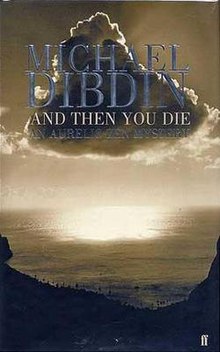
I read one of Michael Dibdin's Aurelio Zen books, And then you die. Part of the plot (not really a spoiler) involves Zen (an Italian) finding himself unexpectedly in Iceland. The Italian consul, who meets him there, tells him where he is, and they have this exchange (in Italian):
Snæbjörn Guðmundsson: This is Iceland.
Aurelio Zen: I don't see any ice.
Snæbjörn Guðmundsson: No, Greenland's the icy one. 
This is true. Iceland isn't specially icy (not all over it, anyway) and Greenland is very icy. This fact always pleased me.

But Zen is Italian, and does not speak English (he originally believes himself to be in America, where he was bound for, and assumes the people are speaking in some obscure regional dialect of English). The Italian for 'ice' is ghiaccio, though, so the etymology of the Italian name of the country, Islanda, is not obvious as it is in English. It comes as a direct borrowing from the Icelandic name, and the Italian Wikipedia page has to explain this fact, indicating its non-transparency. Similarly, Greenland is Groenlandia in Italian, while 'green' is verde. In Italian, the confusion should never arise.

Friday, 4 September 2015

Steven Pinker at the Royal Institution

I went to a talk by Steven Pinker to promote his book, The Sense of Style. It was held at the Royal Institution, which is a science institution and this book is probably the least scientific thing Pinker has ever written, but still. I went along because although I'm now enough of a linguist to know that Steven Pinker is not some kind of god, his book The Language Instinct is still indirectly the reason I'm now a linguist (I read it aged 15 or so and found it fascinating, and that was my first introduction to linguistics). I took my copy along to sign and he very graciously did so despite me not buying a copy of the one he was plugging.


The talk itself will be available to watch on the Ri channel so I needn't summarise it too thoroughly. Pinker was a very entertaining speaker, with lots of jokes that most of the audience didn't seem to have heard before (I had heard them but still laughed because he tells them well). He began with the standard 'everyone has always said language is degenerating' bit, and the 'look how silly most style advice is'. So far, so expected. But the interesting part was when he got onto his own advice.

Digression: style guides serve one useful purpose, which is to ensure consistency within a particular publication. So the Guardian, for example, has a style guide, and it means that the writing of many different people published in the Guardian follows the same rules (usually). It's a slightly different style from the New York Times, but that too is internally consistent. Everyone knows the rules are arbitrary to some extent (else they'd all be the same), but the important thing is to follow the ones for whoever you're writing for. Therefore, style guides that lay out pernickety rules as if they're gospel are never going to be useful. They just cater for nervous writers who think there is a right way to do things that they need to know. People who think they need style guides really just need to read more and to have more confidence in their command of language, not to be told they're doing it wrong.

So this was why I thought it was odd that Pinker had done a style guide at all: what makes him think that his advice is any more likely to stand the test of time than Strunk and White's, now hopelessly outdated? While he did have some arbitrary peeves (he seems not to like the intensifier use of literally, for example, which is currently 'wrong' but very common and no doubt on its way to being unremarkable), his main focus was on the big picture. This is unusual in style guide land and, I would guess, more along the lines of what you'd get if you took a writing course (I've never taken one so I don't know, but I'm assuming they don't teach you not to split infinitives). But developing a good, readable, accessible style is of course much more what 'style guides' should help with, rather than minor grammar issues.

He promised that there would be insights from cognitive science and linguistics. I'm not sure how much there was from linguistics in the talk (perhaps there was, and I missed it as it's too familiar to me?) but his main point was that a good writer uses 'classic prose' style. I'd never heard this term before, but having now googled it a little bit, it seems that it's related to something called 'plain style'. I'm not totally clear on what each is - either classic style is a fancier version of plain style, or else it's plain style with some sophisticated thought. Either way, classic style apparently has clarity as its main aim. This is obviously a very good aim. Pinker criticised 'academese' among others as being very verbose and not at all clear, and much of it is, but I always aim for simplicity and clarity and encourage simplicity for the sake of clarity in my students' work. The focus is on the thing being shown and guiding the reader with not too much hedging, narrating a story.

The cognitive science part came when he compared this to the idea of knowing what someone else knows (theory of mind, illustrated by the Smarties tube task or the Sally-Anne task). Bad writers, he said, can't forget that just because they know some jargon or fact doesn't mean that others also know it. Good writers are better at putting themselves in other people's shoes and bringing the reader along with them.

This was pretty cool, and also linked into a hoary old chestnut of style advice: passive voice. He demonstrated how narrating a story means that sometimes it's better to use active and sometimes passive, so it's silly to say never to use passive. But he also said that passive voice is more common in bad writing. Why? Because bad writers work backwards from their own knowledge and don't properly tell a story in order, beginning from the position of not knowing something.

I hope I haven't spoilt all the good bits of the book. I'm putting it on my reading lists, as I think it'll be useful for students. Their 'curse of knowledge' is different, though: rather than being unable to forget that they know something and wrongly assuming their reader does too, they are unable to forget that their reader does know the material and feel as though they don't need to explain it. And although I didn't feel exactly that I learnt something, as such, the talk did make some subconscious knowledge conscious and that always makes it easier to apply it. But don't analyse the writing in this blog post because I publish these totally unedited (because time) so the style is bound to be all over the place.

Tuesday, 1 September 2015

Misunderstanding

I'm currently reading English for the Natives by Harry Ritchie. I might try and do a proper review sometime, but for now here's a snippet.

I knew that this book was not going to be sympathetic to my linguistic views when I saw Ritchie at the English Grammar Day this year and he went on about how wrong Chomsky was about Universal Grammar. I work within the paradigm of Generative Grammar, which is what people outside GG call 'Chomskyan' grammar. Chomsky himself does not use this term, and I dislike it as it implies uncritical acceptance of all his ideas (and, actually, the worst critics of Chomsky do assume this of his 'followers', as they inevitably call them, as if he is a cult leader).

Generative Grammar has been extremely successful, and is a flourishing research area, but there is an equally flourishing anti-GG crowd as well. Some of these people simply work within different frameworks and don't pay too much attention to us, but others actively attack Chomsky's ideas in particular. A characteristic of these people is that they tend not to engage with very up-to-date work, they tend to look at Chomsky only and no other researchers, and they often misunderstand or misrepresent things. Ritchie is not a linguist, although he has had some training, and so I'm going to put the mistake I'm about to talk about down to misunderstanding rather than deliberate misrepresentation. (One thing that is definitely misrepresentation is when he switches from a reasoned exposition of the ideas of Universal Grammar into using terms like 'magical', which is simply ridiculous when he outlined the non-magical explanation a few pages earlier.)

On page 51, during the 'ah, but it turns out Chomsky was totally wrong' section, he describes Geoffrey Sampson's work refuting Chomsky's claims using the British National Corpus. At one point, he says that he simply 'dusted down his 1947 edition of Teach Yourself Malay' to show that there is no universal distinction between nouns and verbs - apparently this language doesn't have this supposedly universal demarcation. They must think generative grammarians literally never look at other languages. If it was that easy to disprove just by looking in one book, would the theory really have stood up all these years? He even then says that English 'often dispenses with any noun-verb distinction and relies on the speaker to figure out how the word is functioning', with examples like 'cut' which can be either, depending on context.

This is such a basic misunderstanding. English and Malay both do distinguish nouns and verbs. Having them behave differently in the two different contexts precisely is distinguishing them. When cut is a noun, it can take an article, for instance ('make a cut along this line'), while it cannot when it's a verb, but then it can have a subject ('she cut the cake'), which nouns cannot. This is distinguishing nouns and verbs. Malay is even less of a good example: it actually has affixes to indicate if a word is a noun or a verb. This is not even just context: the form of the word itself distinguishes the categories.

The literature, especially popular books like this one, abounds with such fundamental errors. See, for example, the recent book by Vyvyan Evans, criticised here for its many, many misrepresentations. See also the lengthy debate about recursion, admittedly not helped by a fantastically unclear definition of recursion, but which once properly defined ought simply to have ended but trundles on regardless.

Anyway, I'm expecting the book to get much better once we're past the Chomsky-bashing, because Ritchie had a lot of interesting things to say at the English Grammar Day and spoke (and writes) in a very entertaining manner.

Saturday, 30 November 2013

(On the) origin of (the) species

Recently I went to the Hancock Museum in Newcastle. I had a look round their shop and saw this iPad cover designed to look like the jacket of Charles Darwin's book On the origin of species.


The trouble is, as you can see, it says Origin of the species. This is a reasonably common mistake: the content words are present and the 'little words' get mixed up or left out. Doesn't matter? Well, maybe not, but maybe it does.

The way Darwin wrote it, it's clear that it refers to the process by which there are lots of different species (natural selection). The way it's written on this cover, it might do, because the plural of species is species. But it easily might not, and I suspect that it doesn't in the minds of the people who make this mistake. After all, one of the major ideas in this book is the idea that humans are descended from apes, so it's natural for people (self-centred as we are) to think of it as being about the origins of the human species.

Does it matter? Well, I think so, because humans are not the most important thing in the world, no matter what we may think. To us, though, we are. It would just be nice if people designing (quite expensive) products to sell could take two minutes to make them accurate.

Monday, 4 November 2013

Interesting uses for linguistics 1

In the book '48 hours' by J Jackson Bentley (a fairly crappy crime thriller), forensic corpus linguistics turned up. In the book, a woman is kidnapped and her kidnappers make her send a videoed message to her boyfriend. She's a smart cookie so she gives lots of coded information about where she's being held in the message, including the word 'print'. The police try to find out what she might mean by this. They do that by running the word through a database to see what words 'print' occurs with most often.
“Luke again,” the speaker chirped. The computer is showing that the word ‘print’ can be associated with the word ‘press’ in the next sentence, as in ‘printing press’. This could be code for Dee telling us that the industrial unit houses a printing press.”
There's a good deal of suspension of disbelief required to get through this book, but this is a real thing. It's called 'collocation': when a word tends to co-occur with another one with greater than chance frequency.

If you look at a corpus (collection of texts) like the British National Corpus, you can very easily make it tell you this stuff (I'm no corpus linguist and even I can do it). Here's a screenshot of what happens if you look for the words that most frequently occur immediately after the word 'print' or one of its derivatives (such as 'printing'). The photo's a bit small but 'press' is there on the list, in eighth most common position (if I've worked the search terms right), after things like 'characters', 'material' and so on. I suppose, if you were looking for a clue to a place, 'press' would be the first one to give you anything to go on.


You can click on the words and find out what the context is, just in case there's some false results or you want more detail or whatever, and you get this:


That shows you the type of writing it was found in, and gives you the bit of sentence either side so that you can understand the phrase in context. I'm not really au fait with police techniques, but I wouldn't be at all surprised if they do use this kind of method when it's appropriate. There are such people as forensic linguists who work closely with the police, whose job is often to determine if a particular person is the author or a document.

Spoiler alert: 
So they located a nearby printing press and, after much showdown, rescued 'the girls', as the two adult hostages were patronisingly referred to throughout. 

Friday, 10 May 2013

They wait you

Sounds sinister, that title, like a line from a classic ghost story. It's not - I said it, in the perfectly pleasant surroundings of Côte in Covent Garden, talking about the lunch we'd had that day in the London Review Bookshop.

This bookshop is a very nice bookshop with a small selection of linguistics books hidden at the bottom of a small set of shelves in the basement. But I wasn't there to peruse the books. It was lunchtime, I was having a break from seeing Ice Age things at the British Museum with my parents and we needed some lunch before going to see Pompeii and Herculaneum things. There's a very nice cafe in the bookshop, selling home-made sorts of food and a million types of tea. It's small though, and popular, so we had to wait for a table. The waitress suggested we wait in the bookshop and she'd come and get us when there was a free table.

I was telling my aunt about this when we met her later on, and I said:
They wait you in the bookshop.
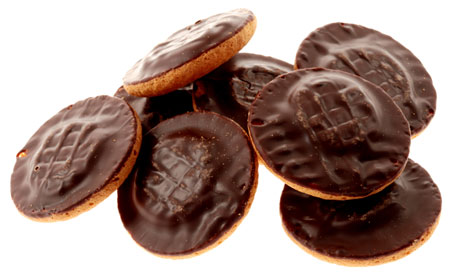
Wait is not normally used this way, but I liked it so I let it stand. Normally, wait doesn't have an object - that is, (roughly) something acted on by the verb. Sleep doesn't have an object (I slept) but catch does (I caught a rabbit), and eat either can or can't (I've eaten or I've eaten six Jaffa cakes). Wait is like sleep (I  waited). What I said included an object: They wait you (we can ignore in the bookshop for now, because it's optional in the sentence).

Sometimes, we have verbs that change the number of objects they have (in this case from 0 to 1) because of some syntactic difference. This is different from eat, which either has a 'null' object meaning 'some unspecified kind of food' or just has two very closely related meanings.

Wait normally has a subject which is the person doing the waiting: if I say I waited, it's me who's done the waiting. With eat, that subject stays the same whether we add an object or not: I ate or I ate six Jaffa cakes, it's still me who ate something. But look at the sentence above: the subject is not the person who is waiting. When I said They wait you in the bookshop, it's not 'they' who are waiting, it's the object of the sentence, you (=us, in that case). So when I added the object, I also changed the role of the participants in the action.

What I meant by that utterance was, I suppose, They make you wait in the bookshop or They cause you to wait in the bookshop. I've turned it into what linguists, in an uncharacteristic show of naming things transparently, call a 'causative'. It's comparable to grow: I can say either I grew, and then it is me who became larger, or I can say I grew a plant or I grew the profits and then it is something else that I have caused to become larger.

It's also related to something called 'middle voice'. It's called that because it's in the middle between active and passive. If you think about a sentence like The cake cuts well, then the cake is grammatically the subject of an active verb, but the meaning is that the cake is the thing that is cut, and that's the meaning you'd get from a passive form: The cake has been cut. English doesn't do this loads, compared to some other languages, and that's not what's happening with wait above. It's just a similar phenomenon.

Monday, 6 August 2012

Replace all

I've just finished reading the Hunger Games trilogy by Suzanne Collins. It was all right, not great literature but a fun enough read. Odd typos in the last book though.

One thing was that there very often lacked a space between sentences. I have no explanation for that. Another thing was three misspellings, all related. The first was evapourate. The second was elabourate. The third was labouratory. In each case, the error is an extra u where there shouldn't be one. Can you see why?


Sunday, 10 June 2012

Monday, 7 May 2012

A strange case of misattributed prescriptivism

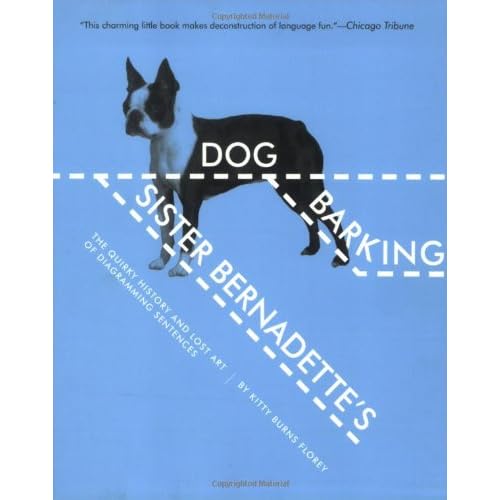
I recently treated myself to this book for the princely sum of 5p (plus £2.80 delivery from America - really,  you can't say fairer than that). It's called Sister Bernadette's Barking Dog, though unless you have been through the US education system you might not be able to tell that from the cover:


It's about sentence diagramming, which, when I first heard the term, I thought was the same thing as what we do in syntax, representing the structure of sentences as tree diagrams. Apparently not: it's a different way of doing a similar thing, and US kids were taught it in school until quite recently (I think around the same time they stopped teaching grammar in UK schools). It's a nice little book, and I'll review it at some point, because I did find it quite interesting. 

But today's post is about a passing mention on page 116-7. In a chapter in which the author, a copy editor named Kitty Burns Florey, ponders incorrect usage and whether diagramming sentences could help to eliminate it, she says this of Lynne Truss's punctuation book Eats, Shoots & Leaves:
...as exemplified in Truss's ridiculing of what she considers bad English - including the attempts of immigrants to use it (resulting in such less-than-hilarious errors as "Plum's 49c a pound"...
Florey then devotes a paragraph to her admiration for people whose first language is not English, and the cuteness of their errors. I think this is a fairly uncontroversial stance; in this largely monolingual country, I at least (a monolingual speaker surrounded by amazingly competent non-native speakers and polyglots) share this admiration. And Lynne Truss is ridiculing foreign greengrocers? Not fair.

Now I do happen to have my copy of Eats, Shoots & Leaves to hand. Lynne Truss is a massive prescriptivist, at least in the realm of punctuation, by anyone's standards (and actually, if you are going to be a prescriptivist, you might as well be a punctuation prescriptivist because at least it is a contrived system with entirely invented rules and no natural existence other than its sometimes arbitrary relation to prosody). She says things like this:
Someone wrote to say that my use of "one's" was wrong...and that it should be 'ones'. This is such rubbish that I refuse to argue about it.
Well, OK, fine, but she has just spent several pages arguing about other incorrect apostrophisation, so this seems a bit like sticking your head in the sand. Anyway. Not the point. The point is, I'm not saying she isn't a prescriptivist; that's the whole point of the book. But does she really go so far as to ridicule immigrants' attempts to use English? My memory of the book told me no. And anyway, it's entirely written in British English, even as far as the lack of a serial ('Oxford') comma in the title, which in most US publishing house styles would be Eats, Shoots, & Leaves, so why would she refer to the price of anything in cents?

So obviously I checked. There is a long chapter on the apostrophe, and in that chapter she does refer to greengrocers' famous misuse of it (which the "plum's 49c" example must surely be an example of). However, at no point does she even mention immigrants, or the price of plums, and she also writes this:
The only illiteracy with apostrophes that stirs any sympathy in me is the greengrocer's variety. 
So not only does she not mention immigrants and not use the quoted example, she excuses errors such as the one she supposedly ridicules.

I did consider, of course, that the US version of the book might be different. It seemed unlikely that it would have been completely rewritten, but perhaps a word changed here or there for US readers might give an unintended interpretation. These days, we can check this kind of thing because Amazon allows you to search inside a book. I did, and at no point in either edition does the word plums come up, however you punctuate it. In fact, the editions appear to be exactly the same, even down to the same pagesetting.

Did Florey read the book wrong? Did she misunderstand something that was never there? I can't see how she possibly could. Are greengrocers mostly immigrants where she comes from? Round my way they're exclusively English. Just a case of misremembering? Maybe, but I can't help thinking that if you're accusing someone of something, you should double-check they do actually do it.

(By the way, Florey is just as big a prescriptivist as Truss. I think you have to be, to be a copy editor. She spends the next few pages after this comment railing against ain't, youse and double negatives as 'seriously low class'.)

Friday, 25 November 2011

Who are 'Asians'?

So, there's this book. (You can't Click to look inside!, that's just part of the image. Go to Amazon if you want to do that.)

I'm not going to review it because I haven't read it (it's only on Kindle and I don't have one, as you know), and it's not fair to review a book based on the publisher's blurb. Let me just say that I'm deeply sceptical about its central claim, which is
that "human cognition is not everywhere the same"-that those brought up in Western and East Asian cultures think differently from one another in scientifically measurable ways. Such a contention pits his work squarely against evolutionary psychology (as articulated by Steven Pinker and others) and cognitive science, which assume all appreciable human characteristics are "hard wired." 
Of course there are cultural differences, and they may well be measurable, but I really don't think that this challenges the idea that all human cognition is basically the same.

[Update: I found this blog post with the text of an article submitted to Cognitive Linguistics. It reanalyses Nisbett's work and reckons it's due to linguistic differences rather than cultural differences, as Chinese people respond differently from Japanese people in tests. For instance, head-directionality, they claim, means that Japanese people mention context first, whereas American people mention salient information first.]

Anyway, like I say, I'm not reviewing it. I'm quibbling about a decision (by the publishers?) to keep the subtitle that was used in the US edition. It's this:
How Asians and Westerners think differently... and why.
I'm reasonably comfortable with the use of catch-all expressions for broad ethnic groupings; sometimes it's necessary. So 'Westerners', for me, means North Americans and West/Central Europeans, and probably also Eastern Europeans as well nowadays. As far as I can tell from the blurb, that's pretty much what the author intends:
those brought up in Northern European and Anglo-Saxon-descended cultures
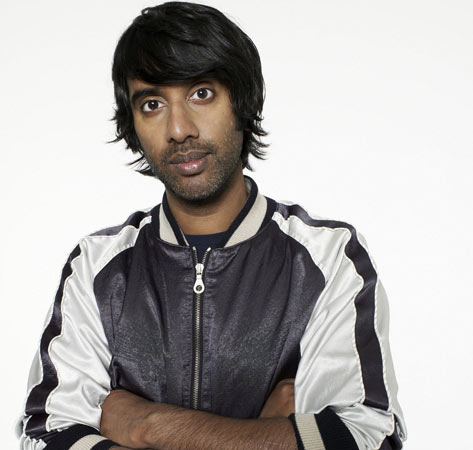
But 'Asian', to me and to most UK English speakers, means people who look a bit like this:

That's Nihal, a well-known DJ on BBC stations Radio 1 and Asian Network. This differs quite a lot from what most US speakers mean by 'Asian':

Presumably the publisher knows about this difference. And presumably they didn't put the subtitle on the front cover for this reason. And throughout the blurb, it refers to 'East Asians', which is presumably a concession to this difference in the meaning of the word. But still, it makes me think the whole book is equally as careless (I'm sure it's not) and puts me right off reading it.

(Actually, we really could do with a better term than 'East Asian'. 'Oriental' doesn't seem to cut it these days, even though it just means 'eastern'. I'm fresh out of ideas though.)

Wednesday, 2 November 2011

Kindle is for lowbrow, hard copy for highbrow?

That's the main message of this Telegraph article, which did some kind of statistically dodgy survey and found that while 71% of the books (real ones) on respondents shelves were 
autobiographies, political memoirs and other weighty non-fiction titles,
the most popular books on Kindle are - surprise - the popular genres like mystery, thriller, romance and fantasy. It's supposedly because if you're using an ereader, people can't judge a book by its cover, as it were. It frees readers from the shackles of their intelligent, thoughtful public image and allows them to indulge their mucky desires for fluffy pink romance and heaving flesh. 

Thursday, 13 October 2011

Word count shock - higher than expected

It's been a while since I've done a post about word counts. Since I moved here from Tumblr I've tried to be, you know, interesting, so there's been fewer posts about the trials of writing a PhD (which is what this blog began life as).

However, this new development is so shocking that it merits a post. I recently compiled all my comments on all my drafts, and taking a tip from Monica Macaulay's excellent Surviving Linguistics (for some reason not easy to get hold of anywhere but from the publisher), I printed them out and filed them. While doing this I added up all the word counts and it came to.... 37,774. This is astonishing, considering I would have said I had around 20,000, so I'm pretty chuffed with myself. However, I now have to write the other 40-odd thousand, so perhaps I should stop congratulating myself and get on with it.

Wednesday, 21 September 2011

Is that a fish in your ear?


There's a new book out which I haven't read yet. However, that never stopped anyone posting an Amazon review, so I'll throw my thoughts into the pot. It's called Is that a fish in your ear?: Translation and the meaning of everything, by David Bellos. His son Alex wrote a book called Numberland, which I also haven't read but is always on Waterstone's featured displays.

I've got another book called The meaning of everything (which is excellent, by the way - by Simon Winchester, about the Oxford English Dictionary), so no points for the sub-title. Points for the title though, which references the Babelfish from Douglas Adams' Hitchhiker's guide to the galaxy.

There was an extract of this book featured in the Independent the other day, describing how Google Translate works. Google Translate is a much-mocked tool, and originally rightly so. It could be relied upon to give you absolute garbage, no matter what you put into it. Hours of fun could be had translating text from one language to another and back again, and sniggering at the Chinese whispers result. Even better fun if you put it through more than one language on the way. These days, however, Google translate is disappointingly good. It gets translations pretty much completely accurate most of the time (NB It still should NOT be used to translate if you don't know the output language - you cannot guarantee it isn't utter nonsense).

The section featured in the Independent describes how it works. Here's an extract from the extract:
  
In fact, at bottom, it doesn't deal with meaning at all. Instead of taking a linguistic expression as something that requires decoding, Google Translate (GT) takes it as something that has probably been said before.
The corpus it can scan includes all the paper put out since 1957 by the EU in two dozen languages, everything the UN and its agencies have ever done in writing in six official languages, and huge amounts of other material, from the records of international tribunals to company reports and all the articles and books in bilingual form that have been put up on the web by individuals, libraries, booksellers, authors and academic departments.
It uses vast computing power to scour the internet in the blink of an eye, looking for the expression in some text that exists alongside its paired translation. Drawing on the already established patterns of matches between these millions of paired documents, Google Translate uses statistical methods to pick out the most probable acceptable version of what's been submitted to it.
This is fascinating, and obviously a good way to do it. After all, people do speak and write in fairly formulaic chunks a lot of the time. It's an efficiency device, so that we don't have to create new expressions from scratch all the time. This is why you get annoying cliches like at the end of the day and in any way, shape or form. It's also why you have standard greetings (how's it going) and ways of expressing yourself like I'm so sick of (X).

And as the author points out, human translators basically work this way too: they can often pre-empt the person they're translating and guess what will come next, based on frequently-used expressions. But this way of translating assumes that everything we say or write (or almost everything) has been said before. One of the first things we tell beginning linguistics students is that we can come up with a completely new sentence, that's never been uttered before, and any speaker of English can understand it. The standard practice is then to come up with some ridiculous sentence, like All of my armadillos have been put through too hot a wash and have shrunk.

I suppose that, faced with this sentence, Translate would take its constituent parts and translate them. So, for instance, it might find the string too hot a wash, or even have been put through too hot a wash, paired with a translation, somewhere in its corpus.

In fact, I just tried it and it didn't fare so well. I put it through an English-French-English process and it came back with this translation:
All my tattoos have been too hot to wash one and have narrowed
If you fiddle with the alternate translations you get there eventually, though I'm not sure how idiomatic it is. Ah well. There's jobs for human translators yet.

If you're waiting for the paperback edition of this book, in the meantime I highly recommend Mouse or rat?: Translation as negotiation by Umberto Eco. I have read that one, and it's utterly engrossing. 

Saturday, 3 September 2011

Linguistic sci-fi, part one

We were having a conversation about linguistic sci-fi the other night in the pub (best place for it, I find). I love sci-fi, and I love linguistics, and I once read a list by Geoff Pullum (in the collection of his columns, 'The great Eskimo vocabulary hoax') of books that combine the two.

To count as linguistic sci-fi, language/linguistics has to be relevant to the story, in my opinion. It's not enough that they just speak a different language, like Klingon in Star Trek. Although there is some linguistic aspect, as Klingon is obviously supposed to sound aggressive, you couldn't say that Star Trek is linguistic sci-fi just because of that. To count, the language has to be central or at least important to the plot.

The books on Pullum's list turned out to be surprisingly hard to get, but this is one I did find on Amazon:

It wasn't that great, to be honest. The basic idea is that someone wants to control the people of Pao, who are docile and peaceful (well, not warlike anyway). To control them and make them a bit more fighty, the scientists at another planet, Breakness, have devised a new language which will allow them (force them?) to be less placid. It's obviously all very Sapir-Whorfian, and an interesting idea. It's unfortunately not really my kind of book, being the kind where the characters must flee things and avenge people and wear big weapons and so on.