Showing posts with label punctuation. Show all posts

Tuesday, 10 August 2021

Perhaps I'm asking a question?

I've just finished reading a book called 'Statistics without tears' by Derek Rowntree. It's a basic tutorial on statistical concepts focussing on the ideas and principles, rather than walking through actual calculations in any detail. I found it useful and would recommend. But I'm here to talk about language, not statistics! 

The book is written in what I would describe as a very 'careful' style. You know it - the way older academic writers tend to, with quite precise attention to punctuation. Even though the tone of this book was very informal, friendly and not at all stuffy, I felt that every colon and dash was considered. 

So it was interesting to me that both times Rowntree used a sentence in the form Perhaps you recall..., he ended it with a question mark: Perhaps you recall the idea of a confidence interval? (p.183). I've had a quick look around the internet and can't find much on this topic other than a few sites peeving about the use of a question mark with perhaps, saying that it is not necessary and therefore wrong. There are people asking about it in English forums, indicating that it's something that might feel natural. 

It seems likely, then, that it's a 'declarative question' - the same as if he'd written You recall the idea of a confidence interval?. These are common enough, though definitely I would say a feature of less formal writing, just as contractions like I'll or don't are, which Rowntree also uses throughout. But it is interesting that he doesn't use this form - he uses perhaps. The question mark itself is enough to allow the reader to see that it's a question, and to therefore know that they are not being told that they do recall the idea, but rather prompted to agree that yes, they do recall that idea. So perhaps adds a bit more prompting, a bit more questioning, a bit more possibility of you not in fact recalling the idea of a confidence interval but that's absolutely fine because it was a few chapters ago and it's complicated stuff so don't worry. 

Monday, 21 January 2019

Have you eaten Grandma? (review)

Image result for have you eaten grandma
Cover of 'Have you eaten Grandma?'
by Gyles Brandreth

I was considering writing a review of this book, Have you eaten Grandma? by Gyles Brandreth, but to be quite honest it's not worth bothering.
[Edit: I ended up writing a review of it anyway so here you go.]

It's neither surprisingly good nor toe-curlingly awful. I got it for professional purposes (I'm teaching a module on 'Grammar for Everyone' this term and want to look at all sorts of books that claim to be about 'grammar') and I'll get something out of it for that, I suppose, but I'm glad I didn't buy it for pleasure.

I had been ready to be cross about it after seeing this little video in which Gyles (known as being a pedant, has done truly awfully smug programmes about language in the past) talks about some of his 'bugbears' including redundant myself, can I get rather than may I get, and so on. In fact, it's exactly what you expect.

The majority of it is punctuation advice. It's fine, with only a few mistakes, but Eats, Shoots and Leaves is better if that's what you want. Then there's lists of words, either just ones he likes or ones that people often get wrong in writing (accept vs except, for instance) and mnemonics (sometimes very weird ones) to help remember them.

He has a bizarre joy in some -- but not all -- neologisms. He seems to have (like Stephen Fry) come around from pure prescriptivism to the joys of what he calls 'slang' some time in the 1990s, and so he loves things from then. He's constantly saying End of, for example, like at the end of the video above. He gives a long list of initialisms like WTF (which he loves) and describes some of them as being of 'the Whatsapp and Snapchat generation', which needless to say were totally unfamiliar to the teenager I asked. And yet he is so rigidly inflexible about some things that he was taught were correct, and so are immutable rules for him (you mustn't ever, ever say bored of, for example, despite the fact that there's no harm in it whatsoever and millions of people do say it).

There's an embarrassing section of the abbreviations part where he talks about labels for gender and sexuality that verge on poking fun at LGBTQIA-type initialisms. He shows a clear support for non-binary, non-straight identification, but still betrays an opinion of 'simply straight' being 'normal' and 'knowing where you are'. The section on American vs British English is terrible, and relies only the books of people like him, not linguists. This is not a book that seeks to promote truth.

This is very evident throughout, when he often refers to 'the Brandreth Rule' on particular points. This means that he knows that there are different ways of doing things, and his arbitrary choice is the one he likes the best. That's what this book is. It's for people aged about 50 or 60, who 'love the English language', and just want someone who agrees with them to reinforce their opinions and tell them the things they already know so that they can be smug about knowing them. I've come to realise that anyone who says they 'love the English language' doesn't really love the English language, not as it really is. They love some idealised version of it, the version they speak, the version they think is 'best', and which is being 'corrupted' by Americans, kids, foreigners, or modern education.

It's a perfectly acceptable, slightly dull book. If you want to learn some stuff about punctuation or commonly confused words, then it's one way of doing that (but not the best way). If you just want an authority to refer to on certain style points, it'll do that (but there are better authorities to refer to). It's not the best of any of the things it does, but it is by Gyles Brandreth, and that is its selling point. End of. (Sorry, that was such a lazy way to end this but I couldn't resist.)

Thursday, 1 December 2016

Worst. Blog. Post. Ever.

The snowclone 'Worst. X. Ever' (from the Comic Book Guy in The Simpsons) is easy enough: just substitute X with whatever it is you're commenting on, and you're done.


The full stops represent the way Comic Book Guy says the phrase, with a distinct pause between each word. It distinguishes this quotation use from just any old utterance of 'worst X ever'.

What do you do with them when the X is more than one word? These two tweets illustrate the difference. This one gets it wrong:
While this one gets it right:

If your X is more than one word, you can't put full stops after every word. The full stops represent pauses, and you don't pause in the middle of perfume name and Tinder bio. They're intonational phrases, spoken with a single intonational contour.

I slightly suspect it might be different with a phrase where the stress falls on the second word, though. For example, Worst. Jacket. Potato. Ever. seems to work a bit better (though Worst. Jacket potato. Ever is still best in my view).

Wednesday, 16 December 2015

German suddenly makes Esperanto make sense

As you know, I'm learning German and dabbling in Esperanto. Esperanto is primarily based on romance languages as far as the vocabulary goes, with a bit of English and German thrown in, and its cases are a bit like German. One thing that was bugging me about Esperanto was that when I learnt about subordinate clauses, there was always a comma after the main verb. Like this:
I hope, that I get something nice for Xmas. 
This is weird to me, as it's just not the way we do it in English and I can't help reading it with a strange Shatneresque style. But I have discovered that German does this (romance languages do not, at least in my experience), so it appears to be another aspect of Esperanto borrowed from German rather than the romance languages.

Tuesday, 3 November 2015

The Oxford, comma

For those that don't know, the Oxford comma (or serial comma) is the comma that can come before 'and' in a list. I was taught not to put one there when I was at school, but it is a stylistic choice (and a regional one: it's more used in America). It's massively controversial and people get far too worked up about it. Just google it and you'll see.

These examples are frequently cited as evidence that the Oxford comma is essential:


What they show is that sometimes, the writing would be clearer with the comma before 'and'. It's true; it would be. But there are also times when it would be better without:
Those at the ceremony were the commodore, the fleet captain, the donor of the cup, Mr. Smith, and Mr. Jones.
Here, the sentence could read as if Mr Smith donated the cup, but he is meant to be just another person in the list.

And then there are times when you'd have to be some kind of weirdo to misunderstand the meaning:


Note, of course, that all of these examples are only ambiguous in writing. In speech you have different intonation patterns to tell you what the meaning is.

What this boils down to is people on the internet wanting a rule that they can blindly apply and then criticise those who don't know it. What would be a more sensible strategy would be if people just read their work through and applied punctuation where it helps to make the writing better, and not where it doesn't.

(FWIW, this excerpt from Mental Floss seems to get the balance about right: 'George Ives, the author of a 1921 guide to the usage style of the Atlantic Monthly Press, ... [shows that] making the comma before "and" standard practice is more economical. This way, the reader will know for sure that if it's missing, there's a good reason.')

Sunday, 21 June 2015

Gove's random writing style rules

Michael Gove has been the subject of this blog in the past. These days, he's no longer Education bod and is now Lord Chancellor, if you can believe that. Because this job apparently doesn't involve much actual work, he's got a lot of time on his hands and is spending it complaining about the way people write and making lists of things his people should do or not do when they respond to letters.

His list of things is a mixture of surprisingly sensible advice on general style (don't be repetitive, don't be pompous, be nice and thank people for their letters), content (refer to the inherited economic situation at every opportunity) and really random concerns about punctuation and grammar.

He also seems to have been influenced by Strunk and White, as his advice also includes 'if in doubt, cut it out' (which is good advice if you are writing formal documents), and 'in letters, adjectives add little, adverbs even less'. (There is a point here, although it cannot be taken too literally, as 'little', 'even' and 'less' are all adjectives or adverbs.)

According to the Independent article I linked above, his 'rules' include the following:

Use active voice and present tense. 
This is a well-worn rule. It's good advice in some ways, because people do sometimes use passive sentences to 'pad out' their writing, but there's so much nonsense written about it and people are so demonstrably unable to tell what's active and passive anyway (scroll down to section 3 at that link for examples), it's not actually very helpful advice.
Don't use 'impact' as a verb.
Lots of people have peeves about words that were originally nouns being used as verbs. That's fine. It's illogical, because so many of our verbs were originally nouns it seems silly to pick out just one or two, but whatever. I think it's because this particular one is perceived as a 'management-speak' buzzword, which is indeed annoying.
Don't use contractions.
Fair enough. Formal writing does usually avoid contractions (so 'don't' should be 'do not', for example). I used to enforce this quite strictly in student essays, but these days I let it go, as I recently noted, because I'm on a mission to discourage the lumpen, clumsy, underconfident writing style I see too much of. I don't know what kind of letters these civil servants write; if it's very formal then they should follow Gove's rule, but if they want to adopt the 'warm tone' he elsewhere encourages, I'd use contractions.
While 'best-placed' and 'high-quality' are joined with a dash, very few others are. 
Bit of a weird thing to say. There are well-established rules about when you use a hyphen. There are some that are a matter of preference, such as with prefixes (so some newspapers prefer to hyphenate 're-think' while others prefer 'rethink'), and these are (or should be) flexible enough to allow for violations in cases of potential ambiguity. If we turn to examples of the type Gove cites, there is a rule: 'best-placed' and 'high-quality' are spelt with a hyphen if they are used attributively (which basically means before a noun, like I used 'well-established' just now) and not if they are used predicatively (which basically means after a verb like 'to be', as in 'the rules are well established'). You would not write 'the food is very high-quality', for instance. So it's daft to pick out two random examples and incorrectly state that they always have a hyphen and incorrectly state that others don't, when you could just follow the correct way we're all already doing it. But hey - what do I know.
Don't use 'unnecessary' capitalisations.
Agree. Some people like to use capitals to make words seem more important, I think. Capitalisation rules are pretty arbitrary (compare English with German, which capitalises nouns) and it has changed even since I was at school (when I was taught to capitalise seasons), but there are rules and not following them makes you look like you don't know them.
Replace 'ensure' with 'make sure'.
OK. Random, but I guess it seems simpler.
Don't start a sentence with 'however'. 
As I recently wrote, 'however' is tricky. Sometimes people introduce a silly rule in order to rule out a genuinely incorrect usage without having to explain its complexity, but in the process rule out a lot of other correct usages. 'Don't end a sentence with a preposition' used to be one of these. I have a strong suspicion that the common ban on first person pronouns in essays is one too - if students can't write 'I', they can't write stupid waffly phrases like 'I believe that'. Likewise, banning sentence-initial 'however' would also rule out some incorrect used of 'however'. But it would not catch those I complained about in my post linked above, and it would rule out a lot of perfectly fine ones. So I think this another Strunk & White rule, who apparently allow uses like 'However much you complain, I'm not going to stop doing it' but dislike it when it's used with a comma: 'However, we were unable to change her habits'. This is silly, out-of-date advice which will lead to old-fashioned, distant writing. I'm saying nothing about whether that says anything about Gove's character.


Wednesday, 23 July 2014

Noun phrase juxtaposition confusion

Associated Press caused a twitter hoo-ha when they mistakenly led a lot of their followers to think that there had been yet another air crash, this time involving the plane carrying the bodies of people who were killed in the recent Malaysia Airlines crash. They phrased it like this:
Breaking: Dutch military plane carrying bodies from Malaysia Airlines Flight 17 crash lands in Eindhoven.
Lots of people reasonably thought that this meant that this plane had crash landed in Eindhoven. It didn't; it meant that the bodies from that crash have been taken to Eindhoven, where the plane has landed safely. You can read the Gawker article linked above for all the responses (my favourites are those who say 'well, AP style is 'crash-land' so it clearly didn't mean that').

One of the tweets, about halfway down the Gawker article, says that 'AP should have thrown some tactical commas/hyphens/apostrophes in that one'. Bear with me while I derail my linguistics blog into the realm of punctuation for today's post.

Monday, 16 July 2012

Forensic linguistics for spam detection

We're all getting quite good at spotting email spam now. Our filters are pretty clever and get rid of all the obvious stuff anyway, so that leaves us with just the non-malicious stuff from companies we've bought things from, and the ones that the filter can't quite detect. Most of us don't fall even for these ones, but some people obviously still do, or they wouldn't still be doing the rounds. Almost all of these tell you something about your account, either the email account you're using or some other account that they purport to be from, and ask you to verify your details. By doing this, you're giving your details to some scammer who will then use them for nefarious purposes.

Now I think that this is the chance for linguistics to come into its own, and simultaneously force everyone to learn how to write properly. The plan is twofold:


Monday, 18 June 2012

'Scare quotes'

Lately I've seen two very effective uses of scare quotes - the quotation marks you put round a word or phrase to indicate to your reader that you don't mean the word or phrase literally. 

There's a whole blog of scare quotes used wrongly or with unintended effect, including examples like this one:


This is the equivalent of doing the bunny-ears gesture when you say something (and it's weird that I just defined a writing convention by the gesture that clearly arose from the written form). 

Anyway. So there's this sign up in my department, because someone's phone is 'lost'. (I've removed the person's details so as, you know, not to put people's phone numbers on the internet without their consent, but if you've seen the phone let me know and I'll pass it on.) The sign looks like this:


Those magnificent scare quotes around lost convey, perfectly, this person's passive-agressive attitude to this: the phone is not lost, it has been stolen, but because the sign-maker has no evidence for this, he will keep up the pretence that it is merely lost. But you know who you are, phone-pincher.

The other scare quotes I saw this week performed a very different function. Our region is switching over to digital TV in September, and so 'they' (don't know who is in charge of this) have sent us a booklet telling us what will happen and what we need to do. One of the things we might need to do, if we have outmoded equipment, is buy a new telly. Luckily we're OK, but there might be some old people who need to buy a digibox but don't have a SCART socket on their telly (stay with me, we're going somewhere). The booklet tells them that if this is the case, they need to ask for a digibox with an 'RF modulator'. In scare quotes. This tells the reader, effectively,
Don't worry, we know all these technical terms are meaningless. You don't need to know what it is, just ask for this and you'll be given the right thing. 
The same punctuation mark, used in two different ways, to such different effect.

In the 'lost' sign, it's almost like lost and stolen are scalar implicatures, which means that stolen is a type of lost but more specific. If a phone is stolen it is also lost, but if it is lost it is not stolen (by implicature, as you would say stolen if you meant it, because you use the strongest term on the scale that is true).

In the second case, it's the use of quotation marks in the same way we might use them in academic or technical texts, when you use a term and need to show that you're using it as a term, for the first time. It's interesting, actually, that this is a type of punctuation that doesn't seem to need much explicit teaching. It must be an intuitive thing. Which might, of course, lead to the signs on the blog I mentioned earlier - the writers think they are defining terms, although they aren't really. The writer of the sign above thinks he needs to point out that (s)he is using the term 'urine drops'. Although why the writer felt the need to use the term 'urine drops' I really don't know.

Monday, 7 May 2012

A strange case of misattributed prescriptivism

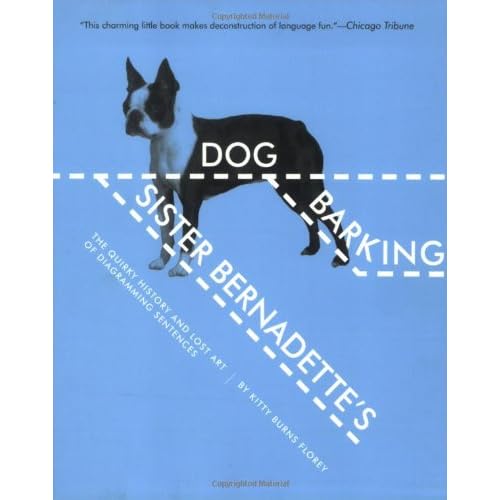
I recently treated myself to this book for the princely sum of 5p (plus £2.80 delivery from America - really,  you can't say fairer than that). It's called Sister Bernadette's Barking Dog, though unless you have been through the US education system you might not be able to tell that from the cover:


It's about sentence diagramming, which, when I first heard the term, I thought was the same thing as what we do in syntax, representing the structure of sentences as tree diagrams. Apparently not: it's a different way of doing a similar thing, and US kids were taught it in school until quite recently (I think around the same time they stopped teaching grammar in UK schools). It's a nice little book, and I'll review it at some point, because I did find it quite interesting. 

But today's post is about a passing mention on page 116-7. In a chapter in which the author, a copy editor named Kitty Burns Florey, ponders incorrect usage and whether diagramming sentences could help to eliminate it, she says this of Lynne Truss's punctuation book Eats, Shoots & Leaves:
...as exemplified in Truss's ridiculing of what she considers bad English - including the attempts of immigrants to use it (resulting in such less-than-hilarious errors as "Plum's 49c a pound"...
Florey then devotes a paragraph to her admiration for people whose first language is not English, and the cuteness of their errors. I think this is a fairly uncontroversial stance; in this largely monolingual country, I at least (a monolingual speaker surrounded by amazingly competent non-native speakers and polyglots) share this admiration. And Lynne Truss is ridiculing foreign greengrocers? Not fair.

Now I do happen to have my copy of Eats, Shoots & Leaves to hand. Lynne Truss is a massive prescriptivist, at least in the realm of punctuation, by anyone's standards (and actually, if you are going to be a prescriptivist, you might as well be a punctuation prescriptivist because at least it is a contrived system with entirely invented rules and no natural existence other than its sometimes arbitrary relation to prosody). She says things like this:
Someone wrote to say that my use of "one's" was wrong...and that it should be 'ones'. This is such rubbish that I refuse to argue about it.
Well, OK, fine, but she has just spent several pages arguing about other incorrect apostrophisation, so this seems a bit like sticking your head in the sand. Anyway. Not the point. The point is, I'm not saying she isn't a prescriptivist; that's the whole point of the book. But does she really go so far as to ridicule immigrants' attempts to use English? My memory of the book told me no. And anyway, it's entirely written in British English, even as far as the lack of a serial ('Oxford') comma in the title, which in most US publishing house styles would be Eats, Shoots, & Leaves, so why would she refer to the price of anything in cents?

So obviously I checked. There is a long chapter on the apostrophe, and in that chapter she does refer to greengrocers' famous misuse of it (which the "plum's 49c" example must surely be an example of). However, at no point does she even mention immigrants, or the price of plums, and she also writes this:
The only illiteracy with apostrophes that stirs any sympathy in me is the greengrocer's variety. 
So not only does she not mention immigrants and not use the quoted example, she excuses errors such as the one she supposedly ridicules.

I did consider, of course, that the US version of the book might be different. It seemed unlikely that it would have been completely rewritten, but perhaps a word changed here or there for US readers might give an unintended interpretation. These days, we can check this kind of thing because Amazon allows you to search inside a book. I did, and at no point in either edition does the word plums come up, however you punctuate it. In fact, the editions appear to be exactly the same, even down to the same pagesetting.

Did Florey read the book wrong? Did she misunderstand something that was never there? I can't see how she possibly could. Are greengrocers mostly immigrants where she comes from? Round my way they're exclusively English. Just a case of misremembering? Maybe, but I can't help thinking that if you're accusing someone of something, you should double-check they do actually do it.

(By the way, Florey is just as big a prescriptivist as Truss. I think you have to be, to be a copy editor. She spends the next few pages after this comment railing against ain't, youse and double negatives as 'seriously low class'.)

Monday, 16 April 2012

Fuckin A and the importance of commas

I saw this image on the internets illustrating this poor chap's inability to use commas (and knowledge of the difference between the spelling of comma and coma, an important distinction). 
After sniggering at the inappropriate mental image, I actually had trouble working out what the original meaning was. The comma is supposed to go after I have to watch him, I think (although a full stop would be better, probably), so 'Robby' has to watch his grandpa tonight. Then he says fuckin a man, tonite is gunna suck.

Well that's odd, I thought. Surely, if I know anything about anything, fuckin a is short for fuckin awesome (sorry about the inordinate amount of swearing in this post, by the way). And you would not be saying that it was awesome if you then said it was going to suck. Which he does. It's sarcasm, I suppose, but I missed it because people like this are not normally known for their use of sarcasm (by 'people like this' I'm generalising horribly over all people who write like this, but it's true).

So I looked it up on Urban Dictionary, because that's where you get incomplete and inaccurate information about colloquial expressions, and it said that it does stand for awesome, but that you can use it whether the situation is good or bad. The entry never mentions the word 'sarcasm', though, so I wonder if it's not sarcasm but in fact just generalisation or broadening of an expression from an exclamation of pleasure to an exclamation of any strong feeling. Knowing the intonation would help, but as I don't associate with teenagers I can't say it's a usage I'm familiar with in real life. Or irl, as the internet would say.

Monday, 27 February 2012

A and an and innateness

I tutor students on writing skills in order to not starve to death in a garret while I write my PhD. Most of the time they have problems with punctuation, argumentation, structure and so on. Most of the time I patiently explain how to do it right, and then they have to work on improving. Sometimes that's hard, like if they have difficulty in writing critically, and they have to really practise. Sometimes it's simple: honestly, the number of times I've explained how to use a semi-colon and the student has said 'Oh, that's quite easy, isn't it? I wish someone had told me that before'.

Every now and then, a student has a problem and I can tell them, 'You already know how to do this; just do it the way you say it'. I love it when that happens. The trouble is, students with poor grammar are used to not trusting their own knowledge. They say I seen it happen, but they must write I saw it happen. They say We don't know the reasons for this but they must write We do not know the reasons for this. They say /ðɛə/ and /ðɛə/ but write there and their. It's a minefield out there.

So I do understand when a student isn't sure about using a and an. It's a simple enough rule, on the face of it: use a before consonsants and an before vowels. But then what about words like university or hour? And abbreviations like MP and USB? If you follow the rule, you end up with something that conflicts with what you feel like it should be. Here, the key is to trust your instincts. Of course, the rule works off the sound of the pronunciation, not the spelling. So University sounds like you- and hour sounds like our. MP sounds like empee and USB sounds like you-ess-bee.

But the clever thing is that I could say to that student, just do it the way you say it and you will always be right. That's quite exciting. A native speaker of English, once they're no longer a very young child, will never ever get that wrong (apart from slips of the tongue and the like - but that's different). They will never be unsure which they should use. It's obviously not innate, as it's a language-specific rule, and children do say Can I have a apple, but I can't recall if it's something you're explicitly taught. I have a feeling it's not. But it is an example of the worry caused by learning that there are rules and that you're probably not doing it right.

Friday, 30 December 2011

The importance of apostrophe's

Yes - I know. It's a deliberate mistake.

Anyway, this is a screenshot from something on TV (via Tony Tooke):


As you can see, this shop offers rabbits eggs for 2/4 (that's two shillings and fourpence) a dozen.

I'm joking, of course, clearly there is no such thing. They can't possibly be selling them because if they were, it would read rabbits' eggs. Of course. I mean, the ability of grocers to use apostrophes appropriately is widely known and noted.

Monday, 31 October 2011

14 punctuation marks that you never knew existed

I did know that some of them existed, actually. The full list is here. It's an annoyingly ad-full page but worth persevering with to learn that marks like these exist (comments are from the original site, not mine):


Because Sign

Because Sign
This one's so cool. It's like the "Therefore" sign, but upside-down, and it means because.

Exclamation Comma

Exclamation Comma
Just because you're excited about something doesn't mean you have to end the sentence.

Hedera

Hedera
Hedera is Latin for ivy. Why that is relevant here is not very clear at all, but this little glyph was used back in the day to mark paragraph breaks. Seems like it was probably really hard and annoying to draw, but it looks nice.