Showing posts with label TV. Show all posts

Sunday, 26 November 2017

I'm literally lowkey a telly star now

I was on the telly recently! It may just have been the local station, but it's a start. Media stardom beckons! If you want to watch it, it's here.

It's a funny thing, being asked to talk about some research that's not your own and that you may not have actually read (as I hadn't, in this case). I was talking about what the papers had been calling 'gradable adverbs'. As I attempted to explain, it's the adjectives that are gradable and the adverbs that do the grading, so you can describe something as hideously old or bizarrely purple. We are apparently, says a linguist from Lancaster with a book to promote, using less of these and this shows we're becoming more confrontational. Furthermore, this is something we are learning from the Americans. Ding ding ding, all the boxes ticked for a news story: language is fundamentally changing, it reflects a deep and sweeping cultural change, American English is ruining our language.

I haven't read the original research, as I say, so I don't know how much of this Paul Baker actually says. I also couldn't really comment on the veracity of British usage following US usage by around 30 years. But I could say that we definitely are not losing all our adverbs, and it definitely can't be ascribed to us becoming more confrontational. I did agree with my interviewer that the words we are losing are the 'posh' ones (frightfully, awfully and so on), and there is, I'm sure, a link between your desire to sound posh and how direct your attitude is.

But we've got LOADS of these adverbs. We use them all the time. Kind of and sort of and a bit are pretty common, as is pretty, really, etc. They go in and out of fashion. You can check corpora, as Baker did, to find out what ones were preferred in a certain type of text at a certain point in history, and you can do other kinds of searches of online corpora to find out what's going on right now.

Two that I really wanted to mention and didn't manage to are literally and lowkey.

I can't believe that all the papers missed the chance to moan about literally as well, and can only assume that (as evidenced by them using the meaningless phrase 'gradable adverb') that they don't really know what an adverb is so didn't realise that it is one. Anyway; it is.

Literally gets a lot of column inches (or whatever the online equivalent is). People get upset because other people use it as an intensifier rather than using it to mean what they think it should mean. Other better people than me have written about why worrying about this is a fruitless activity, and why the peevers aren't using the literal meaning anyway (=to do with letters) and the slackers aren't using it figuratively (go on, try it - try replacing literally with figuratively. It won't make sense because that's not what it means) so I won't try. But what it is is an intensifier, exactly like what Baker says we are losing, although it's a bit more versatile in terms of its syntax. So there's one more new one we can all adopt.

Lowkey is not so familiar to me; I've never heard it in the wild, I don't think. I've seen it written, online, so it's obviously used by people outside my own social circle (=young people, probably). Gretchen McCulloch has written about it and gives some examples. It means kinda, so it's a 'downtoner' of the kind Baker also says we are losing. There's something more going on, I think, as one of Gretchen's examples has it combined with an intensifier af (= as fuck):
When you're lowkey sad af but trying not to care
But there's another one. We've got tons of these. Come on, people. Use your adverbs. Those adjectives need grading!

Monday, 13 March 2017

That's not a dumb question, innit

In my MA syntax class this week we were talking about innit and how it's going from being a tag question to a kind of discourse particle.

Tag questions (aren't we?, don't you?, won't she?) have the following properties (among others):

  1. They follow the main clause 
  2. They have the form of a question
  3. They contain an auxiliary verb that matches the one in the main clause or is do (are, do and will in the examples above)
  4. The verb agrees in person and number with the main clause verb (e.g. 1st person plural, 2nd person singular or plural, and 3rd person singular in the examples above)
  5. They have the opposite polarity to the main clause (so they're often negative, following a positive main clause, but can be positive if the main clause is negated: He's not coming, is he?) (though see NB below)
  6. They have a pronoun that matches the main clause subject (we, you, she above)

Isn't it is a form of tag question, then: it has all the above properties in an example like It's a funny old world, isn't it?. But in some dialects, it has crept out of these constraints and is used in a broader range of contexts, and as well as losing a lot of its phonological properties (it's reduced to innit), some of the syntactic properties in 1-6 no longer apply to it.

1: It still follows the main clause. But that's about it.

2: It may not have the form of a question. Lots of times, it's written without a question mark (OK, that's no guarantee, but it's telling). It's attached to sentences that can't possibly be questioned, like assertions on the part of the speaker: You're fit, innit. That's the speaker's opinion. How can it be questioned?

3: The verb probably doesn't match the main clause one now - in the example I just gave, it does, but you can also say I've got no money, innit, where it doesn't.

4, 6: We no longer need the agreement in person and number. In We're late, innit, the verb in the main clause is first person plural. Innit, if it comes from isn't it, is 3rd person singular. Similarly, the pronoun is it rather than the matching one in the main clause, we.

5: Generally, the polarity is opposite to that in the main clause, but only by chance: innit is negative, and more sentences are positive than negative. But I heard an example on Gogglebox this week of a negative clause followed by supposedly negative innit:
That's not actually a dumb question, innit. 
Cool, innit?

NB: Tag questions can have the same polarity as the main clause if they're both positive, but it has a different meaning. Compare: 
a. That's the bus we need to get, isn't it? 
b. That's the bus we need to get, is it? 
In a, the speaker thinks they have the correct information and wants their interlocutor to confirm it. In b, the speaker thinks that the interlocutor has the relevant information, and wants to confirm it. But we don't find negative assertions and negative tags:
*That's not the bus we need to get, isn't it? 

Monday, 29 February 2016

Poochi!

I re-watched the Minions film last night, and wondered about their language. The Minions are these chaps and their buddies (there are no female Minions, as far as I can tell):

They speak in a language that isn't quite understandable but you get the gist - like Pingu or the Clangers. However, unlike Pingu or the Clangers, there are very definitely words in the Minions' speech, and some of them are definitely recognisable. Some are English but most are Spanish or Italian, or a mix of them all. There's also a little bit of romance language grammar in there too: at one point, one of the Minions says me le due, meaning 'I will do it', and you can see the object clitic le (a clitic is basically a type of pronoun that goes before the verb in romance languages, like the m' in je m'appelle Laura).

When I asked about the Minion language on Twitter, @terminologia directed me to this Arika Okrent article which goes into much more detail, including noting the many aspects of 'baby talk' - in that me le due sentence, for instance, there is the object form me - just like an English toddler might say me do it. The article also points out that some of the language is Indonesian - I hadn't noticed it, but there's a very clear terima kasih 'thank you' at one point. (Actually, I thought terima kasih was Malay, and so it is, but it was borrowed into Indonesian and that's the language the director is familiar with.)

Here's the Minions Dictionary (though I don't think it's quite complete).

Sunday, 3 January 2016

Oldman, not old man

Another thing I watched over Christmas was a repeat of A Touch of Cloth, a comedy detective series by Charlie Brooker. There's a character in it called Detective Oldman, and many jokes are had around her surname and the phrase old man. The thing is, the name is pronounced differently from the phrase. You pronounce the name with a reduced second vowel, so it's [ˈɒldmən], whereas the phrase old man is pronounced something like [ɒldˈmæn] (the first vowel varies a bit). Even if you don't read IPA, you can see they're different in the vowels used and where the stress is placed. This meant that in the programme, for the jokes to work, her name had to be pronounced like the phrase rather than in the usual way, which sounds decidedly weird. 

Saturday, 2 January 2016

Seen as this is the 1930s

I watched ITV's Harry Price: Ghost Hunter over the Christmas break, which starred Rafe Spall as the eponymous psychic investigator/faker/unmasker.

One linguistic fact of note is the spelling of his first name, which I assume is a respelling reflecting the pronunciation of the name Ralph, which is now usually pronounced as it looks.

But what caught my ear was the very modern-sounding language. One character used vowels which I would have said were characteristic of Estuary English or MLE: monophthongs where RP would have had a diphthong, for instance. And Rafe Spall himself said, at one point, seen as rather than the normatively correct seeing as (meaning more or less because or since). I'm hesitant to say that this is anachronistic, as it's almost invariably a 'recency illusion' when anyone makes an argument like that. Rather, it's probably just that we expect posh and middle class people in period dramas to speak in RP, and when they don't we find it jarring. But I can't find out how old this variant is, because it's virtually ungoogleable and I'm not sure where else to go to look for it. Seen as has indeed increased massively since 1960, but I can't filter out the false hits like we were seen as inferior, where it's not the same thing. Anyone happen to know about this? (Sorry if the chart is not the right size - html skillz are failing me today. Follow the link above to the original.)

Thursday, 13 March 2014

Code-switching contrastive emphasis

I'm watching Salamander. It's a kind of political thriller, lots of running about, photocopying and suchlike. It's also Belgian, and the dialogue is mostly in Flemish. It's a bit complicated to explain the situation, because 'Flemish' is Dutch as spoken in Flanders, but then some varieties (eg West Flemish) can be considered separate languages, and Flemish is a cultural label as well, and... well. Anyway. They're speaking Flemish for most of the time. Every now and then, though, they switch into French, either for a single word, a few words, or some of the characters seem to use French as their preferred language so you get a whole conversation in it. You also sometimes get 'parallel talk', where one person in a dialogue uses Flemish and another uses French.

One such scene took place, in which a dialogue took place between about five people, one of whom was using French. He said 'We have to know who our enemy is', and a Flemish speaker replied 'enemIES', stressing the fact that there are more than one single enemy. This is contrastive stress, and is a nifty way of indicating that you're contrasting something you've said with something the other person either said or implied. The contrast can be lexical/semantic: I want BEANS (not cheese), or it can be grammatical, as you can see here, where singular is contrasted with plural. Normally you need to contrast two things that are similar in some way, like two nouns/foodstuffs/potato fillings.

What's special about this is that the two languages do plural in different ways. French adds an -s in the written language, going from ennemi to ennemis. But in fact, in speech, you won't usually hear that -s, and the only thing to tell you the difference is the 'determiner', an article, demonstrative, etc. In this case it was 'our', which in French is notre for singular and nos for plural. I didn't catch the exact word in Flemish but in Dutch it's vijand for 'enemy' and the plural is marked with an -en: vijanden. The possessive determiner stays the same, and in any case the Flemish speaker didn't repeat 'our'. So we had this:
A: (We have to know who is) notre ennemi. 
B: vijandEN.
The Flemish speaker contrasted a possessive determiner with a totally different morphosyntactic category, a plural inflection, because he was contrasting the feature [number], which is encoded on the determiner in French and the noun suffix in Flemish.

Monday, 28 January 2013

Women in public

This is a blog about linguistics and language, but I do occasionally stray into academia (which is where I do linguistics). This is one such post, so feel free to skip it if you're here for the linguistics.


Thursday, 23 August 2012

Spoffles, flanges and pobbling

Words get into the language in lots of funny ways. Most of them have been there so long we don't know, or we just know that we brought them with us when we left Germany. Lots of them were borrowed, from Latin and French in the case of English. Lots of words we make ourselves, with our word-making tools like suffixes (brightness) and compounding (carwash). My favourite type of words are the ones that someone makes up, and they catch on.

Quiz was supposedly an early example of this, when (according to anecdote) a Dublin man had a bet that he could introduce a new word into the language. Sadly, as with so many such anecdotes, it's probably bunk, as it was in use already by the alleged time of this bet. Still, there are some words that we know were invented this way, as the people who did it either did so on film or are around to tell us.

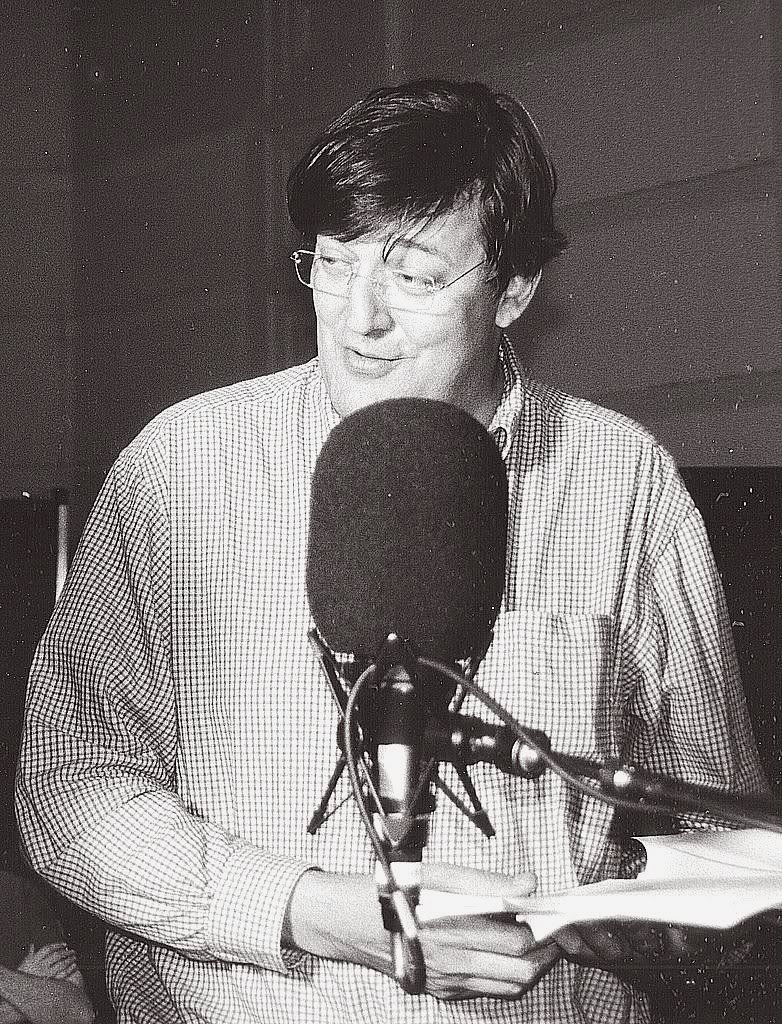
Spoffle, quite apart from being a great word, is a useful one, if you ever have anything to do with microphones, as I sometimes do. It's this thing, in front of Stephen Fry:

Source: http://www.stephenfry.com/forum/topic/fry-a-day/page/759
It's the foamy cover for a mic that prevents 'popping' and cuts down wind noise. Essential item, apparently unnamed (people seem to use the very dull microphone cover) until Hugh Laurie called it a spoffle (in Stephen Fry's hearing, which is partly why he's in the photo above). This is what I always call it, and lots of others do too. At my old job it was the common name for such things. But, astonishingly, it's not in the OED and it doesn't have a Wikipedia article. Apparently it used to but it was deleted, and now it's not even mentioned in the section on microphone covers.

Another word that came out of British comedy is the collective noun for baboons, a flange, and for gorillas, a whoop. Flange has caught on remarkably well and, although it too doesn't get into the OED (they're so cautious, those lexicographers) it's used by people, including (allegedly) academics (although I have not read the papers or books in which it's used). Here's the sketch, with Mel Smith and Rowan Atkinson talking to Pamela Stephenson:


Literature has been a source of some good words. Lewis Carroll invented the word chortle as a blend of chuckle and snort, although not many of his more creative efforts from the Jabberwocky have caught on. This OED blog post talks about Edward Lear, who made up a lot of words (runcible spoon being a particularly well-known example) and also used obscure real words. It has a charming anecdote about the blog-writer's doctor friend who was certain that pobble meant 'to amputate toes', until the blog-writer introduced her to the rhyme The pobble who has no toes. Pobble's Bay also seems to be a place in Wales, which does rather remind one of The meaning of Liff by Douglas Adams and John Lloyd (who created QI, presented by Stephen Fry - we have come full circle so it's time to stop waffling).

Tuesday, 29 May 2012

Double modal or double fluff?

Those of us who are interested in dialect syntax but don't make it their business to conduct experiments into it are always on the listen-out for interesting examples. You can't help it, after a while. On the Antiques Roadshow back in April, I heard one of the experts say this:
What date would that might have been?
He didn't stumble over it, it was very fluent production, so he either meant to say it or didn't notice what he'd said. But we seem to have a double modal construction here, something which is not found in Standard English and is attested but not common in certain dialects.

The modals are would and might, and if we put the sentence into a declarative form, you can see what the issue is:
That would might have been what date.
Either modal on its own is fine, but both together is not permitted in Standard English. As this is not part of my dialect I can't be sure that this particular combination is allowed in any dialect, but certainly two modal verbs can co-occur in many people's speech.

Not, however, in the antiques expert's speech, I'll bet. I would put money on this being a performance error, which went unnoticed because the fronting of the first modal would means that it's not adjacent to the second modal might. I would guess that he started out asking what date it would have been, and switched halfway through to asking what date it might have been, and the two met in the middle in a sticky mess. Perhaps the much higher frequency of would-questions than might-questions had some influence too (frequency estimation not based on any data or actual facts at all).

This kind of thing makes it so much harder to do dialect syntax through data collection. You might only have a few instances of double modal questions in hours of data, if you're working from interviews, and if a couple of them might be performance errors, how can you be sure of anything? This is why dialect syntacticians have to be cunning as a fox who's just been appointed Professor of Cunning at Oxford, and devise data collection methods that they think will cause people to use more double modals, but without telling them that they want them to use double modals. And getting people to say something in a certain way is really bloody hard. Normal people seem to have this quaint idea that what you say is more important than the way you say it.

Monday, 13 February 2012

I've got a couple of questions

To me, a couple means two. If I say I'd like a couple of poppadoms, I want two poppadoms. It might sometimes mean about two, though it might not be exactly two - I might for instance say that I met a friend a couple of days ago, and not be unduly put out if I realised that it was actually three days ago. And equally, if I ask for a couple of chips and you give me three or four, I'm not going to complain or pull you up on your failure to carry out my request. If, however, you gave me eight chips, then I'd have to stop you and tell you I only wanted a couple. It means two, though there's some leeway for a bit more (not less though - a couple can never ever mean one).

But it doesn't necessarily mean two for everyone. As far as I can see, there are some people for whom it always means two, and exactly two, and those people are to be found all over the internet referring to their outdated rule books and invoking etymological arguments. You can ignore those people. There are also people who, similar to me, perhaps, mean around two but maybe three or four. And there are some people who mean three, or four, or a few, or more than two anyway.

I had an encounter when I told someone of this persuasion (with an Irish dialect) that I had a couple of questions. I asked precisely two questions, and after she answered them she waited patiently for the next. When I said that was it, she said Oh, you meant two when you said a couple. For her, a couple definitely meant more than two.

On the TV programme Two and a half men (I like it, OK? It makes me laugh) Charlie Sheen responds to another character saying I only had a couple of [something - drinks, maybe?] with the line,
Jack the Ripper only killed a couple of prostitutes.
Jack the Ripper killed at least five women (and they were still women, by the way, despite being prostitutes). I wonder if Charlie sees a couple as always being more than two, or 2-5, or if he was deliberately expanding the meaning of the phrase for the sake of the joke.

Friday, 3 February 2012

Hong Kong dollar


Here in the Northeast of England (and in some other British dialects), it's common to hear phrases like ten year or twenty pound, with nouns quantified by a numeral lacking the plural morpheme you'd find in Standard English. It's one of the features of the Geordie dialect I quite like, though I don't do it myself. (Although you'll notice that the colloquial terms quid, nicker and so on tend to be singular - you don't ask someone to lend you twenty quids or twenty nickers. In fact, you'd get some decidedly funny looks if you did ask for that, and possibly a bumper pack of underwear.)

Andrew Graham Dixon presented a Culture Show special called Cash in China's Attic on Friday night, about the booming antiques market in China. He kept on telling us the price of various things, and sometimes he said It's thirty thousand Hong Kong dollars, but sometimes he said It's thirty thousand Hong Kong dollar. He seemed to alternate between using the plural and singular forms. He's not a Geordie, or a speaker of any dialect that this is a feature of, as far as I know. And it's not the case that dollar is always used in the singular in this currency, and he was experiencing L1 influence from English: a Chinese man used the plural form. 

What I think was going on is that he had an interesting case of assimilation to the dialect of many of the people he would have met in Hong Kong. Chinese (Cantonese or any of its other varieties) doesn't have much in the way of inflection, and it doesn't have plural morphology. This means that, although people from Hong Kong mostly seem to speak excellent English, they sometimes make mistakes like not using plural forms. So a lot of antiques dealers and shopkeepers probably told Andrew Graham Dixon the price of things by saying It's one thousand dollar. Either he's just got used to it and started saying it the way everyone else does, or he's assumed that that's the way it's meant to be said and done it consciously. I don't know which, but it sounded decidedly odd. 

Tuesday, 4 October 2011

Shallow Fry

Heh. The post title is a reference to Stephen Fry, so I will now probably receive hate mail for daring to criticise the sainted National Treasure. In his defence, before we start, he didn't write Fry's Planet Word, but he did put his name to it so he has to answer for it.

The programme mentioned above is a BBC2 series currently running, on language. The second episode is the one linked to above, and the first episode is here. I think the first episode was better, actually, but both have the same good and bad points. I'll begin with what's good about these programmes.

Saturday, 20 August 2011

You literally take them literally

Literally gets a lot of bad press. It's a word in a state of confusion. It's busy getting a new meaning as a kind of intensifier, but it's also stubbornly hanging on to its old meaning of 'in actual fact'. (Really and actually have gone further down this road.) This allows pedants to say things like:
Really? You literally exploded with excitement? That must have caused a mess.
And so on. The Oatmeal does a good comic of it, actually. Part of it's here, but there's more of it, including the punchline, at The Oatmeal:
So, on Eight Out of Ten Cats (Channel 4) the other night (12/08/2011), I heard one of the panellists, the comedian Jon Richardson, tell a story which included two uses of the word literally.

[The footballer Wayne] Rooney said "We literally don't know when a game's over", and they're so thick you take them literally.

Both uses of literally appear in that story. First of all, Rooney says it in the new sense, using it as an intensifier. But then Jon uses it in the old sense, meaning 'at face value'. But he can't have noticed, so much have the two senses diverged, that Rooney has already used it, because it takes all the sting out of his joke. He means, 'they said this, not meaning it literally, but they're so stupid it might actually be true'. But if Rooney's already said literally, then you've got no humour in trying to take them literally unless the word has lost all of its original meaning. There's nothing very unusual in that, metaphors lose their meaning all the time and we cease to notice them, but not usually when the original sense of the word is also used in the same sentence.