Showing posts with label Standard English. Show all posts

Monday, 13 September 2021

To the kitchen!

I walked past a board advertising a new housing development and it boasted that the new flats would have integrated appliances to kitchen. This, I felt, is a nice example of Estate Agentese, a minority variety of English with a few unusual distinctive features. This variety seems to be acquired in adulthood, rather than as a native variety, when one becomes an estate agent and acquires the norms of the community. As such, it's likely to exhibit a lot of variation.

It's characterised by unnecessary verbosity, but at the same time greater levels of omission than are usual in standard English. So here, we have a redundant specification that the appliances are in the kitchen (where else would they be in a small flat without a utility room?), and a bare definite noun with no determiner (to kitchen rather than to the kitchen), which is also a feature of headlinese and other reduced written registers. We might also find high register vocabulary: they talk of aspect and premises and being well-appointed.

It was the choice of preposition that caught my eye here, though. This is a curious feature of this variety. Which preposition you use in any given sentence is notoriously difficult. You can rationalise all you like about the meaning of the word, but it is still a bit random at times. It's totally normal, for instance, to mention the dangerous creature either to your left or on your left. However, in standard English, you would expect a description of where the appliances are to be in the kitchen, not to the kitchen, which we would associate more with direction of movement. This might be a generalisation of its use in phrases like to the rear of the house. Or maybe it's an extension of the verb form of integrate, where you might integrate the appliances into the kitchen.

If you're a speaker of this variety of English, do chip in with your thoughts!

Monday, 19 October 2020

Greyhound-dialect puzzles yam

Because I have two long dogs (a greyhound and a galga) I follow long dog content on instagram, and I'm always slightly intrigued by their distinctive dialect. Here's a representative example: 

Photo of a greyhound in front of Lindisfarne castle with the caption: Flapsy earsies and lots of sheeples 👀🐑 Dey didn't like yam vewy much - don't worries, ze feeling was mutual!!

The posts are always written from the dog's perspective, and the dogs have this slightly childish manner of speaking (which is fair enough, they're only young) so they use diminutives like earsies and cutesy words like sheeples in the post above. Their spellings presumably reflect their phonology, so here you can see that this dog has vewy for very, indicating a common variant of the /r/ sound, especially in children. That one isn't necessarily universal, but what is universal to greyhounds is the 'th-stopping' you can see in Dey for They, where 'th' sounds are pronounced as /d/. This dog doesn't have it in all relevant contexts, as elsewhere he says ze for the rather than de or da, which would be more usual. Some of these things are also found in other dog dialects and even beyond, in cat varieties. Others are quite specific to greyhounds. 

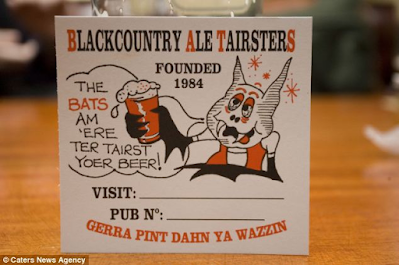
The thing that I spotted the other day was this yam. Yam is well-known as a feature of the Black Country dialect, around Wolverhampton and Dudley, where it's a variation of the verb be. In Standard Englishes you get am just for first person singular (I am). In many varieties you get levelling so that was or were is used for all the forms in the past tense (I were) or even is in present (you is). I think this is a form of levelling too: am is used for other persons than 1st singular, as in the message from the Black Country Ale Tairsters (tasters) below: The BATs am 'ere ter tairst yoer beer!. 

Beer mat featuring a cartoon of a boozy bat and the message 'the bats am 'ere ter tairst yoer beer'

Then you get it running together with the pronoun in speech and you've got yam. I did all that from memory (sorry, lots of teaching prep to do this week) so the details might be wrong, but that's about the size of it. But what it isn't, is yam being the pronoun itself. That's what the greyhounds are doing, they're using yam in place of me in standard Englishes, not in conjunction with the verb to be. It's not a one-off from Finn the greyhound either, it's pretty standard Greyhound. So they've innovated or borrowed a new first-person pronoun. 


Wednesday, 28 January 2015

Two wrongs don't make a right

I saw this cartoon tweeted recently:


It's the old chestnut that a double negative actually makes a positive, and if you say the non-standard phrase 'I didn't do nothing' you are in fact saying that you did something. It's used to try to shame or humiliate people into using the Standard English single negative: 'I didn't do anything'.

This is quite silly. Generally, linguists point out that lots and lots of other languages have double negatives as the standard form, and so it's ridiculous to suggest that it's somehow illogical. Italian is yer go-to example here, and for some reason it's always about telephoning: 'non ha telefonato nessuno', or 's/he hasn't telephoned nobody'. Jack Chambers has pointed out that as most non-standard English varieties have double negation (more technically called negative concord), perhaps it is in some way more 'natural' than the artificial standard of single negation that is imposed on us.

But even more than this, it's not even true that a double negative will be interpreted as a positive. It can be, if you give it the right intonation. But it's a very specific intonation with a pretty strong emphasis on the 'nothing'. Without that, there's simply no way that it can possibly mean 'I did something'. Anyone at all would interpret it was meaning what it's meant to mean. They might be a pedant about it and pretend not to understand, but they definitely would. And even in a criminal trial, where testimony has to be unambiguous, I don't think that they would try to hang the crime on the guy for using this syntactic construction.

Monday, 15 July 2013

Gwynne, and racism, classism, sexism and all the isms

A couple of weeks ago (because I am slow to get round to blogging), that Neville Gwynne person was on the BBC again talking his usual nonsense. In case you've forgotten, he's a retired teacher who wrote a grammar book and occasionally pops up in the media with odd opinions and crazy thoughts (he is a big fan of Michael Gove, which really tells you all you need to know). I wrote about Michael Rosen's response to him and his antics back in March.

This time, I wanted to talk about correcting people's grammar, and whether it's a good thing or not.

First, let's clear something up. Rosen says (in the article cited in the previous post I linked to)
In fact, we would neither be able to speak nor understand if we didn't know [grammar].
Gwynne says (in his book, on page 5)
For genuine thinking we need words... If we do not use words rightly, we shall not think rightly.
(Note his use of the hideous adverb 'rightly' because of his obsession with not using adjectives as adverbs!)

These are two very different positions, and I agree wholeheartedly with Rosen and disagree wholeheartedly with Gwynne. Rosen is right because language is, basically, grammar. 'Grammar', when not used in the school sense, is simply the way language works. Without it, you just have a bunch of sounds and maybe not even that. But you cannot go from that to saying that thinking requires words. This is a complex philosophical issue and one that I'm not going to get into here. It is possible that thinking does require language (definitely not just words), and if it does, OK, fine, we need to know grammar (not just words) to think, or at least think clearly and in some sophisticated manner which goes beyond what all animals do. But it is absolute fact that we do not need 'correct' grammar to think, and that is the dangerous message that Gwynne peddles.

I can see his argument, but he's got it wrong. He sees well-argued, cogent writing with correct grammar and poorly-argued, badly-written writing and thinks that one leads to the other. No. The two may well be related, but one is not a cause of the other. I see it myself: the most able students are often those who can also write well. The students less able to put together a clear, logical argument also tend to write less well. But this is far more likely to be due to general ability level, which affects both variables independently.

Furthermore, take this video of Boris Johnson and Russell Brand on Question Time (it's a BBC thing on YouTube so if it disappears, just look for any other footage of these two people):


Russell Brand has a persona, and part of that persona is his dialect, which includes many non-standard forms that Gwynne would consider to be wrong. However, Brand is also intelligent and is often booked for these things because people love to see him in opposition to the posh morons in power. He is highly articulate (he also writes well, and has a newspaper column). He sometimes says stupid things, but he says them all quite well and certainly makes a good, insightful argument. Boris, on the other hand, is educated, probably got taught all this 'proper grammar' stuff, but can barely string a sentence together. His spoken grammar is not 'correct' because he never utters one single 'grammatically correct' sentence. Ever. (I haven't checked everything he's ever said, but his hit rate is a lot lower than Brand's, for sure. Scripted speeches don't count.)

Gwynne teaches mostly non-native speakers of English, as far as I can tell, via the internet. This is admirable. I should think that his students, many of them in developing countries, will benefit greatly from having a good standard of written and spoken English. It is important to teach the standard, because that is what learners will be expected to learn by those who test them and those who judge them for entry to university courses and employment, and it's what they themselves will expect to learn. Some people can go too far with their linguist-centred descriptivist outlook and claim that it's oppressive to do this, but in fact we are failing language students if we don't teach them the standard. Similarly, when I mark essays, I correct them if they don't use standard English. I do think, though, that students should be taught what people really say and what the acceptable alternatives are, alongside what is 'correct'. Sometimes this is beyond the time constraints of the course or the abilities of the student.

Likewise, children should be taught how to use the standard dialect of their language (in their country, as standard US is different from standard British and so on). This will help them to get on in life. But they should not be told that any other way they speak is wrong: if you are a normally developing human, you speak your own language perfectly. There simply isn't any other way to do it. It's like telling a person they walk wrong. Maybe they walk in a way that displeases some people (dragging their heels, or too slowly) but they still walk perfectly fine.

It might not seem that important, but there are serious consequences of views like Gwynne's. In the recent Trayvon Martin case, Rachel Jeantel's testimony given largely in AAVE (African American Vernacular English) caused a lot of debate. A common example used in sociolinguistics classes is the Oakland school board case from the 1990s: in a county in California, it was decided that something needed to be done to help the black children, who were systematically performing worse than the white children, even when all else was equal. It was suggested that they might be at a disadvantage because they spoke AAVE at home, which is significantly different from standard English, and needed to be taught how to 'translate' it into standard English. This stirred up an enormous amount of racism and eventually the scheme came to nothing. People would rather black children continue to underperform and start their academic life at a significant disadvantage than risk their own children coming into contact with this dialect in the classroom. But the point is, there is no inherent reason why AAVE is not the standard dialect: it's simply an accident of history. What is now the standard is the variety spoken by the people in charge. A good education should teach children how to use the standard as well as their native dialect, but you can't judge a person's intelligence by the dialect they speak.

In the UK, there is no equivalent to AAVE. We have Multicultural London English, which is similarly stigmatised, but the two are very different. We do have a lot of regional dialects, though, and these are generally looked down upon and their speakers thought to be stupid, lazy or simply wrong. This means that working-class people, who are more likely to use regional dialect features, have to make a far greater effort than those who grew up with the standard as their native dialect. They may therefore do less well at school, and they may get less good jobs. Given that they are already at a societal disadvantage simply by being working class rather than middle or upper class, this only serves to compound the problem.

Gwynne no doubt considers people who use non-standard forms to be either stupid or lazy (because why else wouldn't they have learnt the correct forms?). Some of them are. But some people who use standard English are also stupid and lazy, and their language doesn't give you an easy way to judge them. Meanwhile, the dialect-users who are intelligent and hard-working are unfairly discriminated against. Young women are routinely judged to be less intelligent, because they tend to use linguistic features that often become mainstream later on. All of this perpetuates an unequal society in which rich white men have greater advantages and poor people, women and ethnic minorities have to work harder to achieve equal or lesser status.

Tuesday, 29 May 2012

Double modal or double fluff?

Those of us who are interested in dialect syntax but don't make it their business to conduct experiments into it are always on the listen-out for interesting examples. You can't help it, after a while. On the Antiques Roadshow back in April, I heard one of the experts say this:
What date would that might have been?
He didn't stumble over it, it was very fluent production, so he either meant to say it or didn't notice what he'd said. But we seem to have a double modal construction here, something which is not found in Standard English and is attested but not common in certain dialects.

The modals are would and might, and if we put the sentence into a declarative form, you can see what the issue is:
That would might have been what date.
Either modal on its own is fine, but both together is not permitted in Standard English. As this is not part of my dialect I can't be sure that this particular combination is allowed in any dialect, but certainly two modal verbs can co-occur in many people's speech.

Not, however, in the antiques expert's speech, I'll bet. I would put money on this being a performance error, which went unnoticed because the fronting of the first modal would means that it's not adjacent to the second modal might. I would guess that he started out asking what date it would have been, and switched halfway through to asking what date it might have been, and the two met in the middle in a sticky mess. Perhaps the much higher frequency of would-questions than might-questions had some influence too (frequency estimation not based on any data or actual facts at all).

This kind of thing makes it so much harder to do dialect syntax through data collection. You might only have a few instances of double modal questions in hours of data, if you're working from interviews, and if a couple of them might be performance errors, how can you be sure of anything? This is why dialect syntacticians have to be cunning as a fox who's just been appointed Professor of Cunning at Oxford, and devise data collection methods that they think will cause people to use more double modals, but without telling them that they want them to use double modals. And getting people to say something in a certain way is really bloody hard. Normal people seem to have this quaint idea that what you say is more important than the way you say it.

Wednesday, 26 October 2011

Really quite shocking grammar fails

Really, it's astonishing what errors you can find on printed material. In many cases it shows a real lack of any care at all. Take this photo:
It's a poster for the Xmas party nights on at Newcastle City Hall. This is a local government poster, then, which goes some way towards explaining it; it was almost certainly made by someone with inadequate training, low salary and even less interest in doing it well.

Let's look at what's wrong with it.

Friday, 21 October 2011

Please rejobulate me

This completely amazing letter comes to you from Letters of Note via Language Log.
This poor chap was violently dejobbed in a twinkling, and he is very bewifed and much childrenised! He hopes that he will be rejobulated with as much alacrity as may be compatible with [the recipient's] personal safety. How could you refuse?

Sunday, 21 August 2011

If we do be clever

I have a pub quiz team, and one of the quizzes we go to has a bonus question which is worth five points if you get it right, but you lose five if you get it wrong. You can also choose not to play, and not take the risk.*

We were deliberating this one week, as we had an answer but it was risky, and we wondered if we should try to be clever or just play it safe. My team-mate said to me,
If we do be clever...
Copula be is not normally a verb that can take an emphatic do in Standard English. (It can in some dialects - it sounds kind of West Country to me, I think.) However, in this instance, it was required. If she had said
If we are clever...
then our cleverness is an attribute that we have, not a temporary behaviour. Be in this utterance is a dynamic verb rather than a stative one, but that doesn't quite explain it. Other verbs that can be stative and non-stative can take do:
She has two children.
She is having a baby.
If she does have a baby...
I think this might just be a lacuna, a gap in the language. There's no grammatical reason, as far as I can see, for be to act like a stative verb even when it isn't.

There are other tests for whether a verb is stative and be in this sense has mixed results:
We are being clever [progressive]
??They forced us to be clever [complement of force]
??Be clever! [imperative]
??What we did was be clever [pseudo-cleft]

*In fact, that's a linguistic issue in itself. The wording of the instructions is:
Five points for a correct answer, five away if you get it wrong or don't play.
This is ambiguous, with the scope of the disjunction not clear. Is it that there's five points off if you get it wrong OR you can choose not to play, or is it that you lose five points IF you either get it wrong OR don't play? In other words, is the structure this:
...[DisjP [DP 5 points off if you get it wrong] [Disj or [CP don't play]]]

or this:
...[CP if [DisjP [TP you get it wrong] [Disj or [TP you don't play]]]