Showing posts with label comedy. Show all posts

Monday, 27 January 2020

Very dedicated police force


I’m writing this on a train to Yorkshire (an East Midlands Railway train, train fans!). The announcer chap said that if we saw anything suspicious, we should contact a member of ‘the railway’s very dedicated police force’, the British Transport Police. Oh how I laughed. See, he’s taken a standard phrase ‘dedicated police force’, which contains the word ‘dedicated’, meaning they work specifically for the railways, are dedicated just to them. But he’s used that same word, ‘dedicated’, in a different way, meaning that they care about their job, they are dedicated workers. 

But - and this is important - all he did was add ‘very’. He did nothing else at all to alter the sentence. So how did I know that the meaning had changed? LINGUISTICS, people! In the standard phrase, ‘dedicated’ is a participle. It is shorthand for ‘the police force that is dedicated to the railway’ - it’s a form of the verb, in other words. And as a verb form, it can’t be modified by ‘very’. Things like ‘I’m very running’ or ‘I very work’ are not grammatical for the same reason. In the one he actually said, he used ‘very’. So the word ‘dedicated’ can’t be a participle. It must be an adjective, which is what ‘very’ can modify: ‘I’m very tired’, ‘I’m very clever’, ‘The very hungry caterpillar’, for example. And if ‘dedicated’ is an adjective, it no longer functions as the participle; it’s an attribute of the person it applies to, in this case the British Transport Police. 

All that from a simple addition of ‘very’! Honestly you people, how are you not constantly as amazed as me at how cool language is? 

Monday, 17 September 2018

Bears, hamsters, coffee and hashtags

All hipster bars and coffee shops these days have signs with quirky slogans or jokes on them. They come with a punchline that undercuts the set-up, and the first time you see them they are genuinely really funny. For instance, this classic 'bears' sign:
Image result for funny coffee shop signs
Dunno, maybe bears... 

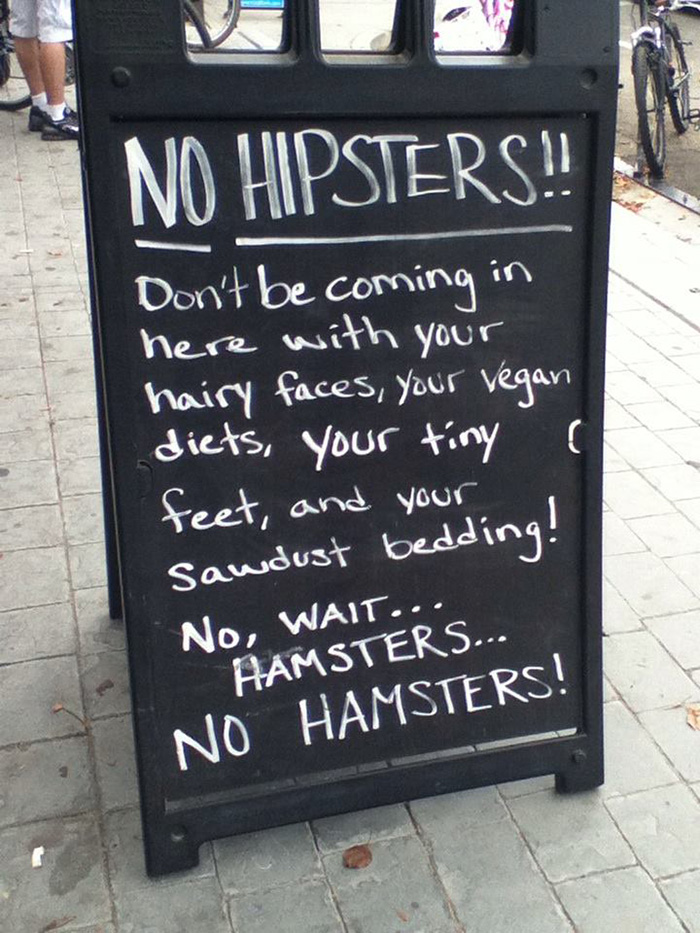
And this one self-referencing hipsters:

Image result for funny coffee shop signs
Hipsters... no wait, hamsters
But after the first time, the joke is no longer funny because it has to be original. That doesn't actually matter, because it will be new to most of the people that see it for quite some time, so it's OK that some people are bored of it (it probably won't put them off going to their regular place or a cafe that looks nice).

There's something more to the joke format that I'm beginning to find wearing, though, and I think it's the Conventional Set-up --> Twist format. Even though this is essentially how jokes work, it has somehow become a cliche on blackboard coffee shop signs.

I was at the annual meeting of the Linguistics Association of Great Britain last week. I go every year, as I'm on the committee, and it's held in a university somewhere in the UK. They had this sign:

Drink responsibly!
#DontSpillIt
If this had been a normal blackboard sign, I'd have found it twee and predictable, even though I haven't seen this exact joke anywhere. The format has become wearing. But somehow, putting the punchline in a hashtag was enough for my jaded joke palate to accept this as a witty sign. A normal blackboard says "We're cleverer than you: we made you think one thing and then turned it round on you". The hashtag somehow says "The sign is real; we mean the main message literally and aren't trying to subvert it. However, look at this funny interpretation too".

Monday, 18 January 2016

A-g-nother g-nu

In the recent series of University Challenge: The Professionals, shown at Christmas time, Jeremy Paxman asked a question involving a gnu. A gnu is an animal, also known as a wildebeest. Here's what they look like:

Brilliantly, Wiktionary captions this photo as 'a few gnus'
It's pronounced the same as 'new', where the 'g' is not silent, exactly, because it changes the pronunciation of the 'n', but it's not pronounced as a /g/. However, in the well-known Flanders and Swann song The Gnu, some of the joke is centred around the pronunciation /gnu:/, with a hard 'g'. This animal isn't that commonly talked about, so you most often hear it in the context of this song, which means that it can be quite hard to remember it's not actually pronounced /gnu:/. Paxman apparently failed to remember this as well, as he pronounced the 'g' when he said it. I'll add this to the list of 'language influenced by comedy'.

Sunday, 3 January 2016

Oldman, not old man

Another thing I watched over Christmas was a repeat of A Touch of Cloth, a comedy detective series by Charlie Brooker. There's a character in it called Detective Oldman, and many jokes are had around her surname and the phrase old man. The thing is, the name is pronounced differently from the phrase. You pronounce the name with a reduced second vowel, so it's [ˈɒldmən], whereas the phrase old man is pronounced something like [ɒldˈmæn] (the first vowel varies a bit). Even if you don't read IPA, you can see they're different in the vowels used and where the stress is placed. This meant that in the programme, for the jokes to work, her name had to be pronounced like the phrase rather than in the usual way, which sounds decidedly weird. 

Sunday, 4 September 2011

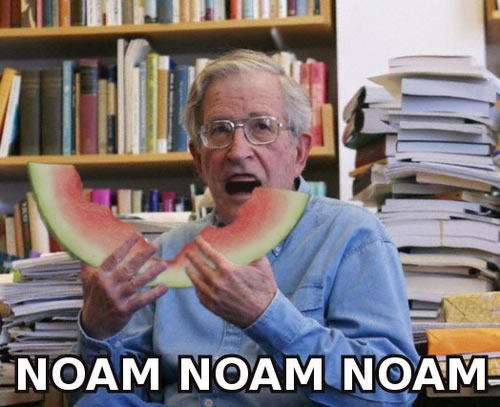
Noam Noam Noam

I have no comment to make on this. It's just a great image for a Sunday morning. 

Friday, 2 September 2011

Thursday, 1 September 2011

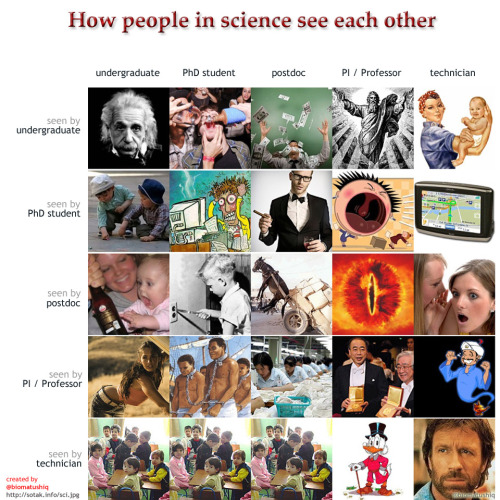
How people in science see each other


Surprisingly accurate, probably for non-science subjects too (if you replace 'technician' with 'IT support').

Saturday, 20 August 2011

You literally take them literally

Literally gets a lot of bad press. It's a word in a state of confusion. It's busy getting a new meaning as a kind of intensifier, but it's also stubbornly hanging on to its old meaning of 'in actual fact'. (Really and actually have gone further down this road.) This allows pedants to say things like:
Really? You literally exploded with excitement? That must have caused a mess.
And so on. The Oatmeal does a good comic of it, actually. Part of it's here, but there's more of it, including the punchline, at The Oatmeal:
So, on Eight Out of Ten Cats (Channel 4) the other night (12/08/2011), I heard one of the panellists, the comedian Jon Richardson, tell a story which included two uses of the word literally.

[The footballer Wayne] Rooney said "We literally don't know when a game's over", and they're so thick you take them literally.

Both uses of literally appear in that story. First of all, Rooney says it in the new sense, using it as an intensifier. But then Jon uses it in the old sense, meaning 'at face value'. But he can't have noticed, so much have the two senses diverged, that Rooney has already used it, because it takes all the sting out of his joke. He means, 'they said this, not meaning it literally, but they're so stupid it might actually be true'. But if Rooney's already said literally, then you've got no humour in trying to take them literally unless the word has lost all of its original meaning. There's nothing very unusual in that, metaphors lose their meaning all the time and we cease to notice them, but not usually when the original sense of the word is also used in the same sentence.

Tuesday, 16 August 2011

Eddie Izzard buys a cow in Old English

English is a Germanic language, so it's closely related to German, Dutch and varieties thereof. It's changed a lot over the years: it's got a lot of French/Latin vocabulary due to those pesky conquests, and its grammar has changed in various ways (loss of inflections, loss of case, word order changes). But Old English was much more like those German/Dutch varieties, and Friesian in particular. Of course Friesian has changed too, but not as much as English has.

So obviously Eddie Izzard is going there, armed with only a smattering of badly-pronounced Old English, to try to buy a brown cow. Why he wouldn't buy a Friesian cow (the 'classic' black and white ones) I don't know, but whatever. Anyway, he totally manages to talk to this Friesian farmer in Old English, and they understand each other. It's brilliant: