Showing posts with label OED. Show all posts

Monday, 14 February 2022

An ilk of that ilk

[Please note that this is a scheduled post, and I am taking part in the ongoing industrial action by my union, UCU.]

You should always learn something at a pub quiz, and I did recently: I learnt what ilk means, as in of that ilk. The question asked us about a phrase that is used generically to mean 'of that type' and specifically in Scottish English and Scots to mean 'of the same name or place'. I had no idea and was coming up with all sorts of nonsense like autochthonous. But of that ilk it was, and once we knew, it was so obvious! An example from the OED of it being used in this way is Wemyss of that ilk, meaning Wemyss of Wemyss. 

Reading the OED entry is really interesting because it was used to mean family or class, and you can see how that's related to the meaning above. But its origin is in a pronoun, it seems, which has come down to Modern English as each or which (Scots is descended from the same predecessor as Modern English is) and that meant same or alike. You could use it like that for a while, as in the OED's example from 1648, During this ilk time.... 

It still seems to be pretty widely used in informal contexts today, as a quick twitter search turns up plenty of examples. You'll be pleased to know, I'm sure, that there's also the occasional sighting of the eggcorn version of that elk. 

Friday, 29 April 2016

Antidisestablishmentarianism is a very long word

There's a really great post at Merriam-Webster about why the word antidisestablishmentarianism isn't in the dictionary. Basically, it's because it isn't a word in common usage. This raises interesting questions about the nature of lexicography, what 'in common usage' means, meta-linguistic mention vs. use, and compositionality of meaning.

The word clearly does have a meaning. Merriam-Webster say it's this:
opposition to depriving a legally established state church of its status
I thought it was something like the movement against the separation of church and state, but maybe that's the same thing - I'm not at all clear about what that actually means. But the point is that the meaning arises directly as a sum of its parts: it's compositional. Well, this isn't strictly true: there is some idiomatic meaning to do with the church and the law as well. But the length of it comes from attaching affixes with strictly compositional meanings. When you have compositionality, you can theoretically create longer and longer words, up to the limit of your cognitive capacity. I could add a morpheme and create antidisestablishmentarianismation, for instance. Some long words in quite common use aren't in the dictionary simply because they're made by standard suffixation processes, and that suffix is in the dictionary so you can work out the meaning for yourself.

So antidisestablishmentariansim is a real word, in the sense that people recognise it and can understand its meaning and it's made with proper word-formation processes. But for M-W, it's not a word in common usage. They have only three quotations for this word which use the meaning they give above, and dictionaries rely on written uses of words. This is why they can seem slow: words only get in when they've achieved plenty of use in print materials.

They do have plenty of quotations of the word with reference to it being a long word, however. It is in the OED, and their quotations refer to this:
1984   T. Augarde Oxf. Guide Word Games xxvi. 216   The longest words that most people know are antidisestablishmentarianism..and supercalifragilisticexpialidocious.
This is metalinguistic mention of the word, not an actual use of the word. We're stepping outside language and talking about the word itself, not using the word to say something. This is sort of difficult to get your head round because we have to use language to talk about language, a long-recognised philosophical problem in linguistics.

Interestingly, M-W say at the end of their piece that it might be considered a viable entry 'simply because it's a well-known word'. The meaning is not well-known, however, so it would be an entry whose definition read something like 'famous long word', and the definition as a secondary bit of information. That would be quite cool and very meta.

Irrelevant postscript: There's a really stupid joke that goes like this: 'Antidisestablishmentarianism is a very long word. How do you spell it?' and the answer is, of course, 'I, T'. I sometimes try that out on my students and some of them groan but a lot of them simply don't understand the joke. Maybe it's the way I tell 'em. 

Wednesday, 30 March 2016

Rotate, but don't turn

I've been looking at mattresses lately. It's bewildering. Not least is the instruction that some of them have:
No-turn mattress. Rotate regularly. 
Rotate and turn are one of many pairs of words that English has that are more or less synonymous but come from different sources. Typically, the one that we get from Romance (French or Latin) is used in more formal contexts or has a technical sense: here, that word is rotate. The Germanic counterpart (here, turn) is usually used in a more everyday sense.

That works for this pair. The OED has examples like The whole stage rotates concentrically and the kid turns on the spit, where each could be substituted for the other. The definitions are also more or less identical:
Turn (intrans): to move round on an axis or about a centre
Rotate (intrans): to turn about a centre or axis
We actually have the transitive senses here, as there is an implied object the mattress, but the transitive definitions are based on the intransitive ones.

The above discussion implies that it ought to be contradictory to say no-turn; rotate regularly, as how can you rotate something that can't or needn't be turned? Of course they mean it doesn't need to be flipped over, but you should turn it 180 degrees about its vertical axis (is that what I mean?? the thing stays flat, anyway) now and then to make sure it wears evenly. Here's an example of a pair of synonyms getting put to use in a situation where two different words meaning turn are needed. If one were so inclined, one could check whether the specific meanings each has (turn = flip over and rotate = stays flat) were generally consistent or if it's random which is used for which. That'll have to wait for another day, though, unless one of my readers wants to do it.

Thursday, 2 July 2015

Some cheeky findings

[This relates to my recent post about 'cheeky Nando's'. If you want to take the survey, do so here. We'd be really grateful!]

Do you call a misbehaving child a cheeky monkey? Do you ever go for a cheeky beer after work? Would you take your Significant Other out for a cheeky Valentine's Day dinner at a nice Italian restaurant? Chances are you said no to the last question, not because you wouldn't make such a romantic gesture, but because cheeky doesn't sound right in that sentence. What's more, if you're from the United States, you probably aren't as keen on the word cheeky in the first place. At least that’s what we thought when the cheeky Nando’s meme went viral a few weeks ago. 

The cheeky Nando’s meme  involved British internet users coming up with ever more incomprehensible (to Americans) explanations of what a cheeky Nando's means. But how come Americans don't know what it means? And, actually, what does it mean? We tried to find out by sciencing.

Tuesday, 29 July 2014

So syllogisms are tricky things

Hooray! It's been too long since Richard Dawkins last tweeted something massively ill-judged for me to blog about.
The context: Dawk is back in a previously-contested argument in which he says that 'mild' rape/paedophilia/violence is not as bad as 'violent' rape/paedophilia/violence, and then the rest of the internet gets cross with him about it. Previously, criticism was mostly around the debatable existence of 'mild rape' or 'mild paedophilia', whereas this time he has been more precise and talked about date rape versus violent rape at knifepoint. We don't need to debate which is worse, or if there is any need to have a hierarchy of such crimes (that's for judges or experts in traumatic incidents to decide, I suppose). What I want to focus on is two vaguely linguisticky things: Dawk's utter failure to grasp the need for something beyond logical truth, and 'so'.

Dawk is presenting this as a logical syllogism (in response to criticism; it wasn't how he first presented it). It isn't actually a classical syllogism, which is the 'all men are mortal' type of deductive reasoning. Really, he's just refuting an implication that some people inferred from a statement of comparison. It's unfortunate that the newspapers that get their content by summarising twitter feeds (I'm looking at you, Independent) couldn't be bothered to find this out, but no matter. While syllogisms and other logical arguments are relevant to linguistics (and I have fun teaching them in my semantics module), more important here is the fact that Dawkins is just banging on and on about logical truth, never seeing that the logical truth of his statement really isn't the point. Nobody seems to have put this in a way that he can understand, so it's not entirely his fault, but still: rape, paedophilia and the like are highly emotive topics and there is currently a lot of discussion about 'rape culture'. Given this, it's not surprising that many people would be less concerned with logical truth and more with the rhetorical effect of such public statements. Many people are extremely worried that some instances of rape are trivialised or simply discounted because the victim was drunk/married to the rapist/didn't say no etc. Saying that date rape is less bad than violent knifepoint rape may be logically true (or it may not be - Dawkins is agnostic on the matter), but humans do a lot more than just compute logical truths. We actually have to work quite hard to see purely logical truth (hence the zillions of logical fallacies that we can make), and we set a lot of store in the inferences we make. Even though saying that X is not as bad as Y doesn't condone X, it still appears to make excuses for those people who dismiss the 'date rape' cases as 'not really rape'.

So, on to 'so'. In the tweet pictured above, someone passive-aggressively tweets about Dawkins, not to him, while @ing him so that he sees it. This is the height of bad twitter manners. Dawkins, in his response, takes exception to Sequester Zone's use of 'so', asking why they used it. I assume that Dawkins is making bizarre linguistic assumptions again, and would hazard a guess that he considers 'so' to be incorrect when it is used as an introductory particle, similarly to 'and' or 'but'. I've seen some other peeving about this lately, with people claiming that 'everyone is starting their sentences with so these days'. As it happens, I agree with much of what it says in the article linked via the response above, but 'so' doesn't always indicate a rehearsed pitch or dumbing-down. It's long been used as a turn-beginning marker, or as a way to indicate that you're returning to a previous topic, or many other things. The OED's got an example from 1602 in their sense 5c, where it's a kind of 'hey I'm talking' marker:
So, let me see, my apron.
And in sense 10b(a) from 1710 (Swift, no less), where there is no preceding statement but one is implied:
So you have got into Presto's lodgings; very fine, truly!
And 10b(b), which it attributes to 'reflecting Yiddish idioms', where there is no preceding statement, or where there is adversative force (probably the use in the tweet) from the 1950s (this example is 1960):
‘I warn you..I ain't got no wine.’ ‘So who wants wine?’
Note, though, that it serves another function within twitter. In a tweet, if you begin with an @-name, it will only be seen by people that follow both parties. The convention, therefore, if your tweet begins with a name but is a mention rather than directed at that person, is to begin with a full stop so that all your followers will see it. Alternatively, you could make sure that the @-name isn't at the beginning of the tweet by using an introductory particle such as 'so'.

Wednesday, 12 September 2012

I doubt that you would suspect this

A recent Language Log post pointed out a humorously ambiguous headline:

The joke is of course that it sounds like the kebab van drove over and duffed up the hapless teen, with the by phrase expressing the agent of the jaw-breaking incident. The intended meaning is the one in which by is a preposition, and the by phrase locates the teenager at the time of the attack (ie he was by a kebab van). Much lolz ensues.

This wasn't the only humour to be wrung from the language in the headline: commenter Bobbie made the following quip, which was immediately either genuinely or wilfully misunderstood by Victor Mair:


Bobbie is taking advantage of the fact that in English, we can say that you have broken your X (if X is a body part) and it does not mean that you did the breaking. There's a term for that which I can't remember just now. Anyway, so Bobbie says what (s)he says, implying that it is unlikely to be the case that the teenager did it himself. Victor Mair's comment was initially baffling to me, because of course American English speakers wouldn't use suspect instead - that would mean the exact opposite! Other commenters said much the same lower down the comment thread.

Some of those commenters also noted that doubt used to mean roughly what suspect means. It's sense 6d in the OED, marked as archaic, and from the examples there, you can see how the semantic shift could have happened. Just add it to the long list of English verbs whose meaning has completely reversed over time.

Thursday, 23 August 2012

Spoffles, flanges and pobbling

Words get into the language in lots of funny ways. Most of them have been there so long we don't know, or we just know that we brought them with us when we left Germany. Lots of them were borrowed, from Latin and French in the case of English. Lots of words we make ourselves, with our word-making tools like suffixes (brightness) and compounding (carwash). My favourite type of words are the ones that someone makes up, and they catch on.

Quiz was supposedly an early example of this, when (according to anecdote) a Dublin man had a bet that he could introduce a new word into the language. Sadly, as with so many such anecdotes, it's probably bunk, as it was in use already by the alleged time of this bet. Still, there are some words that we know were invented this way, as the people who did it either did so on film or are around to tell us.

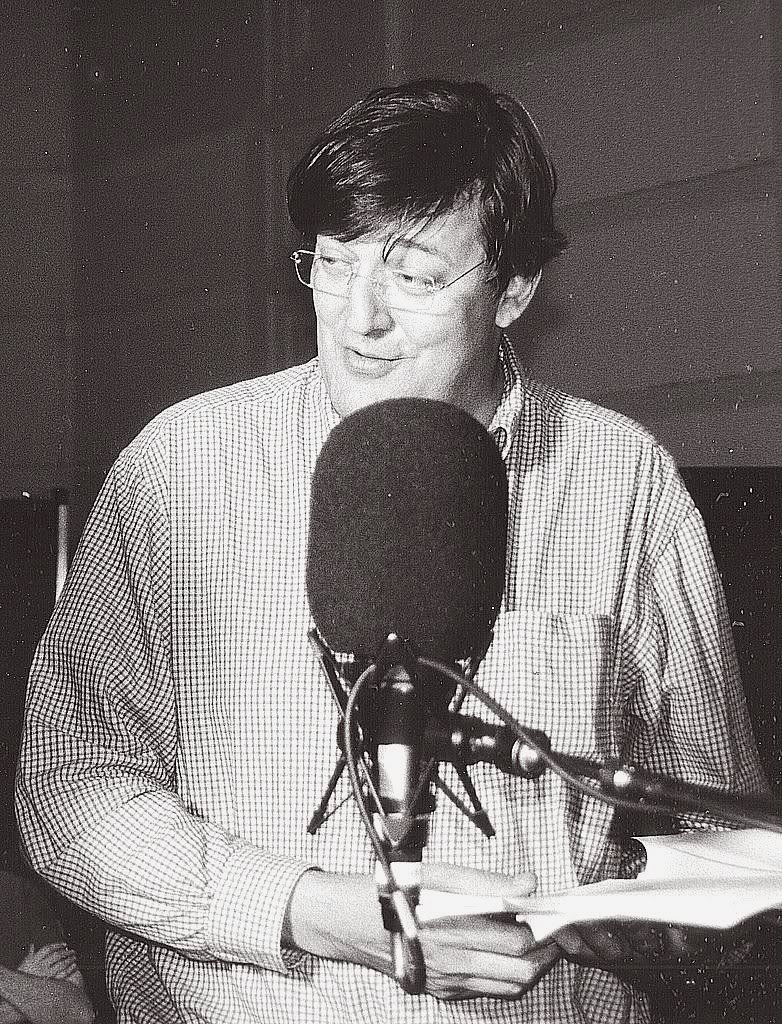
Spoffle, quite apart from being a great word, is a useful one, if you ever have anything to do with microphones, as I sometimes do. It's this thing, in front of Stephen Fry:

Source: http://www.stephenfry.com/forum/topic/fry-a-day/page/759
It's the foamy cover for a mic that prevents 'popping' and cuts down wind noise. Essential item, apparently unnamed (people seem to use the very dull microphone cover) until Hugh Laurie called it a spoffle (in Stephen Fry's hearing, which is partly why he's in the photo above). This is what I always call it, and lots of others do too. At my old job it was the common name for such things. But, astonishingly, it's not in the OED and it doesn't have a Wikipedia article. Apparently it used to but it was deleted, and now it's not even mentioned in the section on microphone covers.

Another word that came out of British comedy is the collective noun for baboons, a flange, and for gorillas, a whoop. Flange has caught on remarkably well and, although it too doesn't get into the OED (they're so cautious, those lexicographers) it's used by people, including (allegedly) academics (although I have not read the papers or books in which it's used). Here's the sketch, with Mel Smith and Rowan Atkinson talking to Pamela Stephenson:


Literature has been a source of some good words. Lewis Carroll invented the word chortle as a blend of chuckle and snort, although not many of his more creative efforts from the Jabberwocky have caught on. This OED blog post talks about Edward Lear, who made up a lot of words (runcible spoon being a particularly well-known example) and also used obscure real words. It has a charming anecdote about the blog-writer's doctor friend who was certain that pobble meant 'to amputate toes', until the blog-writer introduced her to the rhyme The pobble who has no toes. Pobble's Bay also seems to be a place in Wales, which does rather remind one of The meaning of Liff by Douglas Adams and John Lloyd (who created QI, presented by Stephen Fry - we have come full circle so it's time to stop waffling).

Friday, 3 August 2012

Search for nouns

Some people have noticed that the search bar on facebook looks like this, and suggested an improvement:


They think it should read 'Search for nouns'. 


I'm not having a go at these people; the OED defines 'noun' as follows:
A word used as the name or designation of a person, place, or thing.

Wikipedia sensibly adds or idea to its definition, however, as liberty and disappointment are both nouns, and further down expands this to: 
person, place, thing, event, substance, quality, quantity, or idea, etc.
Because Wikipedia is often written by experts, it's a lot more detailed than the OED and goes on to tell us that this definition is not very useful on account of it's a bit fuzzy and doesn't tell us much, and that it's better to have  a formal definition based on the properties of the elements we class as nouns. 

One way to do this is to use such characteristics as 'can occur with a determiner like a or the', or 'can take plural inflection -s'. These characteristics are often not cross-linguistic, but can help to identify nouns if you know the rules for the languages you're interested in. In beginning syntax classes I hand out a cheat sheet with just such tests. 

As I think I've mentioned before, the distinguishing characteristic of nouns that linguists generally use is if they behave like nouns. Does that sound circular? What I mean is, the name 'noun' is used to refer to a class of words that all behave in the same way. They can be the subject of a sentence, for instance, or the object of a verb or preposition. These are grammatical characteristics. The 'people, places and things' definition is a semantic definition: it describes what nouns mean or refer to. 

We can use both to identify nouns, but the semantic definition is not appropriate to denote what facebook wishes you to search for; it does not think you should search in that box for love, peace and understanding; it will not bring you success (or at least, not as an abstract noun). 

Monday, 2 April 2012

Oversuds

I saw the verb oversuds used recently. Clearly it's derived from the noun suds, which became a verb in its own right first. The OED has an entry for suds (v.) dating it back to 1834:
1834   ‘C. Packard’ Recoll. Housekeeper 12   Ma'am Bridge was sudsing the clothes in a tub before her.
It doesn't list over-suds even in the derivatives of suds, though. The prefix over- is attached to suds to give the verb meaning (I presume) to lather up too vigorously or cover in too many soap suds (perhaps giving a surfeit of bubbles, or causing too much mess, or whatever). So far so boring. But I was quite taken with the fact that suds is plural. This is the case when the verb is transitive, as above, or intransitive:
1972   Fortune Jan. 73/1   Detergent foam first became a matter of national concern in the early 1960's, when Representative Henry S. Reuss of Wisconsin, among others, pointed out that detergents were persisting, and sometimes sudsing, in the environment.
Normally, when you form a verb from a noun by simple conversion (as opposed to using a verbal suffix or some other process), it's the singular form of the word that's used. Take the verb bubble. It may actually pre-date the noun bubble, but even if it does, for the purposes of demonstration that doesn't matter. What's important is that there are two words, one a noun and the other a verb, and the verb is homophonous with the singular form of the noun, despite the fact that bubbles, like suds, tend not to occur singularly (in this meaning). A pan of water that's boiling has many bubbles in it, but you still wouldn't say that the water was *bubblesing. Any morphological process is like this, in fact - it's a mousetrap, even if it's used to catch lots of mice, and tights can be footless, even though they lack both feet. It's even a bubble machine, not a bubbles machine, even though it makes millions of bubbles.

Perhaps it's because it's hard to identify a single sud. We can talk about a sud, but it's not generally used in the singular. It is still a count noun, not a mass noun that happens to look like a plural or a pseudo-plural like linguistics. We use it with plural agreement, for instance (though the OED says 'usually'). But we almost always use it in the plural, and I suppose that's influenced the verb formation process. It's very unusual, though.

Saturday, 29 October 2011

'All the protagonists'?

When I was young I liked to learn facts about language. I was also a smug little git so what I liked best of all was to learn a fact that would allow me to say to people 'You're using that word wrongly'.

I'm still a smug little git but now I know that this is prescriptivism and a Bad Thing. Linguists try to avoid it, and instead describe language usage As She Really Is. For this reason, I've decided to revisit a prescriptive usage that I remember learning as a small child. This was an extra-special one for me, because it involved knowing the  etymology of a word and applying it to modern usage, and this is always a good way to make people feel stupid. (What, you don't know classical Greek? You utter ignoramus.) Yeah, I was insufferable. 

Friday, 7 October 2011

Original OED

The Oxford English Dictionary celebrated its centenary a while ago, and to commemorate it they published this limited edition print run of the first edition, from 1911.

The Concise Oxford Dictionary: The Classic First Edition

There's a nice blog post here about the differences between then and now, which as always make for a fun read. While it's quite nice to learn about the words that haven't made it this far (marconigram, kinematograph and so on), my favourite thing is the style of the older edition. It seems so quaint nowadays.

A terrier, for instance, is a
kind of active & hardy dog with digging propensity
And to greet is to
accost with salutation
And relatedly, the blog post notes that while the OED defined cancan simply as 'indecent dance', Percy Scholes, editor of the first Oxford Companion to Music (1938), wrote that
Its exact nature is unknown to anyone connected with this Companion.
Quite right too.