Monday, 26 October 2020

Book review: 'The language lover's puzzle book' by Alex Bellos (Guardian Faber, 2020)

Full disclosure, as I don't normally do reviews in this blog, so publishing this one might be seen to carry a certain amount of weight: the author sent me a copy of this book with a suggestion that I might possibly write about it if I liked it. I did like it, so I am. 

Alex Bellos, Guardian puzzle-setter, has compiled 100 linguistic puzzles – sets of facts about languages from all over the world, with brain-teasers for the reader to solve – with some context about the languages. All of the puzzles are fully work-out-able from the information presented, so in this sense it's a pretty good approximation of what some of our introductory courses look like. I've even used some of the very same puzzles in this book in first year seminars before. They're mostly taken from previous Linguistic Olympiads. This is why I was looking forward to reading it, because for the last few years I've organised a 'markathon' for the advanced papers for the UK Linguistics Olympiad, and so I was already well aware of the fiendishness of some of the puzzles. Happily, Bellos hasn't included the very hardest ones in the book, so they're all manageable, though some are really tricky and would take you a while to do with pencil and paper. 

The way I approached the book was not to try to solve every puzzle as I read through the book. (You could do that, and it would keep you going a really long time, so it's good value if you're looking for a Christmas stocking filler, which I assume is the intended market.) Instead, I cast an eye over a puzzle to get the idea of it, and then flipped to the answers once I'd spotted the principle (or if I couldn't work it out quickly). For me, the interest was more in the linguistic knowledge rather than in the process of solving the puzzle, although some of them were very satisfying in that regard too. For that reason, I actually found having the answers in the back of the book a bit of a nuisance and would have been happy to have at least the bones of the explanation directly following each puzzle, to provide context and grammar facts with perhaps the full walkthrough in the appendix. But that's me, a linguist, not a puzzle-solver. For the average reader it's probably helpful to have the linguistic details separated out from the cultural context. But is that playing into the unhelpful separation of grammar and its speakers, that formal linguists are sometimes charged with? I don't know. 

It's really hard to write a book like this, where you convey the delight of linguistic variation, without falling into the trap of exoticising or depersonalising the languages you're talking about, detaching them from the people who speak them every day when you talk about them as an object to marvel at. I was well aware of this myself when I was asked to be the linguistic expert on a radio comedy panel show earlier this year. Even though the whole production team was consciously committed to not being racist, and fully aware of the perils of accidentally doing so, I know we didn't fully manage it. We avoided some potential clangers, to be sure, but I know we didn't get it right. Can you ever? I'm not sure. And I also think that it's good for there to be books out there that present this delight in diversity rather than just banging on about how wonderful language is without ever going beyond English, so there must be a trade-off, I suppose. In this book, there are the inevitable untranslatable words, Chinese compound words, and other tropes. There are a few scare quotes that I wouldn't have thought necessary (enclosing 'writing system' or 'texts', when the un-scare-quoted terms would have been accurate). Alexander Graham Bell's contribution to Deaf education is also discussed in a positive light, with no acknowledgement of the eugenicist views he held regarding Deaf people and the negative legacy of the methods he used. There are no signed languages included either, with the one exception of Cistercian sign language. But in the main, the material in the book is presented in the spirit it's intended: fascination with languages and the different ways they can do things. Languages are presented from all over the world, and although Europe is over-represented (especially English, which is a conscious decision on the author's part) and Africa rather under-represented considering the linguistic diversity there, it is a world tour.  

Most of the puzzles don't require you to have any linguistic knowledge at all. Some of them need you to make an educated guess about what a language might be like, but a lot of them are simply pattern-spotting and logical deduction.  Puzzle 10 was a nice example of one where you needed to simply match up the patterns, spot the links, but then make a couple of educated guesses about things that didn't quite fit: it demonstrated very neatly the complications that natural languages can bring. And the twist in that puzzle was a joy. I learnt some language facts from the book, including about counting in Japanese and Danish, and I also learnt other non-language stuff too: things about mathematical symmetry, and botanical notation for describing petal structure, and was reminded of the bizarre language to describe coats of arms. 

There's a strong focus on writing systems, as you might expect, with chapters on alphabets and scripts and invented writing systems and codes of various kinds. There are also chapters on terms for family members, counting systems and dates, which reflect the kinds of things that Linguistic Olympiad puzzles are about (and which you can make a self-contained puzzle about). I was impressed by how coherent the themes are, though occasionally something unexpected popped up - puzzle 45 is a fun puzzle about garden path sentences, in the chapter about kinship terms, linked just by including the phrase the old man. 

I'll be adding this to my department's recommendations for prospective students. It's linguistically accurate, as far as I can tell (bar the definition of parts of speech in the 'technical' chapter on grammatical features that differ most from English), with input from linguists and native speakers. And I'll also be passing my copy on to a teenager who I think will like it, having just taught himself Esperanto. I think it would work for someone who likes logic puzzles just as well as someone who likes language-related trivia, though, and definitely for someone who likes learning languages just for the sake of it. 

Monday, 19 October 2020

Greyhound-dialect puzzles yam

Because I have two long dogs (a greyhound and a galga) I follow long dog content on instagram, and I'm always slightly intrigued by their distinctive dialect. Here's a representative example: 

Photo of a greyhound in front of Lindisfarne castle with the caption: Flapsy earsies and lots of sheeples 👀🐑 Dey didn't like yam vewy much - don't worries, ze feeling was mutual!!

The posts are always written from the dog's perspective, and the dogs have this slightly childish manner of speaking (which is fair enough, they're only young) so they use diminutives like earsies and cutesy words like sheeples in the post above. Their spellings presumably reflect their phonology, so here you can see that this dog has vewy for very, indicating a common variant of the /r/ sound, especially in children. That one isn't necessarily universal, but what is universal to greyhounds is the 'th-stopping' you can see in Dey for They, where 'th' sounds are pronounced as /d/. This dog doesn't have it in all relevant contexts, as elsewhere he says ze for the rather than de or da, which would be more usual. Some of these things are also found in other dog dialects and even beyond, in cat varieties. Others are quite specific to greyhounds. 

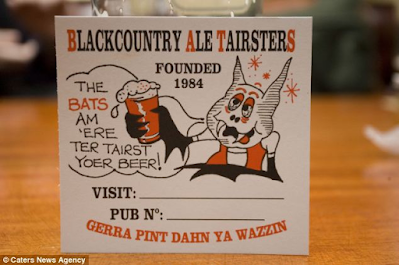
The thing that I spotted the other day was this yam. Yam is well-known as a feature of the Black Country dialect, around Wolverhampton and Dudley, where it's a variation of the verb be. In Standard Englishes you get am just for first person singular (I am). In many varieties you get levelling so that was or were is used for all the forms in the past tense (I were) or even is in present (you is). I think this is a form of levelling too: am is used for other persons than 1st singular, as in the message from the Black Country Ale Tairsters (tasters) below: The BATs am 'ere ter tairst yoer beer!. 

Beer mat featuring a cartoon of a boozy bat and the message 'the bats am 'ere ter tairst yoer beer'

Then you get it running together with the pronoun in speech and you've got yam. I did all that from memory (sorry, lots of teaching prep to do this week) so the details might be wrong, but that's about the size of it. But what it isn't, is yam being the pronoun itself. That's what the greyhounds are doing, they're using yam in place of me in standard Englishes, not in conjunction with the verb to be. It's not a one-off from Finn the greyhound either, it's pretty standard Greyhound. So they've innovated or borrowed a new first-person pronoun. 


Monday, 12 October 2020

Get off of my timeline

Twitter is a never-ending source of language peeving. Lately, a twitter user expressed eagerness to see the 'correct' use of off of. Well, joke's on her because there is no correct use. 

Regular readers will know that this is a linguistics blog, and as such, we're not in the business of dictating correct usage, preferring instead to document and ponder upon usage such as we find it. I wouldn't normally say that there's no correct use, because normally we'd be contrasting standard and non-standard uses and I'd be pointing out that both are valid in their respective contexts. 

The standard equivalent of off of is just off, as you are surely aware. Merriam-Webster says 

The of is often criticized as superfluous, a comment that is irrelevant because off of is an idiom. 

Which is pleasingly snarky, I think. 

Our friend the twitter user responded to all the many people who helpfully gave her examples of off of used in a phrase (such as the Rolling Stones' lyric Hey, you, get off of my cloud) by asking what of is doing - what does it mean, what does it contribute? 

Cover of the Rolling Stones' Get off of my cloud, with a photo of the band leaning against a wall and the writing in bright 1960s colours

Answer: nothing, just like it always doesn't. Lazy of, never contributing any meaning. 

Off of is a preposition (not two prepositions, as it looks like, because it doesn't have two separate bits of prepositional meaning). Or if you like it's an adverb and a preposition - I don't really like but it works as follows. Compare it with on and on to: We drove on (=We continued on our journey) and We drove on to Peterborough (=We drove further until we reached Peterborough). Now to is linking up the verb with the object Peterborough, indicating movement towards it, and on adverbishly indicates continuation of the action. On to can be contrasted with onto like so: We drove on to Peterborough (=We drove on until we got to Peterborough) vs We drove onto the ramp for the ferry, where onto indicates movement to the top surface and doesn't at all mean the same thing as We drove on until we got to the ramp for the ferry. 

There's no comparable difference for off and off of that I can think of. Hey you, get off my cloud works just as well sentence-wise, if not scansion-wise. And helpfully we do the opposite with out/out of: in Standard British English, at least, you would say get out of the house, not get out the house, but both are used and there is literally no reason for the pattern being the opposite way round. I told you. Of is a great word but it's contrary and wilful. 

Monday, 5 October 2020

100% fake leather

One of the knitting websites I use has the parts to make handbags, including firm bases which you can crochet around to get a more sturdy design. I refuse to believe they didn't know what they were doing when they described this as 'a lovely and practical round bottom', but that's not why I'm showing it to you. 

Screenshot of a listing for a bag or basket bottom reading 'A lovely and practical round bottom for your homemade basket or bag.  The bottom is made of 100% leather and is available in different colors and sizes.  Material: 100 % PU leather'

The material is described as 100% PU leather. PU means polyurethane, which means that it's artificial leather, not made from animal skin. This also means that it's absolutely inaccurate to describe it as being 'made of 100% leather', as they do immediately above. 

Or is it? 

Adjectives can be classified as being intersective, subsective, and privative (there's a couple more too but that's all we need for now). 

Intersective ones are so-called because their meaning is the intersection of two things: the adjective and the noun they describe. So, semanticist Barbara Partee gives carnivorous as an example because a carnivorous mammal describes things that are in the intersection of the set of 'things that are carnivorous' and 'things that are mammals'. 

Subsective adjectives are a bit trickier but not much: they describe a subset of the noun. Partee's example is skillful, because a skillful violinist is a subset of violinists - the ones who are skillful. It doesn't describe someone who is both skillful (independently) and a violinist, because it doesn't describe their skillfulness in any other field (e.g. skiing), only violining. (This is also the basis of my good dalek observation, by the way.)

Then we have privative adjectives, which are neither an intersection nor a subset, but actually negate the property of the noun they describe. A fake diamond is not a diamond at all, only something pretending to be one. In our round bottom example, it's not made of leather at all - it's fake leather. 

But Partee cites the acceptability of both the following examples to show that this cannot be the whole story: 
A fake gun is not a gun. 
Is that gun real or fake? 
In the second example, the item in question is still described as a gun. And actually most of the examples that ran through my mind for a privative adjective are more like this: a fictitious detective is still a detective (unless you want to tell Poirot), and a counterfeit banknote is still a banknote, of sorts, isn't it? 

So we need to think of these kinds of adjectives as being subsectives, really. Or if you prefer, the noun encompasses all the things that are putatively or ostensibly that thing: detective includes real and fictional ones, as well as impostors who pretend to be detectives to scam you. Banknote includes not just legal tender but fake notes put into circulation by counterfeiters. And leather includes not just the kind made of animal hide, but includes imitation leathers as well. 

Perhaps more accurately, we would want to say that in different contexts leather has both a broad meaning and a narrow or strict meaning (this is why you get words like SALAD-salad, to indicate the narrow sense). Then we have to step away from semantics into the realm of pragmatics and communication, and note that the customers for whom it's most relevant to know that the item is made of PU leather are vegans, and for them it's actually not helpful to use this broad definition of leather in the description, because they would buy products made only from the subset of imitation leather. 

Monday, 28 September 2020

The grammar of Starbucks (spoiler: it's just the grammar of English with other words)

Ah, Starbucks, home of weirdly huge coffees. Fun fact: since the popularity of flat whites in the UK, it's been much easier for me to get a coffee that's the strength and quantity that I like. An Americano is too big and too weak in all but the most hipster of coffee shops, but an espresso isn't enough coffee for a social drink. A black coffee in a flat white-sized cup is just right thanks (for some reason it's called a 'short black' or a 'long black' in places that recognise that this is a good drink, I assume as a calque of the Italian caffè lungo, which contrasts with just a caffè, which is an espresso). So I ask for that and responses range from just doing what I asked for to utter bafflement from the barista and ultimately a weirdly big coffee for me. Guess which one of those is the Starbucks response. 

It's already weird that the smallest size they have on the menu is 'tall'. At some point, they introduced 'venti' as the biggest coffee - 20oz, which is a pint. A literal pint. Apparently there's now 'trenta', which I assume is 30oz, which is getting on for a litre. So those are size names which are specific to Starbucks, and you just have to know them but it's easy enough to work out that there's a scale of sorts. No big deal. 

This Economist article talks about the language of Starbucks, saying that they 'refer... to macchiatos as 'marble' and mochas as 'zebra'', and putting this down to an effort to create an in-group feeling among its customers: having a language that you and your group know, being part of the crowd, being part of a community. It also says that 

Starbucks even uses its own grammar: you say your size before your syrup, your preferred milk before your primary drink.

OK, we're in my wheelhouse now if we're talking grammar. And... I'm not sure what this is meant to mean. This really just describes the rules of English. If I wanted a large caramel soya latte then that's what I'd say. The adjectives go before the noun, in the order the author mentions with the size first, and the drink type (the 'head' of the phrase) goes at the end. I couldn't ask for a soya large caramel latte, or a latte caramel soya large, or anything else. I could ask for a large latte with soya milk, taking the milk choice out of the noun phrase stack and putting it at the end in a prepositional phrase, and I could do the same with the syrup: a large soya latte with caramel syrup. Notice that if I do this, I need to add in a new noun for soya and caramel to refer to, because I've removed them from their place in the latte noun phrase and put them in a different noun phrase in that extra prepositional phrase at the end (with syrup/milk). At a push I could even take out the size: a caramel soya latte, and make it a large one. But if I'm putting all the bits in the same phrase, modifying just one noun (latte), then they go in the order the Economist author says is special to Starbucks grammar. 

If you want to create an eye-catching linguistics gimmick, you can play with words as much as you like, because we learn new words all the time and we can learn new ones. You can't really play with sounds or structures, though. Sorry Starbucks. Your grammar is nice but it's just English. 

Monday, 21 September 2020

Plan B: Stay home instead

Sometimes, the trains are disrupted for engineering works, usually over Christmas and New Year when fewer people are travelling on expensive peak time commuter tickets that would be costly to lose out on or refund. When they announce the disruption in advance, the standard message is something like this:

There will be no trains on the following days. Please make a Plan B for your journey. 

Here's an example of exactly this:

I was thinking about this once because there was no other way for me to make my journey, so my only option was simply to not go. This doesn't count as a Plan B, though! Plan B can only be an alternative means of achieving the same ends as Plan A. 

So let's say that Plan A was to catch a High Speed Southeastern train to London on May Day bank holiday. This isn't possible because they're doing some works and there are no High Speed trains on that line that day. A suitable Plan B would be to catch a slow train to London on that day. It isn't quite as good but it achieves the end of going to London that day. Or you could get a bus, if there were no trains at all, or you could drive, if you were able to. All would get you to your chosen destination on your chosen day. 

Would getting the train to London on another day count as a Plan B? It might, but only if you could do the original thing you were going to do. Maybe you were going to meet a friend, and you decide to do it on Tuesday instead of Monday. I think that would just about count as a Plan B for your original intentions. But if you were going to an event on that Monday, then going another day doesn't allow you to do what you were going to do, so it's not a good Plan B. 

Staying at home instead, as I had to do when I first mused about this announcement, definitely doesn't count as a Plan B for your original journey - you haven't managed to make the journey at all. But it would count as a Plan B for your holiday plans, for instance. Let's say Plan A was to go and spend Christmas with your parents, but because of work and trains, you can't get there, so you decide to spend Christmas at home. That's a Plan B for the Christmas holidays, but not a Plan B for your journey. The difference is what is under discussion, and therefore what Plan B is an alternative to. 

Monday, 14 September 2020

Religion means lack of religion

We've got some new legislation to make the latest guidance on how many people can hang out together absolutely clear as mud. One of the things you're allowed to have up to 30 people in one place for is religious gatherings and their non-religious equivalents in the case of weddings and funerals and so on. It's written in a way that implies that weddings are religious ('weddings and other religious life-cycle events'; 'other' meaning 'as well as the one just mentioned'), which of course they may not be at all, or they may be a fundamentally religious thing - that's dependent on your religion and beliefs. So then they qualify this with the following wording (it's the same wording as in the EHRC, I just hadn't read it before as I don't make a habit of reading legislation): 

(1) Religion means any religion and a reference to religion includes a reference to a lack of religion. (2) Belief means any religious or philosophical belief and a reference to belief includes a reference to a lack of belief.

Pragmatically, you wouldn't normally include 'lack of X' in the meaning of X. More likely, we add a bit of meaning along the lines of 'if relevant' - the old joke about the boy who was late to school because there was a sign saying 'dogs must be carried' and it took him ages to find one relies on this, as the boy failed to infer the usual additional meaning 'if one is present'. 

When we use nouns (like 'religion') usually, we don't include the lack of that noun in their meaning. When I say that the purpose of university is to provide an education, I'm not including 'lack of education'. If I say that the role of politicians is governance, I don't normally include 'lack of governance' in that (insert your own wry comments here). 

You can sort of fiddle with this to fit in with that interpretation, if you say that 'religious' applies only where relevant, like the 'dogs must be carried' sign. But in fact it's more a reflection of the fact that rather than the default being religion and not having religion is a lack of the thing (X or not-X), we now recognise that lack of religion is an ideological stance as much as having religion. The fact that there are many religions probably makes this meaning easier to arrive at, because rather than X or not-X, we have options A, B, C, and D, where one of them is a lack of any religious belief, or 'none of the above'.