Saturday, 25 August 2012
Linguistic experiments you can take part in
Just a collection of links to experiments that anyone can take part in. For some you have to be a native English speaker, but not all.
Colour naming
Various experiments on pronouns, communication etc
Resolving anaphora meaning

Thursday, 23 August 2012
Spoffles, flanges and pobbling
Words get into the language in lots of funny ways. Most of them have been there so long we don't know, or we just know that we brought them with us when we left Germany. Lots of them were borrowed, from Latin and French in the case of English. Lots of words we make ourselves, with our word-making tools like suffixes (brightness) and compounding (carwash). My favourite type of words are the ones that someone makes up, and they catch on.
Quiz was supposedly an early example of this, when (according to anecdote) a Dublin man had a bet that he could introduce a new word into the language. Sadly, as with so many such anecdotes, it's probably bunk, as it was in use already by the alleged time of this bet. Still, there are some words that we know were invented this way, as the people who did it either did so on film or are around to tell us.
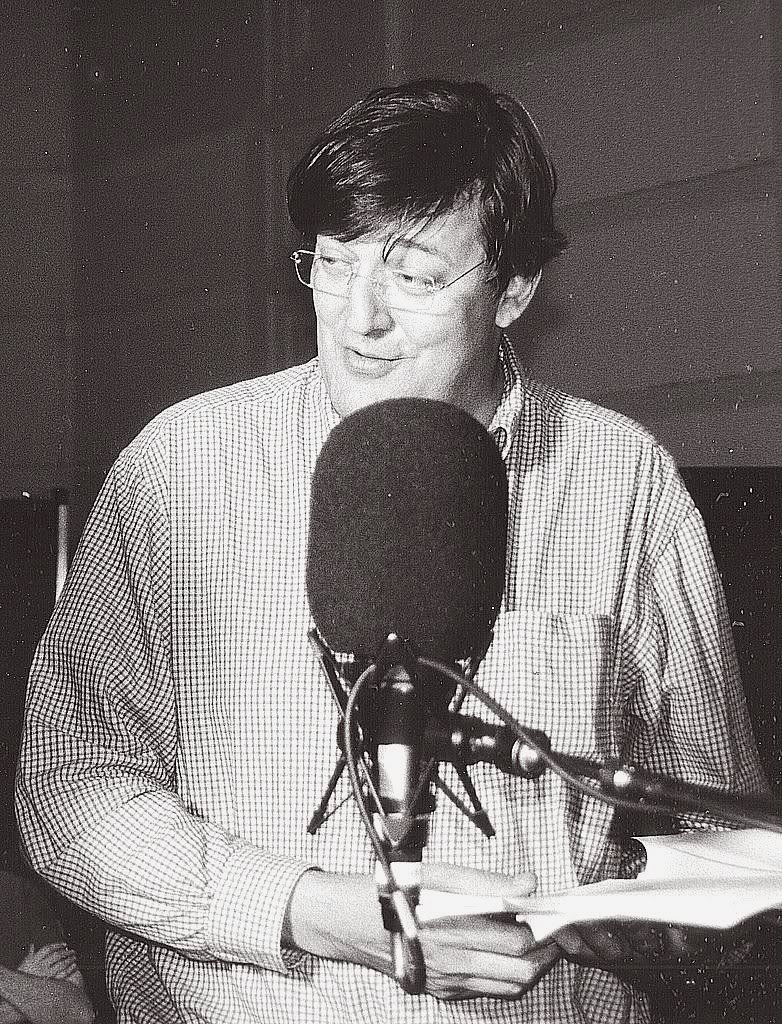
Spoffle, quite apart from being a great word, is a useful one, if you ever have anything to do with microphones, as I sometimes do. It's this thing, in front of Stephen Fry:
It's the foamy cover for a mic that prevents 'popping' and cuts down wind noise. Essential item, apparently unnamed (people seem to use the very dull microphone cover) until Hugh Laurie called it a spoffle (in Stephen Fry's hearing, which is partly why he's in the photo above). This is what I always call it, and lots of others do too. At my old job it was the common name for such things. But, astonishingly, it's not in the OED and it doesn't have a Wikipedia article. Apparently it used to but it was deleted, and now it's not even mentioned in the section on microphone covers.
Another word that came out of British comedy is the collective noun for baboons, a flange, and for gorillas, a whoop. Flange has caught on remarkably well and, although it too doesn't get into the OED (they're so cautious, those lexicographers) it's used by people, including (allegedly) academics (although I have not read the papers or books in which it's used). Here's the sketch, with Mel Smith and Rowan Atkinson talking to Pamela Stephenson:
Literature has been a source of some good words. Lewis Carroll invented the word chortle as a blend of chuckle and snort, although not many of his more creative efforts from the Jabberwocky have caught on. This OED blog post talks about Edward Lear, who made up a lot of words (runcible spoon being a particularly well-known example) and also used obscure real words. It has a charming anecdote about the blog-writer's doctor friend who was certain that pobble meant 'to amputate toes', until the blog-writer introduced her to the rhyme The pobble who has no toes. Pobble's Bay also seems to be a place in Wales, which does rather remind one of The meaning of Liff by Douglas Adams and John Lloyd (who created QI, presented by Stephen Fry - we have come full circle so it's time to stop waffling).
Quiz was supposedly an early example of this, when (according to anecdote) a Dublin man had a bet that he could introduce a new word into the language. Sadly, as with so many such anecdotes, it's probably bunk, as it was in use already by the alleged time of this bet. Still, there are some words that we know were invented this way, as the people who did it either did so on film or are around to tell us.
Spoffle, quite apart from being a great word, is a useful one, if you ever have anything to do with microphones, as I sometimes do. It's this thing, in front of Stephen Fry:
 |
| Source: http://www.stephenfry.com/forum/topic/fry-a-day/page/759 |
Another word that came out of British comedy is the collective noun for baboons, a flange, and for gorillas, a whoop. Flange has caught on remarkably well and, although it too doesn't get into the OED (they're so cautious, those lexicographers) it's used by people, including (allegedly) academics (although I have not read the papers or books in which it's used). Here's the sketch, with Mel Smith and Rowan Atkinson talking to Pamela Stephenson:
Literature has been a source of some good words. Lewis Carroll invented the word chortle as a blend of chuckle and snort, although not many of his more creative efforts from the Jabberwocky have caught on. This OED blog post talks about Edward Lear, who made up a lot of words (runcible spoon being a particularly well-known example) and also used obscure real words. It has a charming anecdote about the blog-writer's doctor friend who was certain that pobble meant 'to amputate toes', until the blog-writer introduced her to the rhyme The pobble who has no toes. Pobble's Bay also seems to be a place in Wales, which does rather remind one of The meaning of Liff by Douglas Adams and John Lloyd (who created QI, presented by Stephen Fry - we have come full circle so it's time to stop waffling).
Monday, 20 August 2012
Pussy Riot and swearing in the media
The other day, Ben Zimmer at Language Log covered the way that Pussy Riot (the name of a Russian punk band currently in the news) can be rendered into Russian (the band is Russian, but the name is in English). Then Arnold Zwicky blogged about the way that the New York Times is coping with having to write naughty words in its articles. He takes this Guardian blog post as a jumping-off point.
I was wondering about this myself. The thing is that it's a sort of pun, or at least a double entendre. It's what the whole point of Mrs Slocombe was in 'Are you being served':
So that means that the word itself can be said quite freely without causing offence, provided that it means 'cat' rather than... its other meaning. After all, here it was being said on a pre-watershed sitcom as long ago as the 1970s. But as Zwicky notes, the 'cat' meaning is pretty much non-existent these days. We all know it means that, but it's rarely used to mean 'cat' (perhaps because of its rude meaning). Furthermore, the band presumably mean it to have its naughty connotations, as they're a punk band and that's what punk bands do. They have a handy get-out by being able to say that it's simply a name about cats, which is apparently what they told the police it meant. So if the word is ambiguous, and has these two separate meanings, does it mean the rude one if that's what its authors intended it to mean? Does it mean 'female genitalia' here? Or is it a word that can mean that, but not necessarily? I don't know. I kind of feel like it does.
Anyway, according to the blog posts mentioned above, the US papers are struggling a bit and basically not banning it, but trying not to mention it more than absolutely necessary, and definitely not in headlines. From what I can tell, in the UK, the media are more than happy to use the name in the papers, on the radio and on TV (and everywhere else). This means that the lovely lunchtime newsreaders have to say 'pussy' quite a lot, and are essentially using rude words in the news.
I was wondering about this myself. The thing is that it's a sort of pun, or at least a double entendre. It's what the whole point of Mrs Slocombe was in 'Are you being served':
So that means that the word itself can be said quite freely without causing offence, provided that it means 'cat' rather than... its other meaning. After all, here it was being said on a pre-watershed sitcom as long ago as the 1970s. But as Zwicky notes, the 'cat' meaning is pretty much non-existent these days. We all know it means that, but it's rarely used to mean 'cat' (perhaps because of its rude meaning). Furthermore, the band presumably mean it to have its naughty connotations, as they're a punk band and that's what punk bands do. They have a handy get-out by being able to say that it's simply a name about cats, which is apparently what they told the police it meant. So if the word is ambiguous, and has these two separate meanings, does it mean the rude one if that's what its authors intended it to mean? Does it mean 'female genitalia' here? Or is it a word that can mean that, but not necessarily? I don't know. I kind of feel like it does.
Anyway, according to the blog posts mentioned above, the US papers are struggling a bit and basically not banning it, but trying not to mention it more than absolutely necessary, and definitely not in headlines. From what I can tell, in the UK, the media are more than happy to use the name in the papers, on the radio and on TV (and everywhere else). This means that the lovely lunchtime newsreaders have to say 'pussy' quite a lot, and are essentially using rude words in the news.
Wednesday, 15 August 2012
Functional and lexical words
Words are split up into two major classes, which we can call functional/grammatical and lexical/content words.
Functional, or grammatical, words are the ones that it's hard to define their meaning, but they have some grammatical function in the sentence. The, for instance. What does it mean? Well, that's hard to say. But its function is easy: it's the definite article. It makes things definite (says that you're talking about a particular instance of whatever follows). Or could - hard to describe its meaning, but its function is clear. Prepositions like on or at or if are also functional. Functional words are a closed class, which means we can't add new ones very easily. Try and remember the last time you heard a new preposition or article.
Lexical words, however, do have meaning: cat and armchair and toilet-brush and velociraptor all have clear meanings that you could describe to someone. They're also all nouns, which is one type of lexical word. Verbs can be lexical too, like fly, arrange and steal. Lexical words are open class, and we can make up new ones willy-nilly, by all the different word-formation rules we can muster. You can probably invent a new word now: just noun a verb or add -ify to something.
Did you know all that already? Maybe you did. If you think you didn't, well, I'm here to tell you that your subconscious knowledge of language includes this.
In The Jabberwocky, Lewis Carroll invents a whole stack of nonsense words. But every single one of them is a lexical word. If they weren't, you wouldn't be able to understand the poem the way you can.
I've emboldened the nonsense words in the first verse here, and they are all easily interpretable by the reader as nouns, adjectives and verbs (which are all generally lexical). The English words are all function words.
The function words are what give us the sentence structure, so if you turn them into nonsense syllables, you're left with no clue. You've just got a string of words, some of which you know the lexical meaning of, but no idea how they fit together.
If you're still not sure that your brain knows this stuff, here's proof. I was watching an episode of slightly naff 00s game show 'Win, Lose or Draw Late' (presented by Liza Tarbuck) the other day (don't judge me, I like game shows, OK?). Paul Tonkinson, who had to draw the book title Life of Pi, began by drawing lines to signify the words in the title. He drew something like this:
Functional, or grammatical, words are the ones that it's hard to define their meaning, but they have some grammatical function in the sentence. The, for instance. What does it mean? Well, that's hard to say. But its function is easy: it's the definite article. It makes things definite (says that you're talking about a particular instance of whatever follows). Or could - hard to describe its meaning, but its function is clear. Prepositions like on or at or if are also functional. Functional words are a closed class, which means we can't add new ones very easily. Try and remember the last time you heard a new preposition or article.
Lexical words, however, do have meaning: cat and armchair and toilet-brush and velociraptor all have clear meanings that you could describe to someone. They're also all nouns, which is one type of lexical word. Verbs can be lexical too, like fly, arrange and steal. Lexical words are open class, and we can make up new ones willy-nilly, by all the different word-formation rules we can muster. You can probably invent a new word now: just noun a verb or add -ify to something.
Did you know all that already? Maybe you did. If you think you didn't, well, I'm here to tell you that your subconscious knowledge of language includes this.
In The Jabberwocky, Lewis Carroll invents a whole stack of nonsense words. But every single one of them is a lexical word. If they weren't, you wouldn't be able to understand the poem the way you can.
I've emboldened the nonsense words in the first verse here, and they are all easily interpretable by the reader as nouns, adjectives and verbs (which are all generally lexical). The English words are all function words.
We can understand it because although we don't know what the unfamiliar words mean, we can recognise them for the right part of speech. We can tell that slithy is an adjective and toves is a noun. How? Well, there's a definite article just before that phrase, and we know that in English, a definite article comes at the start of a noun phrase. We expect it to occur with a noun, which we expect to find at the end of the phrase, and if there's another word in there we expect it to be an adjective and to come before the noun. We also know that nouns can have a plural -s ending, like tove-s, and that adjectives can have a -y ending, like slith-y.Twas brillig, and the slithy toves
Did gyre and gimble in the wabe:
All mimsy were the borogoves,
And the mome raths outgrabe.
The function words are what give us the sentence structure, so if you turn them into nonsense syllables, you're left with no clue. You've just got a string of words, some of which you know the lexical meaning of, but no idea how they fit together.
If you're still not sure that your brain knows this stuff, here's proof. I was watching an episode of slightly naff 00s game show 'Win, Lose or Draw Late' (presented by Liza Tarbuck) the other day (don't judge me, I like game shows, OK?). Paul Tonkinson, who had to draw the book title Life of Pi, began by drawing lines to signify the words in the title. He drew something like this:
____ __ ____Now, if he was representing the length of the words, he would have drawn the last one the same length as the middle one. But he didn't; it's clearly much longer. He is not representing the length of the words but rather their status as functional versus content words.
Tuesday, 14 August 2012
I got a job!
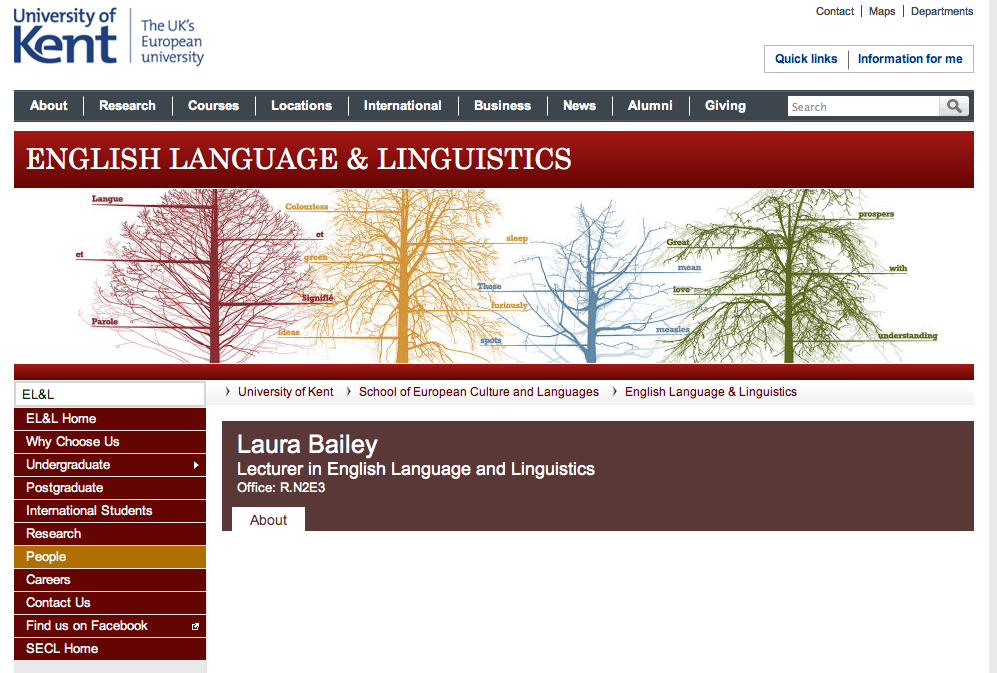
Part of the reason why I was so busy a couple of weeks ago is that I had a job interview, and I got it! I'll be starting at the University of Kent in September, for ten months. I'll be teaching semantics, morphology and research skills.
I'm really excited. It's going to be weird leaving Newcastle after being a student here for 8 years and a person here since 1993, but Canterbury seems like a really nice place and the department very friendly. And I'm thrilled to have got a job, with a proper salary, so quickly.
But all this means that my PhD thesis really needs to get a wiggle on and start writing itself. I'd been expecting it to do it before now but perhaps it's waiting till the very last moment. In the meantime, I'm helping it along. I'm up to the last chapter of substantial writing/finishing, and then will be able to go back and do the fiddly bits. I'm hoping to get the majority done before I go, otherwise there'll be some very late nights till I submit.
Here's a screenshot, in case I wake up in the night and need proof:

I'm really excited. It's going to be weird leaving Newcastle after being a student here for 8 years and a person here since 1993, but Canterbury seems like a really nice place and the department very friendly. And I'm thrilled to have got a job, with a proper salary, so quickly.
But all this means that my PhD thesis really needs to get a wiggle on and start writing itself. I'd been expecting it to do it before now but perhaps it's waiting till the very last moment. In the meantime, I'm helping it along. I'm up to the last chapter of substantial writing/finishing, and then will be able to go back and do the fiddly bits. I'm hoping to get the majority done before I go, otherwise there'll be some very late nights till I submit.
Here's a screenshot, in case I wake up in the night and need proof:
Monday, 13 August 2012
Language limericks!
There's just time to get your submission into Lingua Franca's Language Limerick competition - closing date Friday the 17th.
Saturday, 11 August 2012
Subscribe to:
Posts (Atom)